
Reviewed · POMPEII TOURS
Pompeii Walking Tour: The Real History of the Ruins
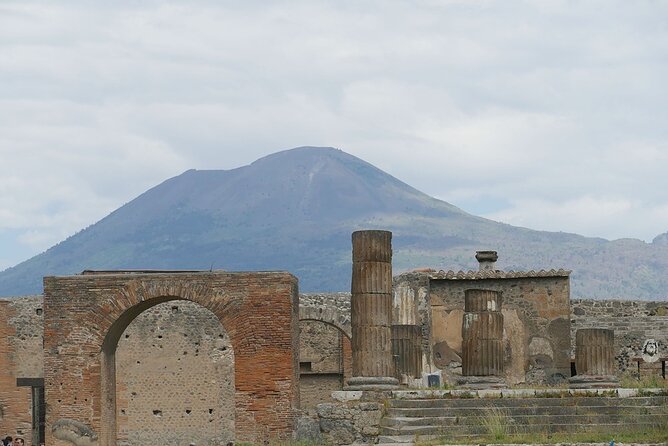
Pompeii feels like a city caught mid-day, frozen by the eruption of Vesuvius in AD 79. This 2-hour walking tour gives you a guided storyline through the ruins instead of a pile of stops, so it makes the place easier to understand fast. I like the tight route and the clear “what you’re seeing and why it mattered” explanations.
Two things I especially like: you’ll spend time in major public and private spaces, including a nearly 2,000-year-old cobblestone street and big-room sights like Teatro Grande. And your guide is a key part of the value here, with several guides praised for humor and making daily Roman life click, whether it’s via a domestic house like Casa del Menandro or the practical world of baths.
One possible drawback to keep in mind is timing. A couple of reviews flagged issues around pickup or late starts, and at least one note said a guide could be hard to understand or leaned more into politics than you might expect.
Key highlights worth your time
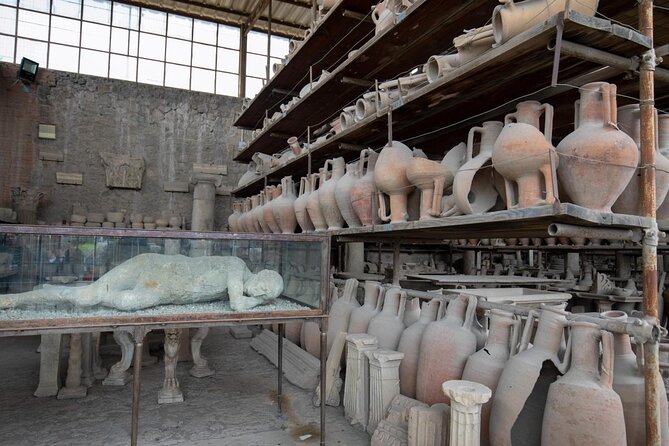
- Teatro Grande: A Roman theater, with theater life explained through what was staged there.
- Casa del Menandro: A wealthy domus of almost 1,800 m², named for a Greek poet image found there.
- Terme Stabiane (Stabian Baths): The oldest bath building in Pompeii, with male and female areas preserved.
- Lupanar: The remains of a mercenary sex-work site, explained in historical context.
- Foro di Pompeii: The political and religious heart, with Temple of Jupiter, Apollo, Basilica, and granaries.
How the Pompeii walk works, from InStazione to Porta Anfiteatro
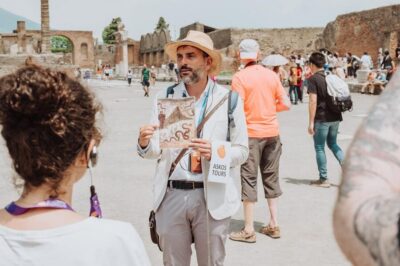
This tour is built for a day with limited time. You meet at the InStazione help desk in Pompeii, and the walk begins from there. The tour runs daily and sets off at 10:30 am, then you check in and head to the entrance at Porta Anfiteatro with your guide.
The format is simple: you’re in a group, you walk, and you get short guided segments at each major stop. The group size is capped at 35 travelers, which is big enough for a lively group but small enough that you can still see what the guide points out without constantly getting separated.
Practical tip: arrive a little early. Even though the plan says 10:30, reviews describe delays for some departures and confusion when pickup times didn’t match what people expected. If you give yourself a buffer, you’ll feel the tour instead of worrying about it.
Also, the tour requires good weather. Pompeii ruins are outdoors for most of the route, and the experience is clearly designed around walking between sites without rain and mud ruining the pace.
More Pompeii tours to compare:
- Pompeii: Entry Ticket and Guided Tour with an Archaeologist
★ 4.8 · 19,459 reviews - Pompeii: Entry Ticket with Optional Audio Guide
★ 4.2 · 12,360 reviews - Pompeii: Small Group Tour with an Archaeologist
★ 4.8 · 12,264 reviews
Teatro Grande: what Romans watched before AD 79
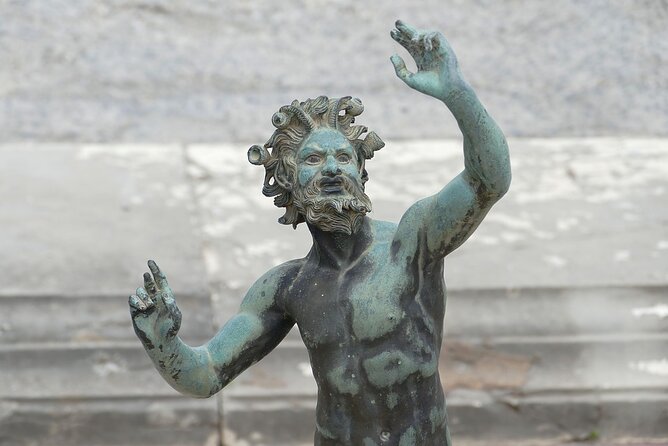
The tour starts inside the Archaeological Park at Porta Anfiteatro and quickly moves to Teatro Grande. This is one of Pompeii’s big theater anchors, and the guide’s job here is to translate space into use.
Why Teatro Grande matters: it was buried by Vesuvius in AD 79 and later uncovered through the excavations of Pompeii. Inside the theater, performances included comedies, mimes, pantomimes, and the atellane. That matters because it helps you see the theater not as a “cool ancient building,” but as a working entertainment machine.
You’ll get a short, focused look at what theater-going would have felt like in a Roman city. The timing is tight, but theater ruins like this are visual. The guide’s commentary helps you interpret what you’re seeing, especially if you’re not already deep into Roman culture.
A quick realism note: with only a couple of hours total, you won’t linger long. If you love architecture and want longer time at a single site, this format may feel fast. If you want a guided crash course with the key stops, it’s a strong fit.
Casa del Menandro: wealthy domus details you can actually spot
From theater life, you shift to the domestic world at Casa del Menandro. This is a large Pompeian urban house, listed as almost 1,800 m², and it’s known for being a strong example of a wealthy family home.
What’s distinctive is the name. Casa del Menandro doesn’t come from the owner’s identity. It comes from an image of the Greek poet Menander found in the house. Even if you only spend about 15 minutes here, that naming detail gives you a clue about how Roman elites mixed cultures and taste.
For me, the value is that you’re not just looking at walls. A house like this connects social status to daily rituals: where people moved, where they hosted, and how decoration signaled who mattered. The guide turns those connections into something you can track while you walk.
You might also notice that excavated houses can be easier to “read” when you have an explanation. A quick tour stop keeps you from getting lost, and it nudges you toward the details that archaeologists used to infer wealth and function. Reviews also praise guides who explain things with humor and clarity, which makes house tours much more than a checklist of rooms.
Via Stabiana and the perfectly preserved cobblestone street moment
One of the tour’s early “wow” beats is the walk along a preserved cobbled street, described as having sidewalks and pedestrian walkways, lined with shops and houses. In other words, you get a chance to see Pompeii as a street-level place rather than only as isolated monuments.
This is where a guided tour shines for first-timers. A street looks like a street until someone points out what the layout implies. When you understand that this was not just a path, but part of how people lived and shopped, you start reading the city.
You also get a sense of why Pompeii’s preservation is so powerful. The ash burial kept many surfaces intact long enough to survive excavation, and the street grid is one of the most immediate parts of that survival.
More walking tours in Pompeii:
- Pompeii: Guided Walking Tour with Entrance Ticket
★ 4.3 · 1,423 reviews - Discover Pompeii: French Walking Tour of the Buried City
★ 4.8 · 253 reviews - Pompeii 3 Hours Walking Tour Led by an Archaeologist
★ 5.0 · 126 reviews - Pompeii: Highlights Guided Walking Tour
★ 4.6 · 105 reviews
Stabian Baths (Terme Stabiane): the oldest bath complex, with gendered space
Next up is the Stabian Baths, also called Terme Stabiane. The big point here is age: it’s described as the oldest bath building in the city. Pompeii’s baths are not just about hygiene. They’re social infrastructure, and Roman bathing was tied to routine, status, and leisure.
You’ll also hear about the male and female sectors being perfectly preserved. That detail changes how you view the building. It’s not one undifferentiated room. It’s a planned experience with separation in space.
The tour stop is brief, around 15 minutes. You won’t see every nook, but you’ll get the framework: what a bath complex is in Roman culture, and why Pompeii’s preservation makes it unusually valuable.
If you like “everyday Roman life” topics, this is one of the best stops on the route. The baths help you understand how a city functioned beyond markets, politics, and entertainment.
Lupanar: mercenary sex for hire, and how the guide frames it
The Lupanar is the hardest stop for many people emotionally, but it’s also a key to understanding ancient life honestly. Lupanari were, across the Roman era, places dedicated to mercenary sexual pleasure, essentially houses of tolerance. Some of the structure remains visible here in Pompeii.
Why include this at all? Because it tells you something about demand, economy, and urban culture. If you only see theaters and forums, you miss part of the city’s social reality.
At the same time, how the tour frames it matters. The tour offers a guided explanation and includes a short visit, about 10 minutes. If you’re uncomfortable with the topic, you can treat it like what it is historically: a glimpse of how Pompeii worked as a city with jobs, income, and socially accepted structures.
You might also notice a review that praised a guide’s ability to make Pompeii feel relatable. In practice, that kind of explanation can help you keep the focus on context, not shock.
Foro di Pompeii: Temple of Jupiter, Apollo, Basilica, and granaries
This is the big political and religious hub. The tour brings you to the Foro di Pompeii, originally built around the 4th century BC in the Samnite era, near a road junction linking to Neapolis, Nola, and Stabiae. After Roman conquest, the forum was rebuilt and enlarged, especially in the 2nd century BC.
The guided stop is a quick sprint through the pieces, but each one has a clear purpose.
Temple of Jupiter and the idea of Rome’s main gods
The temple of Jupiter overlooks the forum. Later it became known as the Capitolium area and was dedicated to Jupiter, Juno, and Minerva. In the basement, the public treasure called erarium was kept, along with sacred furnishings and votive offerings.
This is where the guide’s interpretation helps. You’re not only seeing sacred architecture. You’re learning how religious spaces reinforced political authority.
Basilica: an indoor forum for daily court and business
The Basilica is described as an imposing public building dating to the second century BC. Think of it as a kind of indoor forum, used when weather conditions made outdoor use less practical.
One detail worth paying attention to is the tribunal seating for judges. The access setup used a mobile wooden staircase, reportedly to reduce the chance of condemned people attacking judges. That’s the kind of “small design, big social meaning” detail that makes ancient buildings feel real.
Temple of Apollo and shifting cults
You’ll also see the Temple of Apollo. The cult of Apollo moved to Italic populations through the Greek world. But near the eruption, Apollo’s importance had faded while Jupiter’s prominence grew, tied to the rise of the Capitolium.
A bronze statue of Apollo depicted as an archer is visible, and you can see Diana’s statue in front. Even with limited time, these visual anchors can make the religious story easier to remember.
Granaries and the tools of trade
Finally, the granaries area: it was once a market for cereals and legumes. The fact that no traces of plaster were found suggests the structure may not have been finished at the time of the eruption.
The most practical detail here is the ponderary table, where traders kept tools to ensure exchange correctness and convert measurement units across the empire into the units valid in Pompeii. That’s a subtle but powerful reminder that ancient economies depended on standardized measurement, not just barter.
You might only spend about 5 minutes here, but the “how commerce worked” point lands quickly if your guide is good at translating the function of stone spaces into real behavior.
Price and logistics: does $42.05 buy real value?
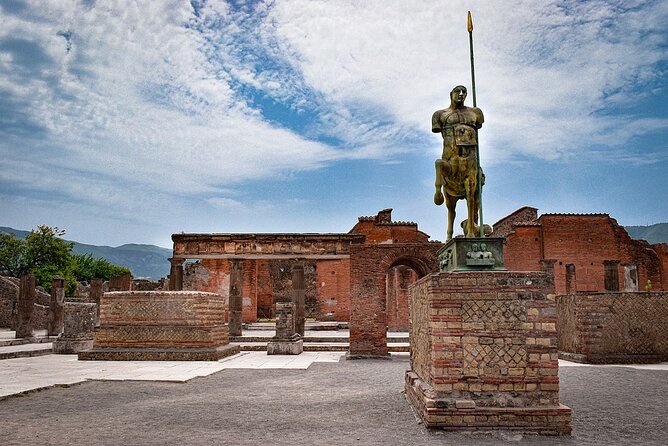
At $42.05 per person, you’re paying for two things: a timed guided walk and admission tickets included. The tour duration is around 2 hours, and it visits multiple major sites. For a first visit to Pompeii, that combination can be a solid use of money because you get help prioritizing what to see, then tickets cover the access costs.
Is it cheap? It’s not the cheapest way to enter the park. But you’re buying guidance in English, interpretation of multiple categories of ruins (theater, house, baths, sex-work site, forum), and you avoid spending your limited time trying to figure out what matters most on your own.
Where you should be honest with yourself: if you love one single topic, like theater or Roman law, you might want a longer, more specialized tour rather than a multi-stop sprint. This one is designed to cover breadth in a short window.
Group size capped at 35 helps. You’re not stuck in a tiny private bubble, but you also shouldn’t feel like you’re walking through Pompeii with 70 strangers.
Guides, pacing, and what to look for on the day
The reviews you provided point to a clear pattern: when guides are good here, they make the city feel like a living place, not just a museum.
Names that came up with strong praise include Grace, praised for being brilliant, with knowledge and humor, and for making two hours go fast. Frederica got credit for careful explanations and humor, with time taken to clarify details. Vincenzo was praised as engaging, funny, and professional, with extra attention so everyone could see what mattered. Igor was described as very well prepared, professional, and engaging with the group.
You also have a couple of caution notes worth respecting. One review mentions a guide could be hard to understand and talked more about politics. Another notes a late start. That doesn’t mean the whole experience is unreliable, but it does mean your enjoyment is closely tied to the guide and the day’s operational timing.
My advice: show up early, be ready for a brisk pace, and keep your expectations aligned with a 2-hour route. If you want long contemplation time, this is not that kind of tour. If you want a clear, guided sampler that helps you “get” Pompeii in one sitting, this format works.
What to pack for a 2-hour Pompeii walk
You’ll be outside through the park, moving between stops quickly. Pack like you’re doing a moderate walk on uneven ancient stone.
I suggest:
- Comfortable walking shoes with grip for cobbles and uneven surfaces
- A light layer and a hat, especially if you’re visiting in warmer months
- Water, since the tour has no lunch included
- Your phone charged, for map checks before you start your route
Small note on food: lunch is not included, so plan your meals around the two-hour window.
If you’re sensitive to certain topics, know that the Lupanar stop is part of the route. You can decide how you’ll handle that moment. For some people, the historical context makes it manageable. For others, it’s a tough stop.
If you need accommodations in general terms, service animals are allowed, and the tour is near public transportation, which can help with overall ease of getting there.
Who this Pompeii walking tour fits best
This tour is a good match if:
- You have only a short time in Pompeii and want the major landmarks connected by an actual story
- You want an English guide to explain what you’re seeing at Teatro Grande, Casa del Menandro, Terme Stabiane, and the forum
- You prefer a guided pace over planning your own route through the park
It may feel less ideal if:
- You want a long, slow day to linger in one area
- You strongly dislike the politics angle some guides may lean toward
- You need extra time at any single ruin for photos or personal study (this itinerary is paced to cover many spaces)
Should you book this Pompeii Walking Tour: Real History of the Ruins?
I think you should book it if your goal is to walk through Pompeii with context, not just with photos. The value comes from the combination of ticket included, English guidance, and a route that covers both the flashy public side and the everyday structures that reveal how Romans lived.
My final take: treat it like a high-quality primer. You’ll leave with names to remember, rooms to picture, and a better sense of how theater, home life, bathing, commerce, and religion fit together in one city that vanished in AD 79.
FAQ
How long is the Pompeii Walking Tour: The Real History of the Ruins?
The tour lasts about 2 hours.
What is the meeting point for the tour?
You start at the InStazione help desk in Pompeii (80045).
Where does the tour end?
The end point is at Scavi di Pompei, Viale delle Ginestre (80045).
Is the admission ticket included?
Yes. Admission tickets are included as part of the guided tour.
Is the tour offered in English?
Yes, it is offered in English.
What stops are included during the tour?
It includes Teatro Grande, Casa del Menandro, Stabian Baths (Terme Stabiane), the Lupanar, Foro di Pompeii, Temple of Apollo, Basilica, and granaries.
Is lunch included?
No lunch is included.
What happens if the weather is poor?
The tour requires good weather. If it is canceled due to poor weather, you will be offered a different date or a full refund.
How many people are in the group?
The tour has a maximum of 35 travelers.
More Historical Tours in Pompeii
- Guided Tours of Pompeii Excavations Historical and Cultural Itineraries
★ 5.0 · 56 reviews - Authentic Amalfi Lemon Tour & Tasting in the Historical Garden
★ 5.0 · 52 reviews - Amalfi Organic Lemon Tour & Tasting in the Historical Garden
★ 4.9 · 46 reviews
Recently reviewed around Pompeii
- Mt. Vesuvius Wine Tasting and Lunch Experience from Pompeii★ 4.5 · 20 reviews
- Pompeii Small Group with an Archaeologist and Skip The Line★ 5.0 · 121 reviews
- Pompeii from Afternoon to Sunset★ 5.0 · 108 reviews
- Private Guided Tour and VR Headsets in the Ancient Pompeii★ 5.0 · 3 reviews
- Visit Pompeii with a local expert guide★ 5.0 · 10 reviews
- Traditional Neapolitan Dinner in Pompei – Villa Franca – Family Restourant★ 5.0 · 8 reviews
- Discover Pompeii on this Guided Walking Tour of the Buried City★ 4.0 · 9 reviews
- 2 Hours Private Walking Tour in Pompeii with an Archaeologist★ 5.0 · 15 reviews
Pompeii Tours, compared.
Entry Ticket and Guided Tour with an Archaeologist
Read our review →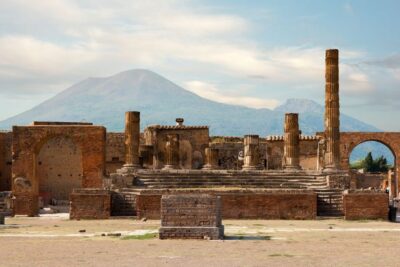

Pompeii Small Group Tour with an Archaeologist
Read our review →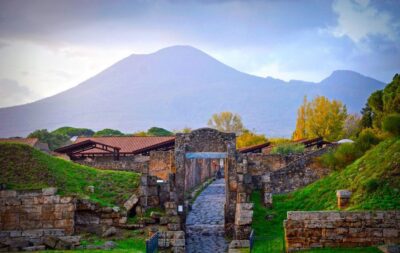
Skip-the-Line Entrance Ticket with Audio Guide
Read our review →
Pompeii and Mt. Vesuvius with Lunch and Wine Tasting
Read our review →
Archaeological Park Tour with Ticket on request
Read our review →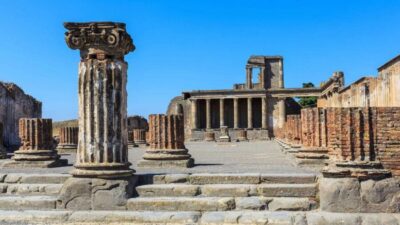
Browse the lists this tour appears in