Reviewed · POMPEII TOURS
Pompeii Skip-the-Line Entry & Guided Tour with a certified guide
Pompeii is one of those places where the ruins can feel like a maze, unless you know what you are looking at. This tour is interesting because it gets you inside with skip-the-line express admission, then walks you through the parts most people miss or misread.
I especially like the guided context. Ruins here are often unmarked, so a good certified guide matters. You’ll also get headsets when the group is bigger, which is a real quality-of-life upgrade when you are trying to hear details while standing in windy stone courtyards.
One drawback to consider: the experience is timed tightly at about 2 hours, and the walking pace can feel fast on busy days or if you want extra time for photos. Also, double-check the meeting point before you go, because GPS can be misleading around the train station area.
Key points worth knowing
- Express entry is included, so you spend less time queued at the site.
- English guided narration turns empty rooms into real stories, including daily life details you can actually picture.
- Headsets for groups over 15 help you hear clearly without constantly craning your neck.
- A focused route covers the Foro, a market space, Forum baths, and two major houses.
- Small-group max of 35 keeps the pace manageable on uneven ground.
- You finish back at the meeting point, which makes logistics simpler than “tour ends somewhere else.”
Why Pompeii makes more sense with a real guide
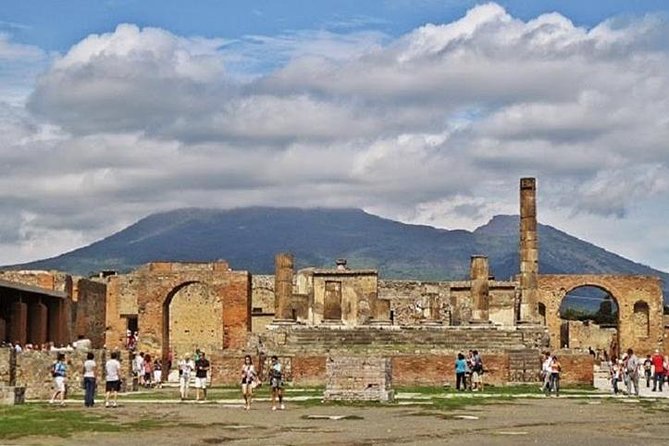
Pompeii is not just big, it’s also oddly readable, in a way that rewards attention. Streets are still there, doorways frame space, and you can tell where people moved. But without guidance, it is easy to stare at walls and miss the purpose of each building.
What I like about this tour format is that the guide does the translation for you. You start at the Foro, so you quickly understand where political power, religion, and commerce overlapped. Then you pivot to everyday life spots like food and bathing, which is where Pompeii stops feeling like a museum display and starts feeling like a living neighborhood that happened to freeze in time.
If you happen to get a guide in the style of Alfonso, Annaliza, or Eraldo, you’re likely to hear clear, story-driven explanations. The key is that the tour is designed for meaning, not just motion.
More Pompeii tours to compare:
- Pompeii: Entry Ticket and Guided Tour with an Archaeologist
★ 4.8 · 19,459 reviews - Pompeii: Entry Ticket with Optional Audio Guide
★ 4.2 · 12,360 reviews - Pompeii: Small Group Tour with an Archaeologist
★ 4.8 · 12,264 reviews
Price and what you truly get for $58.87
At $58.87 per person for about two hours, you are paying for three things that add up: the entrance ticket, the express skip-the-line access, and the guide time. If you were to buy admission on your own and then scramble to find someone available on the spot, you’d probably spend more time than you want.
The value also comes from the route choice. You are not trying to cover “all of Pompeii,” which is impossible in two hours anyway. Instead, you hit a set of places that connect to each other: the central plaza, a market zone, bathing facilities, and high-status homes with art programs.
The one cost that is not included is any add-on ticket for the Villa of Mysteries. In plain terms: if you want that specific site, you need to plan for extra admission elsewhere.
Meeting point: the train station office that you should locate first
Your tour starts at Via Villa dei Misteri, 1, inside the Circumvesuviana area at Pompei Scavi Villa dei Misteri. You’re told to arrive 15 minutes early at the agency, which is on the first floor of a red station building.
Here’s the practical trick: look for the office named Tempio Travel / Pompeii Tickets, and expect it to be about 100 meters from Porta Marina Superiore (the main upper gate area). When GPS points you somewhere else, don’t panic. Use the station building itself as your anchor, then go upstairs.
This matters because one common trip-up is simply missing the exact desk or floor. If you arrive early, you’ll have time to confirm with staff and get your headsets settled before entering the ruins.
Skip-the-line entry: what it helps, and what it doesn’t
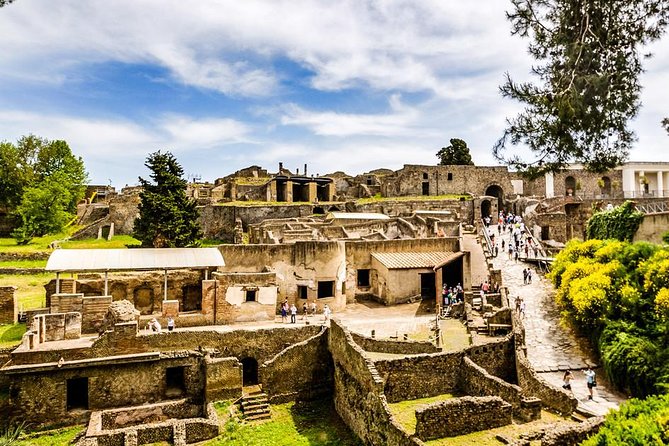
This tour includes express entrance tickets for the archaeological site, so you avoid the slowest parts of arrival. That is a genuine time-saver in peak seasons, especially when Pompeii is crowded and the queues stretch in every direction.
But skip-the-line does not mean walk-in instantly. There is still a pace to the experience once you are inside: getting moving as a group, hearing introductions, and transitioning between stops. Also, the tour length is fixed enough that you will not have hours of free roaming inside the exact same route.
Think of express entry as buying you a smoother start, not a guarantee of maximum time at each room. If you are the type who needs long pauses to photograph details, plan to do your big photo stops quickly and then move on with the group.
A few more Pompeii trips worth comparing
- Pompeii: Skip-the-Line Entrance Ticket with Audio Guide
★ 4.0 · 2,509 reviews - Pompeii: Guided Walking Tour with Entrance Ticket
★ 4.3 · 1,423 reviews - Pompeii: Skip-the-line-Ticket and Guided Tour
★ 4.6 · 1,152 reviews - Pompeii: Guided Tour with Skip-the-Line Entry
★ 4.9 · 812 reviews
The 2-hour walk through Pompeii, stop by stop
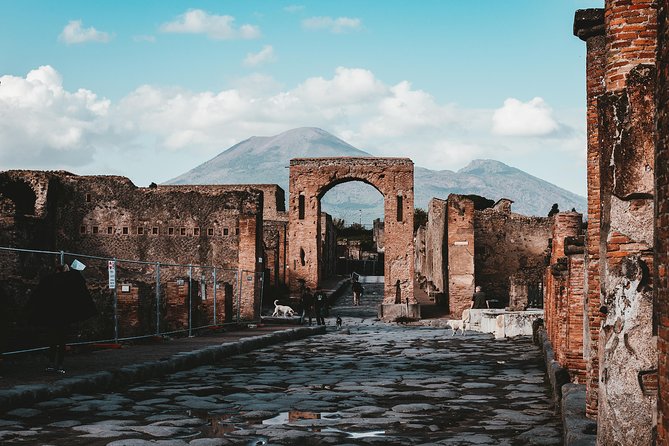
This is a guided route through the most “readable” parts of Pompeii’s center, plus a couple of homes that show how people lived. The stops are designed to move from public life to household life, then into food culture.
Foro di Pompei: the city’s main stage
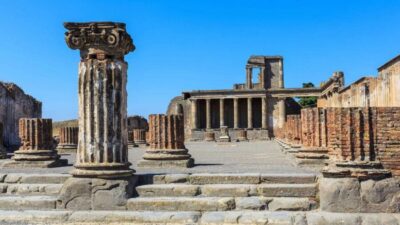
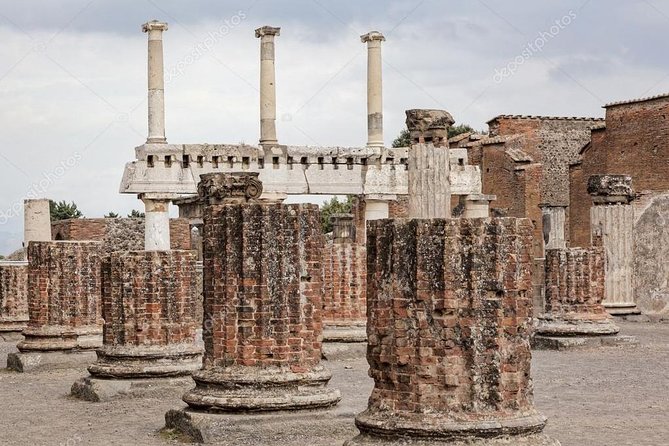
You begin at the Foro, Pompeii’s main plaza and the hub where political, economic, and religious life intersected. It’s the best starting point because it gives you orientation fast. You can look across the space and understand why so many key activities happened here.
Even if you’ve seen photos before, the guide’s job is to help you see structure and function. Why certain buildings sit where they do. What the plaza meant to residents. How the daily rhythm likely worked when people gathered in the same open area for ceremonies and trade.
This stop is where you start building your “mental map,” which makes everything else easier to understand.
Macellum: market life, painted food details, and daily rhythm
Next comes the Macellum, a market space located on the Foro. This is one of the most fun stops because it shows Pompeii as a place where people ate, shopped, and chatted.
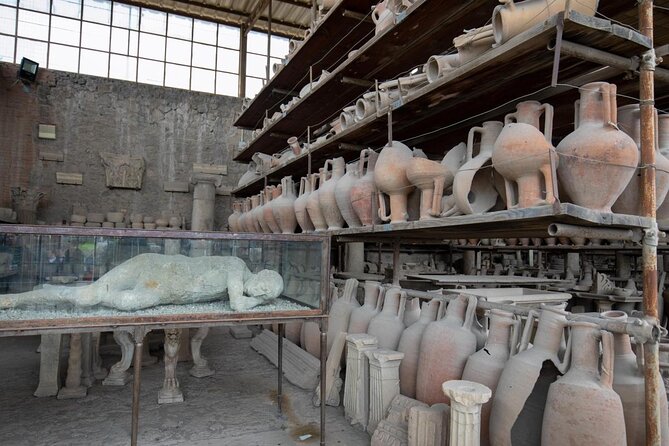
You can even see frescoes that depict foods Romans ate in the 1st century CE. That kind of detail is surprisingly powerful. It’s not abstract archaeology, it’s a snapshot of meals, flavors, and preferences that feel human even after two thousand years.
The downside is that it can feel visually busy. If you want to absorb everything, you need the guide to point out what to look at and what is most important.
Terme del Foro: bathing with real architectural clues
After the market, you go behind the Temple of Jupiter into the Forum baths. These baths covered about 410 square meters and had both male and female sections with separate entrances.
One reason this stop is worth it: the guide can show you how water supply worked. The baths were supplied by the Serino aqueduct, though there was also a well for emergencies. You also get to see how the original ceiling and stucco survive in parts of the complex, plus a calidarium (hot room) with a marble tub and a mosaic floor.
If you’ve ever wondered how Romans managed everyday hygiene at scale, this is where you get answers that feel practical, not textbook.
Casa del Fauno: big-house luxury and the Alexander mosaic copy
Then you visit the Casa del Fauno, one of the largest and most luxurious aristocratic homes of the Roman Republic era. This is a good contrast stop. You go from shared public spaces to private wealth.
Inside, you’ll encounter the Mosaic of Alexander, but important detail: what you’ll see here is a copy. The original is preserved at the MANN, the National Archaeological Museum in Naples. Even so, standing in front of the mosaic helps you grasp how art used to function as status and storytelling.
This stop is often a highlight because it shows Pompeii wasn’t only about daily routines. It was also about power, taste, and display.
Casa dei Vettii: art, erotic paintings, and a darker edge of life
Next is the Casa dei Vettii, a Roman-era domus uncovered during excavations after the eruption of Vesuvius in 79 CE. It’s named for the owners Aulo Vettio Restituto and Aulo Vettio Conviva.
This house has standout artwork, including an area with erotic paintings. The tour explanation links one room used in a context of a prostitute who lived with the proprietor, which gives you a more complicated picture of daily life than the usual “ancient Rome was all noble virtues” version.
If that topic makes you uncomfortable, that is normal. But I like that the tour does not sugarcoat Pompeii. It helps you understand real human behavior, including the parts people often skip when they only want pretty scenery.
Via dell’Abbondanza: the city street that connects everything
After the houses, you continue walking along Via dell’Abbondanza. This street connects major areas between the Foro and Porta Sarno, and it passes key complexes including the Stabian Baths, the Theaters, the Temple of Isis, and the Amphitheater.
Even if you are not entering every single one of those spots during this short tour, the guide uses the street as a way to stitch the city together in your head. You start to see Pompeii as a network, not separate “attractions.”
If you like to follow routes in your own future visits, this is a helpful segment. It gives you a direction for what to explore next.
Thermopolium (Regio VI, Insula VIII, 8): ancient take-away food
You finish at the Thermopolium Regio VI, Insula VIII, 8. The word points to a place where hot food is sold. In modern terms, you can think of it as Pompeii’s fast food, the kind of stop where people could buy something ready to eat instead of cooking at home.
This is a fun closer because it circles back to food. After markets and baths, you end on a practical feeding point. It’s also a great way to remember Pompeii as everyday life, not only grand villas.
This stop tends to land best when you’ve already heard the guide connect it to the bigger pattern of how people moved through the city to work, eat, and socialize.
What made this tour feel great in practice
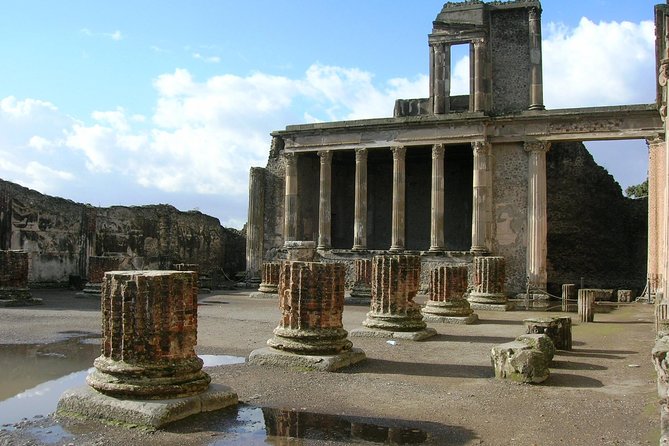
The best moments come from guides who keep things clear and paced. In the feedback you can find a pattern: people loved how the guide made Pompeii feel real and how the walking pace worked with the terrain. You’re moving through uneven ground and changes in elevation, and a good guide helps you keep up without feeling rushed in a chaotic way.
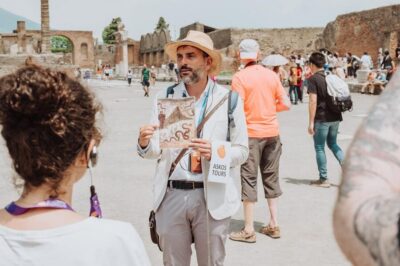
Another real plus is the headsets when groups get bigger. Pompeii is busy, there’s background noise, and without audio you lose too much of the story. With headsets, you can focus more on what the guide is pointing to.
And yes, comfort matters. Even when the route is short, sun and heat can get serious fast. I strongly recommend bringing sunscreen, and if you’re visiting in hotter months, pack an umbrella. It is useful for shade, even if it is not raining.
Practical tips so you enjoy the full two hours
Here’s what I’d do before you show up:
- Arrive 15 minutes early and locate Tempio Travel / Pompeii Tickets on the first floor of the red station building. Use the station as your landmark.
- Wear shoes that handle rough surfaces. The walking terrain is not smooth like a city sidewalk.
- Bring a small water bottle. The tour doesn’t say it includes refreshments, so plan as if you need your own.
- If you care about photos, decide which 2 or 3 moments you want the best shots for. With a timed route, you cannot stop everywhere for long.
- If you’re nervous about missing the guide, check the plan at the meeting point before entering the site.
Should you book this Pompeii skip-the-line guided tour?
You should book if you want Pompeii to make sense fast. The combination of express entry and a guided route through the Foro, market, baths, and major houses is a strong value for a short visit.
You might skip or switch plans if you need lots of unstructured time inside the ruins. Pompeii is huge, and this tour is designed to cover key segments efficiently. Also, if you hate meeting points, do a quick map check in advance and plan to arrive early, because the station area is where confusion can happen.
If you want an efficient first look that still feels human, this is a good pick. It gives you the context that turns scattered stones into daily life.
FAQ
Is admission to Pompeii included in the tour price?
Yes. The tour includes entrance tickets with express access to the Pompeological site.
How long is the guided tour?
It is approximately 2 hours.
What language is the tour offered in?
The tour is offered in English.
Are headsets provided for listening to the guide?
Yes. Headsets are provided, especially for groups larger than 15 people.
Where do I meet the guide?
Meet at Via Villa dei Misteri, 1, at the Pompei Scavi Villa dei Misteri Circumvesuviana station. The office is called Tempio Travel / Pompeii Tickets on the first floor, about 100 m from Porta Marina Superiore.
Does the tour include the Villa of Mysteries?
No. Entrance tickets for the Villa of Mysteries are not included.
Are service animals allowed?
Yes, service animals are allowed.
What is the cancellation window?
You can cancel up to 24 hours before the experience for a full refund.
Recently reviewed around Pompeii
- Mt. Vesuvius Wine Tasting and Lunch Experience from Pompeii★ 4.5 · 20 reviews
- Pompeii Small Group with an Archaeologist and Skip The Line★ 5.0 · 121 reviews
- Pompeii from Afternoon to Sunset★ 5.0 · 108 reviews
- Private Guided Tour and VR Headsets in the Ancient Pompeii★ 5.0 · 3 reviews
- Visit Pompeii with a local expert guide★ 5.0 · 10 reviews
- Traditional Neapolitan Dinner in Pompei – Villa Franca – Family Restourant★ 5.0 · 8 reviews
- Discover Pompeii on this Guided Walking Tour of the Buried City★ 4.0 · 9 reviews
- 2 Hours Private Walking Tour in Pompeii with an Archaeologist★ 5.0 · 15 reviews
Pompeii Tours, compared.
Entry Ticket and Guided Tour with an Archaeologist
Read our review →

Pompeii Small Group Tour with an Archaeologist
Read our review →
Skip-the-Line Entrance Ticket with Audio Guide
Read our review →
Pompeii and Mt. Vesuvius with Lunch and Wine Tasting
Read our review →
Archaeological Park Tour with Ticket on request
Read our review →