Reviewed · POMPEII TOURS
Pompeii: Guided Tour with Priority Entrance
Pompeii is interesting because it is not a museum you look at from behind glass. It is an entire city you walk through, and every corner can explain how Romans lived, worked, worshipped, and relaxed. I like that this tour gets you priority admission into the ruins, and I also like the headset commentary, so the guide’s story stays clear even when the site is crowded and loud.
The main drawback is simple: Pompeii is enormous, and a 2 hour 30 minute route means you must accept a fast pace and a selection of highlights. You will likely finish thinking of the next area you want to explore on your own.
You meet your guide at Camping Zeus (Zeus Car Park) and you return there when the tour is over. It runs in English, uses mobile tickets, and keeps groups to a maximum of 25 people, so the whole experience feels organized instead of chaotic.
Key things to know before you go
- Priority entrance helps you start seeing Pompeii sooner, not waiting at the front gate.
- Headsets help you follow the guide clearly while walking outdoors in busy areas.
- Forum focus means you get context for the day-to-day city center, not just pretty ruins.
- A tight highlight route covers major stops like the Temple of Jupiter, baths, the Lupanar, and the Basilica.
- Smaller group size (up to 25) makes it easier to keep up, especially on uneven ground.
Priority Entrance and Headsets, the Real Win at Pompeii
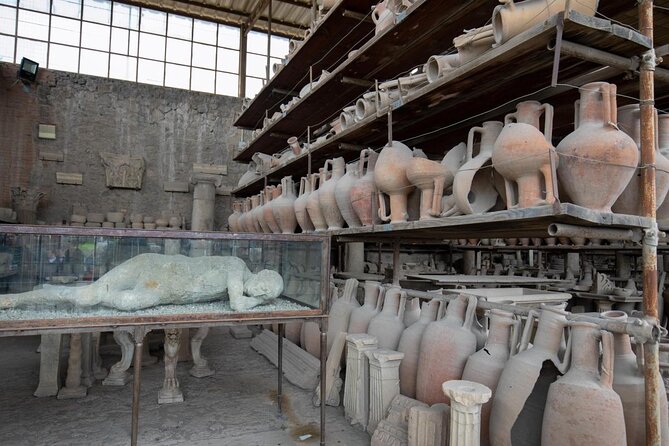
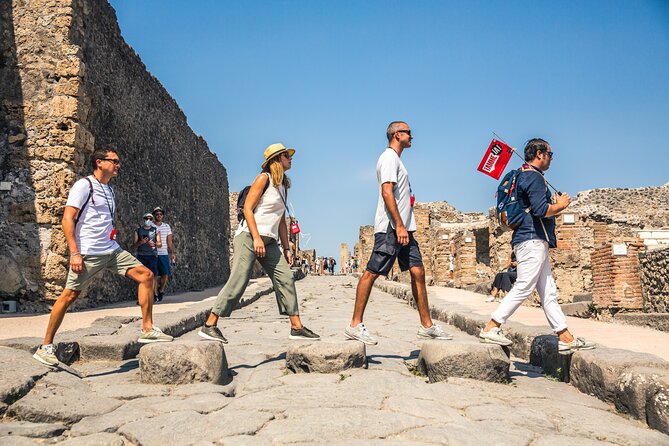
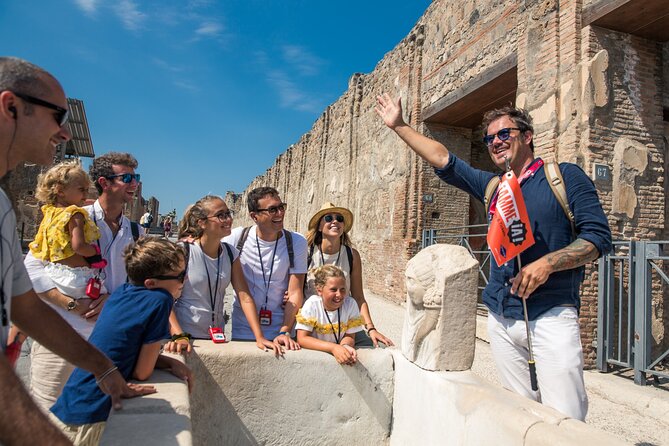
What makes this tour feel practical is that it reduces the two biggest Pompeii headaches. First, priority admission helps you bypass the slow start that can drain your energy. Second, the guide uses headsets (especially helpful when the group is bigger than 10), so you hear the explanation without constantly turning your head and losing the thread.
In a place like Pompeii, context is everything. If you only wander, you see walls, doorways, and street stones. With a guide, you connect them to what those spaces meant, how people moved through the city, and why certain buildings mattered. On this route, you get a guided walk that connects the Civil Forum, the Temple of Jupiter, market life, public baths, and major civic buildings so the city feels like it is operating, not just collapsed.
There is also a quiet comfort factor. A small group of up to 25 plus headsets means less shouting and less “where are you?” It is still an outdoor site, so you will sweat and you will walk. But your attention stays on what matters.
More Pompeii tours to compare:
- Pompeii: Entry Ticket and Guided Tour with an Archaeologist
★ 4.8 · 19,459 reviews - Pompeii: Entry Ticket with Optional Audio Guide
★ 4.2 · 12,360 reviews - Pompeii: Small Group Tour with an Archaeologist
★ 4.8 · 12,264 reviews
Meeting at Camping Zeus and Timing Your Start
Your tour starts at Camping Zeus in Pompei, at Via Villa dei Misteri 3. The local meetup point is described as Zeus Car Park, and the tour ends back at the same location. That matters, because it avoids the end-of-tour scramble that can happen when your group is dropped somewhere else.
Plan to arrive early enough to get oriented. The site is a long walk inside Pompeii, and once you are moving, you want your body and brain ready. One review noted delays and headset or microphone trouble on a specific day, which is a reminder that tech can fail. The fix is simple: when you receive your headset, do a quick test, and then keep it on and adjusted for clarity.
Also, Pompeii is hot. The tour itself specifically suggests sunscreen and comfortable shoes. I would add one more practical rule: do not carry heavy bags. Uneven ground is part of the experience, so lighter luggage makes the whole route easier to enjoy.
If you have flexibility on timing, going earlier in the day usually helps you avoid the worst heat and crush-level crowds. Even if your tour time is fixed, an early start day can still feel better.
The Civil Forum and Temple of Jupiter, Where Civic Life Comes Alive
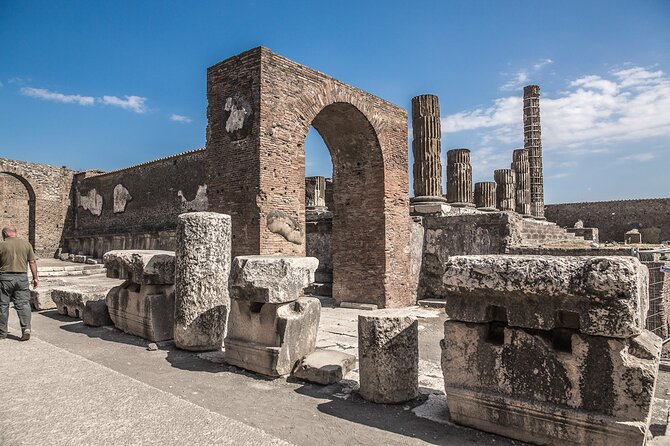
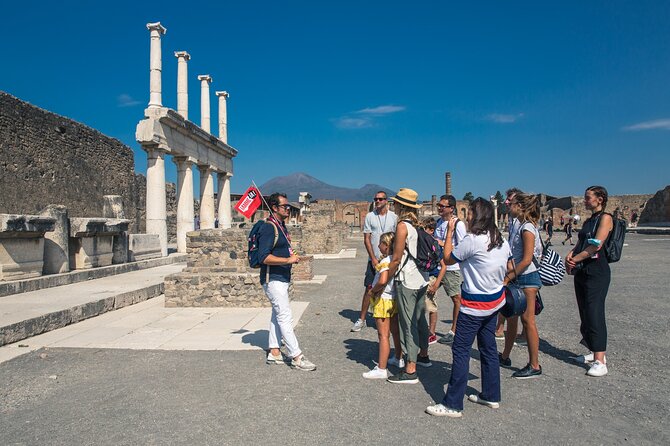
The heart of this tour is the central spine of Pompeii. You start with the Civil Forum, which is described as the core of daily life, filled with public administration, justice, business, trade, and citizen worship. Even if you have never studied Roman civic systems, this stop gives you the “why” behind what you are seeing.
Then you hit the Temple of Jupiter, and this is where the city’s political and religious roles overlap. The temple dominates the north side of the Forum, with Mount Vesuvius rising behind it. When the colony was founded around 80 BC, the temple underwent a major renovation, transforming into a Capitolium-style center with three cult statues of Jupiter, Juno, and Minerva. The important detail here is visibility: statues were placed on a high base so people crossing the Forum square could see them.
If you want one takeaway, it is this: the Forum was not just a meeting place. It was a stage. People ran errands, handled legal and business matters, and watched public religious symbols all in one shared space.
A downside for some people is that the Forum area can get busy, and you are moving with a group. If you prefer slow wandering, you might feel tempted to break away. But the payoff is that you understand what those stones meant within Roman life.
Macellum and Via dell’Abbondanza, Market Life on an Ancient Main Street
After you understand the civic center, the tour shifts to how Pompeians spent their everyday money and time. The Macellum is the market complex, described as a tuff quadriporticus with a worship hall on the eastern side. You also get details that make it feel lived-in, not theoretical.
This stop includes the idea of imperial influence through art. Copies of marble statues of a female and a male armed figure appear in niches, plus a fragment of a larger statue linked to the imperial cult. On one side, there is a sacred board meeting room, and on the other, a masonry counter likely connected to fish sales. The building reads like a mix of commerce and belief.
Then you walk along Via dell’Abbondanza, Pompeii’s main street. It is the decumanus maximus, running east and west from the Forum toward Porta Sarno. The tour framing emphasizes what made it noisy and crowded: shops, workshops (officinae), cafes, snack bars, and restaurants. That description is the practical bridge. You see the street layout, and suddenly you can picture customers, workers, and deliveries moving along the same stones.
One caution: street-level ruins can feel repetitive if you do not have context. That is why this is a guided stop. With the explanations, the street stops being just a path and starts becoming the city’s daily rhythm.
A few more Pompeii trips worth comparing
- Pompeii: Skip-the-Line Entrance Ticket with Audio Guide
★ 4.0 · 2,509 reviews - Pompeii: Guided Walking Tour with Entrance Ticket
★ 4.3 · 1,423 reviews - Pompeii: Skip-the-line-Ticket and Guided Tour
★ 4.6 · 1,152 reviews - Pompeii: Guided Tour with Skip-the-Line Entry
★ 4.9 · 812 reviews
Stabian Baths and the Lupanar Stop, Two Different Sides of Roman Life
This tour includes time at the Stabian Baths (Terme Stabiane), behind the Temple of Jupiter. The baths date to just after Pompeii’s founding as a veterans’ colony around 80 BC. You learn how men and women had separate entrances, which immediately changes how you think about what “public” meant in Roman life.
Inside, the men’s section is described in terms of temperatures and routines: apodyterium (dressing room), then tepidarium for medium-temperature bathing, frigidarium for cold baths, and calidarium for hot baths. Like many Pompeii buildings, the baths were damaged during the earthquake of 62 AD. This kind of detail helps the ruins feel connected to real events, not just a static disaster.
Next is the Lupanar, Pompeii’s famous brothel (Lupanare Grande). This stop focuses on the erotic wall paintings. The guide context also mentions who worked there and how they were paid, described in asses, with a comparison to a wine price. It is a very short stop, but it is one of those places where Pompeii’s “complete city” story shows its edge.
If you are uncomfortable with sexual content, plan how you want to handle it ahead of time. The tour includes it and the ticket coverage is part of the experience. For some people, this stop becomes the most talked-about moment of the trip, for others it is just a quick checkmark in a history lesson.
House of the Faun, Alexander Mosaic, and the Large Theater
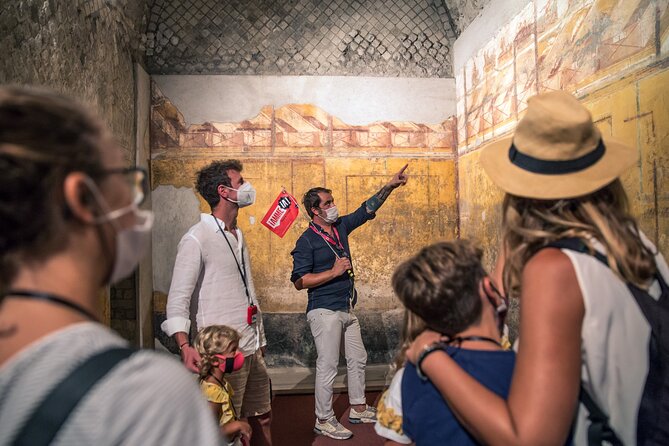
The route continues from the street and public spaces into the more “art and elite life” side of Pompeii. You step inside the elegant House of the Faun, known for mosaics, including the striking Alexander Mosaic. Even if you are not a museum person, mosaics are one of those things where you can feel the craft instantly. This is one of the clearest “how did they do this?” moments in the whole city.
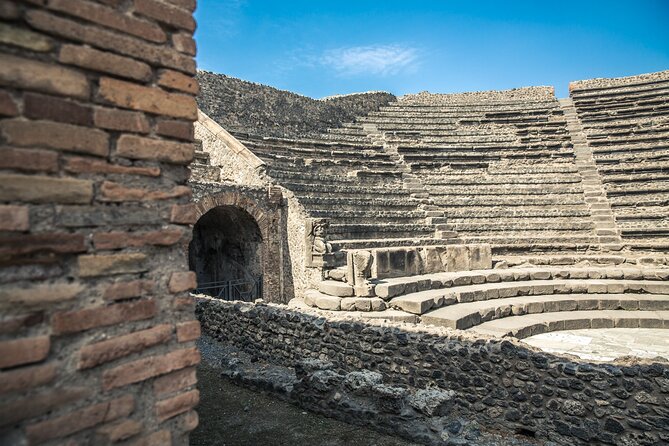
From there, you move to the Large Theater, an open-air venue where crowds gathered for comedies, dramas, and musical performances. Pompeii is famous for its everyday street scenes, but it also had culture and mass entertainment. Seeing an actual performance space helps tie the city’s entertainment life into the same urban story as the Forum and markets.
One thing to keep in mind is that theater areas can still feel busy, depending on time of day and how the group flows. The headset system helps a lot here, because you may be moving between steps, stairs, and viewpoints while still trying to catch the guide’s point.
If you want pure architectural drama, you might feel that some stops get brief. That is not a failure of the guide. It is the math of a 2 hour 30 minute overview.
Basilica and Public Space, Where Business and Justice Took Place
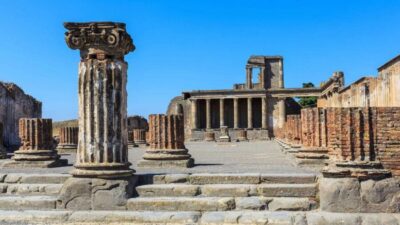
The Basilica is one of the most important civic buildings on the route, and it gets its own stop. It covers about 1,500 square meters and is described as the Forum’s most sumptuous building. The Basilica space was used for business and for administration of justice.
The tour explanation also highlights how you enter and how the interior is structured. It is accessed from the Forum through five entrances separated by tuff pillars. Inside, it is divided into three naves with two rows of brick columns with Ionic capitals. Those details matter because they show how Roman civic spaces were designed for function and crowd flow.
If you only focus on the exterior shell, you miss the purpose. The guide’s framing helps you imagine the movement of people inside, the kind of legal or commercial discussions that happened there, and why this building sat at the center of the city’s decision-making.
This is also one of the stops where the guided timing makes sense. The Basilica area can be visually impressive, but it is even more impressive when you understand what it was built to do. The tour provides free admission for this portion, so the time you spend here is part of your included site access.
Price and Value: Is $59.13 Worth It?
At $59.13 per person, you are paying for more than the guide. You are paying for three things that matter on a day like Pompeii.
First is skip-the-line priority admission. Time saved at the gate can turn an exhausting start into a smooth beginning. Second is the official, licensed guide. In a site this large, a good guide helps you avoid the classic mistake of wandering without understanding. Third is the headset setup, which keeps the explanation audible when you are stuck in outdoor crowd dynamics.
You also get a clear highlight selection that covers major spaces: the Civil Forum, Temple of Jupiter, Macellum, Via dell’Abbondanza, Stabian Baths, the Lupanar, House of the Faun with the Alexander Mosaic, the Large Theater, and the Basilica. That is a lot to do on your own in limited time.
One value warning, though. The tour is designed as an overview, not a deep, slow, one-building-at-a-time experience. If you want to spend hours absorbing one district, you may feel constrained by group pacing. In that case, you might use the guided portion to build your bearings, then go back later on your own.
A small positive from what I saw in guide names: people in this program have mentioned guides such as Alessio, Vincenzo, Claudio, Max, Giulia, Vivianna, and Anarita. Whoever leads your group, the core promise stays the same: context plus practical navigation through the biggest highlights.
Who This Pompeii Priority Tour Fits Best
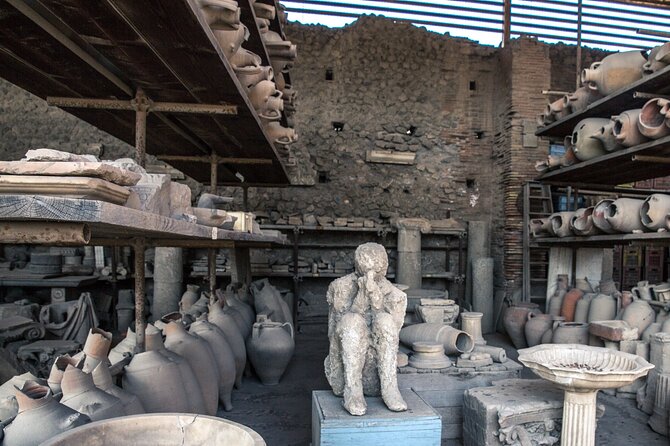
This tour is a strong fit for you if you want Pompeii to make sense quickly. It is ideal when you have limited time, you do not want to plan a complex route, or you know you will enjoy the ruins more once someone explains what they are.
It also works well for people who dislike audio issues in crowds. With headset support, you keep hearing the guide while walking. And with a group capped at 25, it still feels manageable.
I would think twice if you travel with young kids or you strongly prefer to stop whenever you want. This is a timed route, and it can include standing and walking in heat. The experience description also flags that it gets very hot in summer and you should wear sunscreen and comfortable shoes.
If you are the type who loves details and art, you will get plenty of that in the Alexander Mosaic and the civic architecture. If you mainly want a fast hit of the most famous Pompeii scenes, the route does that too.
Should You Book This Pompeii Priority Guided Tour?
Book it if you want a guided, time-efficient Pompeii experience with priority entrance and headset audio, and you are happy trading a bit of freedom for a well-structured overview. The price lines up with what you get: admission help plus a licensed guide plus audio support plus major highlights.
Skip it or plan to do extra self-guided time later if you want a slow, pick-your-own-speed visit. Pompeii is big enough that 2 hours 30 minutes can feel like a strong start rather than the full story. If your goal is to soak everything up, you will probably want to come back for the sections you did not have time to see.
FAQ
How long is the Pompeii guided tour?
The tour lasts about 2 hours 30 minutes.
Is the tour offered in English?
Yes, it is offered in English.
Does the tour include priority entrance to Pompeii?
Yes, priority admission is included to skip the line, and the admission ticket fees are included.
Are headsets provided during the tour?
Yes. Headsets are provided in Pompeii to hear the guide clearly for groups bigger than 10 passengers.
Where is the meeting point, and where does the tour end?
You meet at Camping Zeus, at the Zeus Car Park meeting point. The tour ends back at the same meeting point.
Which Pompeii sights are included?
The tour includes stops covering the Civil Forum, the Temple of Jupiter, the Macellum, Via dell’Abbondanza, the Stabian Baths, the Lupanar, the House of the Faun (including the Alexander Mosaic), the Large Theater, and the Basilica.
Is lunch or transportation included?
No. Lunch and transportation are not included.
What is the group size limit?
The tour has a maximum of 25 travelers.
What is the cancellation and weather policy?
Free cancellation is available up to 24 hours before the experience for a full refund. The tour requires good weather, and if it is canceled due to poor weather you will be offered a different date or a full refund. It also requires a minimum number of travelers.
Recently reviewed around Pompeii
- Mt. Vesuvius Wine Tasting and Lunch Experience from Pompeii★ 4.5 · 20 reviews
- Pompeii Small Group with an Archaeologist and Skip The Line★ 5.0 · 121 reviews
- Pompeii from Afternoon to Sunset★ 5.0 · 108 reviews
- Private Guided Tour and VR Headsets in the Ancient Pompeii★ 5.0 · 3 reviews
- Visit Pompeii with a local expert guide★ 5.0 · 10 reviews
- Traditional Neapolitan Dinner in Pompei – Villa Franca – Family Restourant★ 5.0 · 8 reviews
- Discover Pompeii on this Guided Walking Tour of the Buried City★ 4.0 · 9 reviews
- 2 Hours Private Walking Tour in Pompeii with an Archaeologist★ 5.0 · 15 reviews
Pompeii Tours, compared.
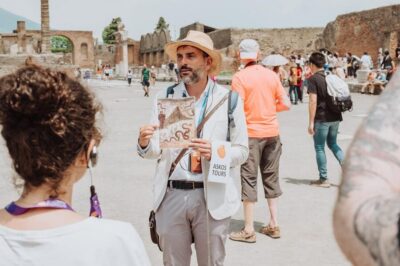
Entry Ticket and Guided Tour with an Archaeologist
Read our review →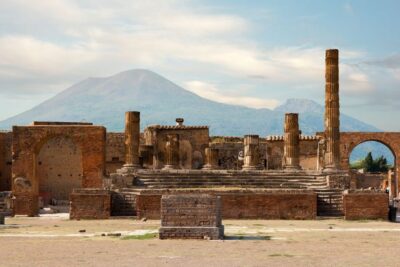
Pompeii Small Group Tour with an Archaeologist
Read our review →
Skip-the-Line Entrance Ticket with Audio Guide
Read our review →
Pompeii and Mt. Vesuvius with Lunch and Wine Tasting
Read our review →
Archaeological Park Tour with Ticket on request
Read our review →