Reviewed · POMPEII TOURS
Pompeii 360° – 4-hour tour with an expert Guide in archaeology
Pompeii 360° is interesting because you are not wandering around a giant ruin map on your own, you are moving through the city with an expert archaeology guide who helps you read what you are seeing. Guides like Luciano and Martina have been praised for being interactive and clear, so the place feels understandable instead of overwhelming.
What I especially like is the mix of big famous stops plus the smaller details that make Pompeii real, like plaster casts at Orto dei Fuggiaschi and mosaic scenes in the domus. My other favorite thing is how the route is built for a 4-hour visit, so you leave with a clear sense of the Forum, temples, homes, theater spaces, and even the baths. One drawback to consider is that the Pompeii Archaeological Park ticket is not included in the tour price, so you will add €20 per person to your total.
Key highlights to look for on this route
- An archaeology-led private tour that focuses on what each site tells you, not just where it is
- A high-impact start at the Anfiteatro Romano, described as the oldest amphitheater in the Roman world and very well preserved
- Vesuvius photo moments planned into the temples and Forum
- Mosaics, frescoes, and plaster casts that turn the eruption story into something you can picture
- Roman daily life stops, including the Odeon and the Stabian Baths
- Optional Lupanar visit, with erotic frescoes, handled at your discretion
Pompeii 360° in plain terms: a private, archaeology-led half day
This is a private tour in Pompeii designed to give you a coherent picture in about 4 hours. The “360°” part makes sense because you do not just hit one theme like temples or villas. You walk through the city’s public center, religious viewpoints, residential luxury, and everyday spaces like the baths, all guided by someone who can connect the dots.
The biggest advantage of a private, archaeology-focused guide is pacing. Pompeii can feel like a choose-your-own-adventure maze, and it is easy to miss what matters when you are trying to figure out routes, entrances, and names. Here, you get a structure that keeps you oriented, even if you only have a half day.
You’ll also see how the guide’s approach affects your experience. In past groups, guides such as Eugenia and Ernesto were highlighted for clear explanations and a positive, engaging style. That matters because Pompeii is not just visual. It is interpretation, and the right guide helps you notice the “why.”
More Pompeii tours to compare:
- Pompeii: Entry Ticket and Guided Tour with an Archaeologist
★ 4.8 · 19,459 reviews - Pompeii: Entry Ticket with Optional Audio Guide
★ 4.2 · 12,360 reviews - Pompeii: Small Group Tour with an Archaeologist
★ 4.8 · 12,264 reviews
Price and logistics: what you pay, what you still need to pay
The tour price is $203.70 per person, and the package includes a licensed expert guide in archaeology, taxes, and a private experience. You also get a mobile ticket for the tour itself, which is handy once you’re in the area.
The key extra cost is the Archaeological Park of Pompeii entrance fee, €20 per person, which is not included. The good news is that the tour’s itinerary lists site admissions as included for each stop, so you are not paying separately at every building. You still need to budget for the park ticket to get into the overall archaeological area.
If you are traveling with younger people, there are specific rules for the park ticket: under 18 is free, and EU citizens aged 18 to 25 pay €2 with valid ID. (This can noticeably change your total, so it’s worth checking before you go.)
Also, on timing: the tour averages booking about 23 days in advance. If your dates are tight, I would not wait until the last minute.
Where you meet: Piazza Esedra and the easy finish
You meet at Piazza Esedra, 80045 Pompei NA, Italy, and the tour ends there as well. That symmetry is practical because you are not stuck figuring out transport or walking back across a spread-out park once you’re done.
The meeting point is also in an area that’s noted as being near public transportation, so you have more options if you are not driving. For many people, that means less stress and more time for the tour itself.
Come prepared to walk. Comfortable shoes matter here, and the tour suggests sunglasses, a hat, and comfortable clothing. Backpacks should be no larger than 30x30x15, so if you travel light, you’ll be happiest.
Stop 1, the Roman amphitheater: start where the city shows off
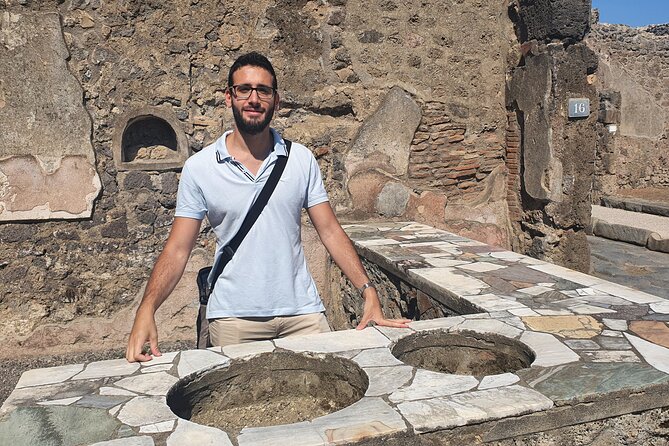
Your tour begins at the Anfiteatro Romano. This is presented as the oldest amphitheater in the Roman world and described as very well preserved, which is a great way to kick off.
Why this stop works: amphitheaters are about more than seating. Even in ruins, you can sense how Pompeii funneled crowds into one controlled space. The guide can help you understand how public life worked, and it sets the tone for the rest of the day, where you’ll keep seeing civic buildings and social spaces.
If you love atmosphere, arrive mentally ready to picture events. If you are more into architecture, you’ll appreciate that this site is still sturdy enough to read details instead of guessing.
A few more Pompeii trips worth comparing
- Pompeii: Skip-the-Line Entrance Ticket with Audio Guide
★ 4.0 · 2,509 reviews - Pompeii: Guided Walking Tour with Entrance Ticket
★ 4.3 · 1,423 reviews - Pompeii: Skip-the-line-Ticket and Guided Tour
★ 4.6 · 1,152 reviews - Pompeii: Guided Tour with Skip-the-Line Entry
★ 4.9 · 812 reviews
Orto dei Fuggiaschi: the eruption story in plaster casts
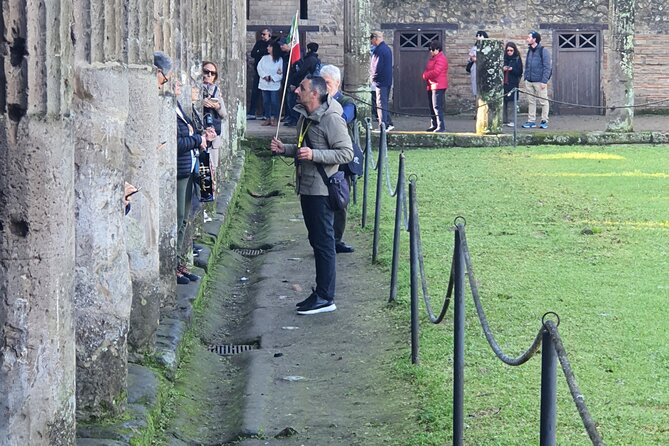
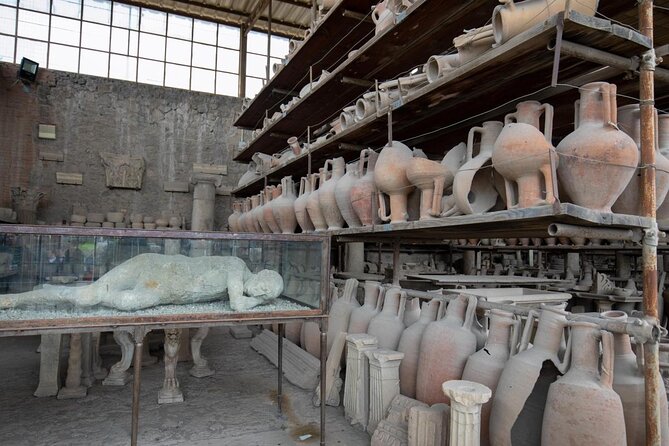
Next is Orto dei Fuggiaschi, a famous garden area where some inhabitants took refuge during the eruption. The key feature here is the plaster casts, which you’ll admire with the guide.
This stop is emotional, but it also helps you understand why Pompeii became such a scientific turning point in archaeology. Instead of vague disaster, you get a way to connect the eruption to real people and physical forms preserved by conditions you can learn to recognize.
The garden setting also adds contrast to the rest of the city walk. It is not only stone buildings. It is also a reminder that Pompeii was lived in and that the eruption was not an abstract idea.
Tempio di Giove Capitolino: temples, power, and a Vesuvius view
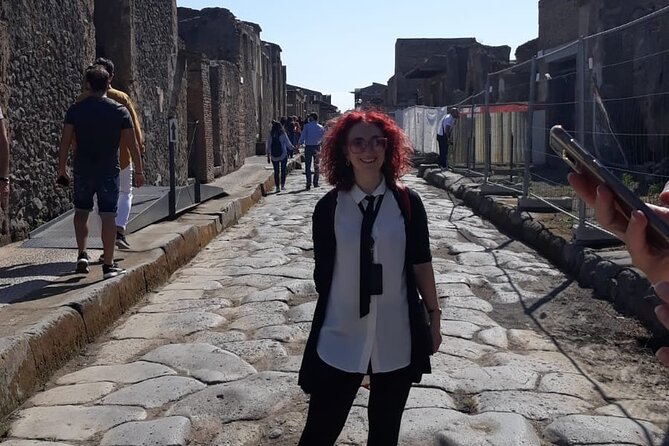
At Tempio di Giove Capitolino, you focus on the temple of Jupiter, Juno, and Minerva. This stop is famous for the view on Mount Vesuvius, and there is even a suggested picture moment.
This is one of those Pompeii moments where you can learn the geography fast. When you can see Vesuvius, the city stops feeling like a set of random buildings and starts feeling like a place shaped by threat and skyline. The guide’s explanation helps you tie the religious function of the temple to its dramatic placement.
Time here is short, so aim to take your photo without lingering too long if you want to keep the momentum through all stops.
Foro de Pompeya: the city’s political, religious, and everyday center
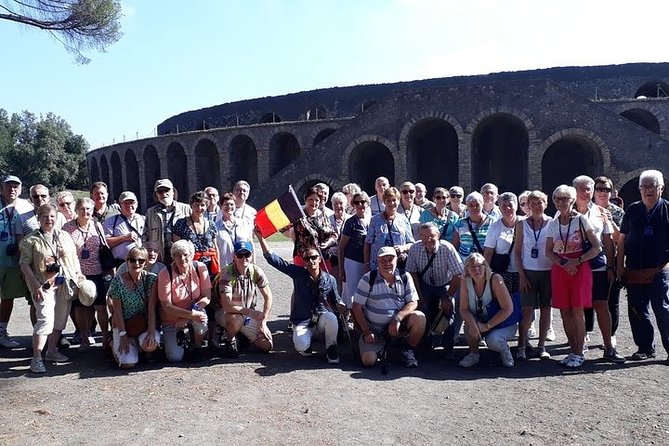
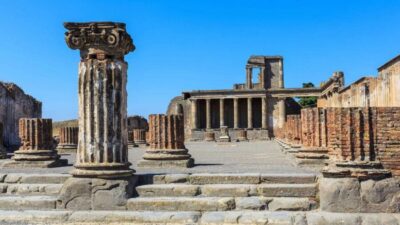
Then you move to the Foro de Pompeya, the center of political, religious, civil, and economic life. It’s one of Pompeii’s most important spaces because it’s where multiple aspects of society overlapped.
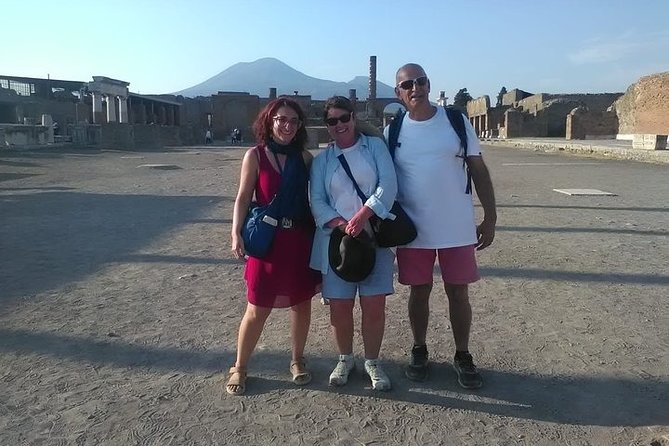
This stop includes a photo stop with Vesuvius behind, which is a smart planning detail. Getting that background view from the Forum area helps you understand how the city visually framed the mountain, even though the mountain is the last thing you can ignore once it’s in your sightline.
If you have limited time in Pompeii, the Forum is where I would want the guide’s interpretation the most. It’s the place where you’ll start to see patterns: where people gathered, where authority sat, where ceremonies and daily business intersected.
Casa del Fauno: largest house, major mosaics, and star-level details
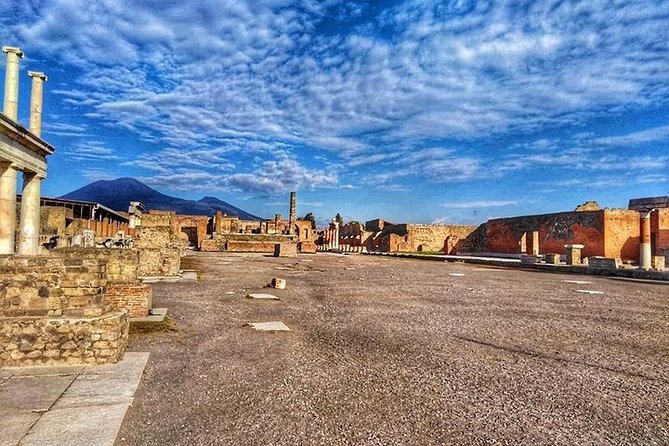
You visit Casa del Fauno (listed twice in the route). First, you see it as the largest house in ancient Pompeii, with about 32,000 square feet mentioned and a sense of big domestic scale. You’ll look at gardens and multicolor mosaics, including the mosaic of Alexander the Great.
Later, you return to the same house area for another look with specific emphasis on the statue of the Faun and the Alexander mosaic again. This duplication is not necessarily a mistake. It can actually help you process the details in stages: first understanding scale, then focusing on the iconic objects once you know the house context.
For me, Pompeii’s homes are where the city turns from ruins into storytelling. The mosaic themes and house layout show wealth, taste, and identity. If mosaics are your thing, Casa del Fauno is where your photo stops will feel justified.
Temple of Apollo: older roots, restored details, and another Vesuvius angle
Next is the Temple of Apollo, described as one of the city’s most ancient temples and noted as restored not a long time ago. You get another spectacular view on Mount Vesuvius and a quick reminder that Apollo’s world included his twin sister Diana, goddess of the moon.
This stop makes sense after the Forum and Jupiter temple because it keeps the theme of sacred space with strong sightlines. The guide can help you appreciate how temples acted like landmarks and how religion was tied to both public life and the broader landscape around the city.
It’s also a good moment to slow down for 5 to 10 minutes, because temple details tend to reward careful looking.
Casa del Cinghiale and Via dell’Abbondanza: wealth and everyday shopping street views
You then pass Casa del Cinghiale, the house associated with a wild boar theme and a nearby mosaic floor. It’s a short stop, but it gives you a taste of how quickly Pompeii shifts from monumentality back to personal luxury.
After that, you walk along Via dell’Abbondanza, Pompeii’s main commercial street. This is where you see shops, houses, and public fountains. The stop’s value is context. It helps you picture what daily life looked like between major public events.
One practical tip: this part is great for photos, but keep your eyes on the ground and storefronts, not just the buildings. In Pompeii, the street-level details are where the city feels most lived in.
Odeon and Teatro Piccolo: music and marble-floor details
You then visit Odeon – Teatro Piccolo, a small theater space used for music and poetry, with attention on details like a precious marble floor.
The theater stops matter because Pompeii is not only politics and homes. It’s also entertainment. Seeing a theater after the Forum and before the baths gives you a fuller picture of leisure and culture.
This stop is brief, so if you care about interiors, take a moment to look at the ground-level materials. A good guide will point out what you might otherwise miss.
Stabian Baths: gym, pool, sauna, and massages in one compact complex
Now you hit Terme Stabiane, the Stabian Baths. The tour highlights the typical Roman thermal bath experience: a setup that includes a gym, a swimming pool, and rooms dedicated to sauna and massages.
This is one of the most rewarding parts of Pompeii if you like human-scale everyday life. Baths were social centers, not just places to get clean. You can think of them as the ancient version of a public hangout that also supported health and routine.
The stop is listed as about 15 minutes, so you’ll get a guided overview rather than a deep architectural study. Still, it’s enough time to leave knowing what each room functioned as.
Casa dei Vettii: one of the best-preserved domus with myth scenes
You visit Casa dei Vettii, described as one of the best-preserved examples of Roman domus. Here you focus on mythological frescoes and mosaics, with an emphasis on beauty and preservation.
This is a major “quality over quantity” stop. Some Pompeii sites are dramatic but broken. Casa dei Vettii is valuable because the condition helps you interpret themes and decorative choices instead of just admiring fragments.
If you are the kind of traveler who gets excited by artwork and symbolism, this is where you’ll feel the most payoff for your time.
Basilica: courtroom power, not a church
Next is the Basilica, with an important clarification that it is not religious even though the name can sound like it. This space is presented as an ancient Roman courthouse where you’ll admire beautiful details.
This stop helps you understand Roman civic order. The Basilica teaches you what authority looked like in practice: law, judgments, and public administration happening in a dedicated structure.
It’s also a good “brain break” after domus and baths, because it shifts your focus back to public function and built governance.
Tempio di Venere: panoramic spot and Pompeii’s goddess focus
At Tempio di Venere, you visit the temple of Venus, dedicated to the main goddess of Pompeii and set in a panoramic spot. Like other temples on the route, it offers another chance to connect architecture with viewpoint.
This is one of those stops where you can take your photo and then let the guide explain why Venus mattered culturally in a city full of art, household imagery, and social messaging.
Casa del Fauno again, then Lupanar at your discretion
You return to Casa del Fauno for the statue of the Faun and the Alexander mosaic emphasis. Then you have the optional stop at the Lupanar, the so-called house of pleasure, with erotic frescoes.
The tour is clear about this: you can visit at the discretion of the customer. That flexibility is important. It means you are not forced into content that doesn’t fit your comfort level. If you skip it, you still get the core Pompeii highlights without derailing the schedule.
House of Venus in the Shell: garden vibes and the birth of Venus fresco
Finally you reach House of Venus in the Shell, a domus near the amphitheater known for a beautiful garden and a fresco representing the birth of Venus.
This stop is a fitting closer because it combines a recognizable art theme with a lived-in feel. Even in ruins, gardens help you imagine daily rhythms, and myth scenes like the birth of Venus connect Pompeii residents to the wider Greco-Roman world.
It also gives your last photos a different feel than temples and courthouses. More color, more domestic atmosphere.
How to make the most of a 4-hour Pompeii route
This is a “see a lot, learn a lot” half day, not a slow museum stroll. To get the most out of it, plan to move with purpose and treat each stop as a chapter.
A few practical tips that help:
- Take your time for photos at planned view stops like the temples and Forum, then let the guide handle the rest.
- If mosaics and frescoes are your priority, focus your attention on the domus stops, especially Casa del Fauno, Casa dei Vettii, and the Casa del Cinghiale mosaic detail.
- If you want a lighter emotional tone, be ready that the Orto dei Fuggiaschi plaster casts are powerful, and you may feel it more than you expect.
The tour’s strength is that it keeps you from getting lost in the details without context. You’ll leave with a map in your head: public center, religious monuments, private luxury, entertainment, daily life, and the city’s sudden end.
Is Pompeii 360° worth $203.70 for a private half day?
For $203.70 per person, you are paying for several things at once: a private expert guide in archaeology, a structured route, and taxes included. The additional €20 park ticket is the one clear extra cost, but it’s the same park entry you’d need for any Pompeii visit.
So the value question becomes simple: do you want an expert to help you make sense of Pompeii quickly? If you do, this route is a strong way to use your limited time. Pompeii punishes guesswork. With a guide, you can spend your energy looking, not decoding.
It’s especially good if you enjoy art and daily-life details, because the itinerary includes mosaics, fresco themes, theater function, and Roman bathing routines. And it’s a nice choice if you want something more tailored than a big group bus tour.
On the other hand, if your dream Pompeii day is drifting slowly and revisiting favorites for an hour each, this schedule may feel brief at individual sites. This tour is about coverage plus interpretation, not unlimited wandering.
Should you book Pompeii 360°?
I’d book this tour if you want:
- Private, archaeology-focused guidance that helps you understand what you are seeing
- A 4-hour plan that hits amphitheater, Forum, temples, homes, baths, and theaters in one coherent circuit
- Built-in Vesuvius viewpoints for photos and orientation
- A guide approach that has been praised for being professional, interactive, and flexible, including support for families in the past
Skip it or choose a longer option if:
- You know you want lots of free time to linger on your favorite mosaics or buildings without a timed route
- You are sensitive to the optional content at the Lupanar, and you want control beyond a discretion-based stop
If your time in Pompeii is limited, Pompeii 360° is a practical way to get oriented fast and leave with understanding, not just images.
Recently reviewed around Pompeii
- Mt. Vesuvius Wine Tasting and Lunch Experience from Pompeii★ 4.5 · 20 reviews
- Pompeii from Afternoon to Sunset★ 5.0 · 108 reviews
- Pompeii Small Group with an Archaeologist and Skip The Line★ 5.0 · 121 reviews
- Private Guided Tour and VR Headsets in the Ancient Pompeii★ 5.0 · 3 reviews
- Visit Pompeii with a local expert guide★ 5.0 · 10 reviews
- Traditional Neapolitan Dinner in Pompei – Villa Franca – Family Restourant★ 5.0 · 8 reviews
- Discover Pompeii on this Guided Walking Tour of the Buried City★ 4.0 · 9 reviews
- 2 Hours Private Walking Tour in Pompeii with an Archaeologist★ 5.0 · 15 reviews
Pompeii Tours, compared.
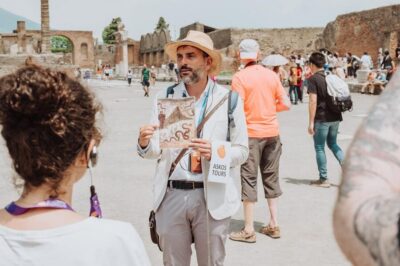
Entry Ticket and Guided Tour with an Archaeologist
Read our review →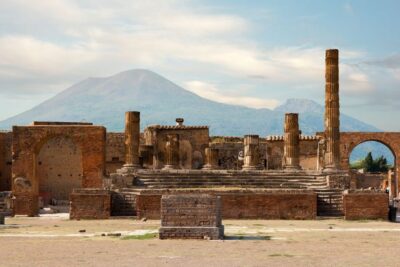
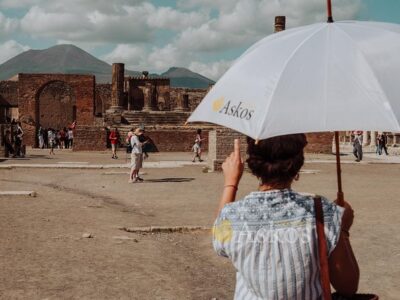
Pompeii Small Group Tour with an Archaeologist
Read our review →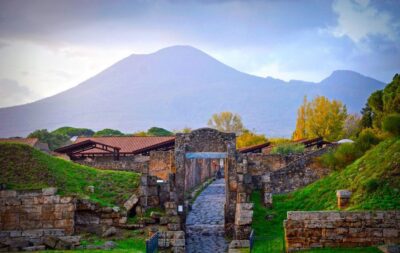
Skip-the-Line Entrance Ticket with Audio Guide
Read our review →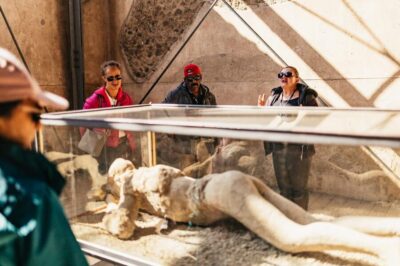
Pompeii and Mt. Vesuvius with Lunch and Wine Tasting
Read our review →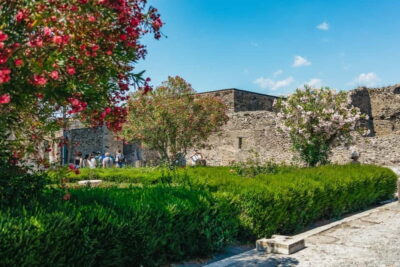
Archaeological Park Tour with Ticket on request
Read our review →