Reviewed · POMPEII TOURS
Pompeii private tour with expert guide in archaeology
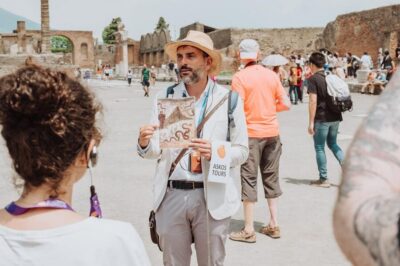
Pompeii is one of those places where you can stare at ruins for hours and still feel like you missed the point. This private tour is interesting because you get a focused, archaeology-led walk through daily life 2,000 years ago, not just a checklist of walls. I like that it is paced for real viewing, with time to understand what you are looking at and why it mattered. You will also appreciate how the guide can steer you toward what you personally care about, while keeping the route logical.
Two things I really like: the visit includes both public life and private life, and the guide is specifically an expert in Pompeii and archaeology. You also get a neat end point at the Forum, where the story of the city clicks into place. One consideration: admission to the Archaeological Park is not included, so you need to budget the entrance ticket on top of the tour price.
Key Highlights You Will Actually Feel in Pompeii

- Expert archaeology guide focused on Pompeii’s real daily-life details
- Gladiator training area and the theater show entertainment and discipline side by side
- Baths and street life connect personal routine to public space
- Red light district and erotic frescoes add context, not just shock
- Domus of rich patricians helps you read mosaics and frescoes like a clue trail
- Plaster casts of Vesuvius victims give the eruption story a human scale
A Private Pompeii Archaeology Lesson in 2 Hours
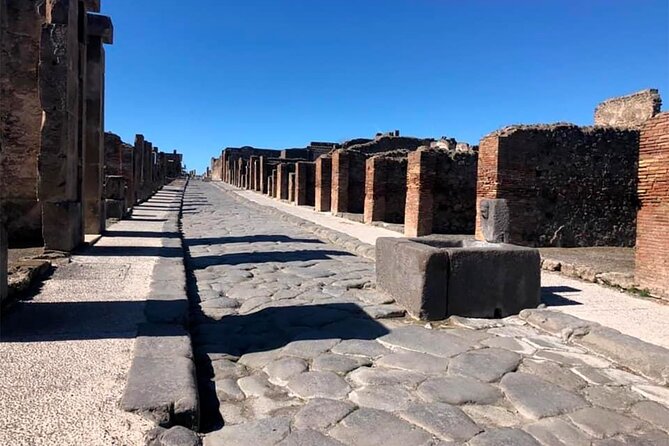
Pompeii can feel overwhelming fast. Streets fork, buildings repeat, and there is always another sign that says do not touch. The value here is not that you get to see more sites than a bus tour. It is that you get the right explanations in the right order, so the ruins start making sense as a living city.
This is a private group tour up to 8 people. That matters because you are not stuck reading from behind other visitors. You can ask questions as you go and actually follow the guide’s thread of the story. And since the tour is offered in English, you are not paying extra just to get by with a few guessed-at words.
At about 2 hours, it is a smart length if you want a strong start to Pompeii without exhausting your feet before you even reach your must-see corners. The tour ends back at your meeting point, after a finish at the Forum area, with an option to keep exploring on your own or return with the guide.
More Pompeii tours to compare:
- Pompeii: Entry Ticket and Guided Tour with an Archaeologist
★ 4.8 · 19,459 reviews - Pompeii: Entry Ticket with Optional Audio Guide
★ 4.2 · 12,360 reviews - Pompeii: Small Group Tour with an Archaeologist
★ 4.8 · 12,264 reviews
What You Actually See: Gladiators, Baths, Erotic Frescoes, and the Forum
One of my favorite ways to read Pompeii is to understand how the city worked from the ground up: work, play, money, worship, and everyday comfort. This route does that. It moves from entertainment and training to street commerce, from bathing culture to household wealth, and then into the civic heart.
You will visit highlights that cover a range of Pompeii’s social life, including:
- the school and training place of gladiators
- the theater
- main streets with taverns and shops
- the Baths, described as a spa still reachable in the ruins
- the red light district and its famous erotic frescoes
- a house of rich Roman patricians (Domus) with frescoes and mosaics
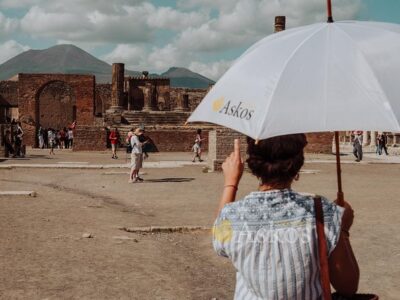
- the Forum, center of social life
- plaster casts of the victims from the Vesuvius eruption
- temples and places of worship
- the main market of the city
That list is exactly why this tour is so popular. It does not treat Pompeii like a museum of isolated rooms. It treats Pompeii like a connected city, where one site helps you interpret another.
The Expert Archaeologist Part That Makes Pompeii Feel Personal
A good Pompeii guide can turn confusion into clarity. Without a guide, ruins can feel like a jumble of stone shapes. With a guide who works in archaeology and Pompeii specifically, you get interpretive hooks: how people moved through space, how daily routines looked, and what the buildings were used for.
The biggest praise tied to this experience is simple: you really need a guide to explain the history of the place to get full value from it. That is also how I think about your time here. You are paying for expertise, not just access.
Also, this tour is designed as a private experience, so your questions do not get swallowed by a group schedule. If you care more about public life (theater, Forum, market) you will likely spend your attention there. If you care more about private life (the Domus, mosaics, and frescoes), the guide can shape the emphasis around what you want to notice.
Stop-by-Stop: Your 2-Hour Walk Through Pompeii
Below is what you can expect as the guide leads you through Pompeii’s most meaningful pieces. I will keep it practical, because the point is to help you know what each area is likely to add to your understanding.
A few more Pompeii trips worth comparing
- Pompeii Ruins Private Tour with Optional Skip-the-Line Entry
★ 4.9 · 732 reviews - Pompeii private tour with an Official Guide
★ 5.0 · 631 reviews - Pompeii Private Tour with an Archaeologist and Skip The Line – 3 hours
★ 5.0 · 564 reviews - Visit in Pompeii – Pompeii Private Tour with Ada
★ 5.0 · 436 reviews
School and Training Place of Gladiators
This is not just about fighters. It is about the structure behind entertainment and discipline. When you see a training area like this with an archaeology guide, you start understanding how people prepared, how spaces were built for repeated use, and how spectacle fit into Roman life.
If you like action-and-organization stories, you will probably find this stop satisfying. If you mainly care about art, it still helps, because it shows how Pompeii’s culture supported performance and public events.
The Theater
From gladiator training, you shift to performance. The theater stop gives you a sense of how Pompeii staged gatherings and shared experiences. Even if you have read about Roman theaters before, seeing the ruins in place tends to help your brain picture how the building would have functioned when it was whole.
One small caution: theaters can be visually similar to other ancient structures. A guide helps you connect what you see to how people used the space.
Main Streets With Taverns and Shops
This is where Pompeii stops being a set of monuments and starts feeling like a place where people actually lived. Taverns and shops mean commerce and casual daily habits. You get a walk through the idea of strolling, buying, eating, and socializing, even though the buildings are fractured and incomplete.
If you enjoy “daily life” travel, this is likely your favorite part of the route. It is also an easy stop to get emotionally attached to, because street life is relatable.
The Baths, a 2,000-Year-Old Spa
Baths were social. They were routine. They were also status in how people spent time. The tour includes the Baths as a spa site that is roughly 2,000 years old, which is a great prompt for asking how long routines took and what kinds of spaces went along with bathing and relaxation.
A practical note: this sort of stop usually means standing and walking through uneven ground. The tour lists a moderate physical fitness level, so pace yourself if you are sensitive to longer periods on your feet.
The Red Light District and Erotic Frescoes
Yes, it can shock people. But the point is context. With an expert archaeology guide, the erotic frescoes and the area itself are not treated like gossip. You get cultural and social framing for how sexuality, commerce, and urban life could appear in Pompeii’s visual language.
If you prefer tours that keep things respectful and historical, you are in the right place. This is the kind of stop where a guide can keep the tone grounded, so the art becomes evidence rather than a spectacle.
Domus of Rich Roman Patricians (Frescoes and Mosaics)
This stop is where Pompeii becomes about wealth and taste. A Domus is a home, and a wealthy one is usually a show of power through decoration. Seeing frescoes and mosaics here, with a guide explaining what you are looking at, turns “pretty surviving art” into a story about who lived there and how they wanted to be seen.
If your brain lights up around symbols, art, and interior design, you will likely love this section. It is also one of the best ways to compare public Pompeii to private Pompeii.
The Forum, Center of Social Life
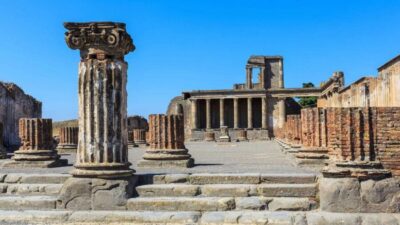
The Forum is the obvious centerpiece for many first-timers, but it hits harder with an archaeology guide. You see it as the city’s civic core: where people gathered, interacted, and moved through political and social buildings.
The tour ends at the Forum area, which gives you a clean narrative payoff. You get your “why this city was built this way” moment before you choose what comes next.
Plaster Casts of Vesuvius Victims
This is one of the stops that changes the emotional temperature of the entire visit. The tour includes plaster casts of victims, described as crystallized at the time of the Vesuvius eruption.
I like that the experience treats this as part of the Pompeii story, not a separate shock photo-op. With an expert guide, you can understand what the casts represent in the larger timeline, and why that matters to the way you read everything else you saw earlier.
Temples, Places of Worship, and the Main Market
These stops round out the city picture. Temples and places of worship connect to belief and daily rituals. The main market connects to food, trade, and the steady rhythm of buying and selling.
Put together, these are the “systems” of Pompeii. Entertainment and bathing make it human, but religion and markets show how the city kept running.
Quiet Corners and the Real Benefit of a Private Schedule

The tour is private, so it can feel different from the standard flow. The experience is designed so you can explore Pompeii in quieter, more suggestive corners, and you can customize based on your interests.
In practical terms, that means you are not stuck rushing through a huge crowd just to check a box. You are likely to get a more thoughtful pace at key points. That can matter a lot at Pompeii, where the physical setting and crowds can drain your attention quickly.
Also, the tour gives you a decision at the end. After the guided tour ends at the Forum, you can decide whether to continue the visit yourself or return to the exits with the guide. That is a nice flexibility if you want to roam and linger after the structure of the tour.
Price and Value: What You Pay for a Private Guide in Pompeii

The price is $302.34 per group, for up to 8 people. That is the part you book as a group rate, and it is a meaningful way to manage cost if you are traveling with friends or family.
But there is one added line item: admission tickets to the Archaeological Park of Pompeii are not included, and the listed entrance fee is €19.00 per booking.
Here is the practical way to judge value:
- If you are a single traveler, the per-person cost might feel steep compared with shared tours.
- If you have 4 to 8 people, the guide cost spreads out and the experience starts to look like good value.
- If you care about understanding, not just photographing, paying for an expert archaeologist guide is usually money well spent in Pompeii.
Also, this tour is booked on average 32 days in advance. That suggests it is not always easy to line up last-minute, especially if you want a specific time window.
Meeting Point, Duration, and How to Plan Your Visit
You meet at Coffee Shop Vittoria, Via Mare, 80045 Pompei NA, Italy. The tour ends back at the meeting point.
Timing-wise, the tour is about 2 hours. That is short enough to keep your energy, but long enough to get real meaning out of multiple key areas. It is also listed as offered in English, and it is a private activity where only your group participates.
The tour says it is near public transportation and that service animals are allowed. It also calls for moderate physical fitness. So if you know you struggle with steady walking on uneven ancient ground, you should plan for breaks and go at your pace.
Pickup and drop-off by minivan is not included, though the option to book it is available through Pompeigrandtour. If you need that extra help, this is the one place where it can simplify the day.
Who This Tour Fits Best

This Pompeii private archaeology tour is a strong match if:
- you want to learn as you walk, not just see
- you prefer a private pace for questions and photos
- you are traveling as a small group up to 8
- you care about both public life (Forum, theater, market) and private life (Domus, mosaics, frescoes)
- you want a guided approach to sensitive stops like the plaster casts and erotic frescoes, with historical framing
If you are someone who just wants to wander Pompeii on your own and does not want structure, you might not need a private guide for only 2 hours. But if you are trying to make your time count, especially on a first visit, the guided arc through the city makes a big difference.
Should You Book This Private Pompeii Tour?
I would book it if you want the city explained in an organized way and you do not want to waste time guessing what you are seeing. The best reason is straightforward: a guide changes the experience from pretty ruins to a readable city.
Also, the route is well chosen. Gladiators, baths, streets, a Domus, the Forum, temples, market, and the Vesuvius casts cover the big parts of daily life and civic life in a tight 2-hour window.
The main reason not to book is the math if you are traveling solo. With a private group price plus an added entrance ticket, it may be more cost-effective to consider a shared option. If you have 2 to 8 people in your group, this becomes much more reasonable.
FAQ
FAQ
Is this a private Pompeii tour?
Yes. It is a private tour/activity, and only your group will participate.
How many people can be in the group?
The tour price is per group up to 8 people.
How long is the Pompeii private tour?
It lasts about 2 hours.
What language is the tour offered in?
The tour is offered in English.
Is the entrance ticket to the Pompeii Archaeological Park included?
No. The entrance fee is €19.00 per booking and is not included.
What is included in the price?
An expert guide archaeologist is included.
Where do we meet?
You meet at Coffee Shop Vittoria, Via Mare, 80045 Pompei NA, Italy.
Where does the tour end?
The activity ends back at the meeting point.
Is pickup and drop-off included?
Pick-up and drop-off by minivan is not included, but you may be able to book it separately through Pompeigrandtour.
What are the physical requirements?
Travelers should have a moderate physical fitness level.
What is the cancellation policy?
Free cancellation is available up to 24 hours in advance for a full refund. If you cancel less than 24 hours before the experience start time, the amount paid is not refunded.
Recently reviewed around Pompeii
- Mt. Vesuvius Wine Tasting and Lunch Experience from Pompeii★ 4.5 · 20 reviews
- Pompeii Small Group with an Archaeologist and Skip The Line★ 5.0 · 121 reviews
- Pompeii from Afternoon to Sunset★ 5.0 · 108 reviews
- Visit Pompeii with a local expert guide★ 5.0 · 10 reviews
- Private Guided Tour and VR Headsets in the Ancient Pompeii★ 5.0 · 3 reviews
- Traditional Neapolitan Dinner in Pompei – Villa Franca – Family Restourant★ 5.0 · 8 reviews
- Discover Pompeii on this Guided Walking Tour of the Buried City★ 4.0 · 9 reviews
- 2 Hours Private Walking Tour in Pompeii with an Archaeologist★ 5.0 · 15 reviews
Pompeii Tours, compared.
Entry Ticket and Guided Tour with an Archaeologist
Read our review →
Pompeii Small Group Tour with an Archaeologist
Read our review →
Skip-the-Line Entrance Ticket with Audio Guide
Read our review →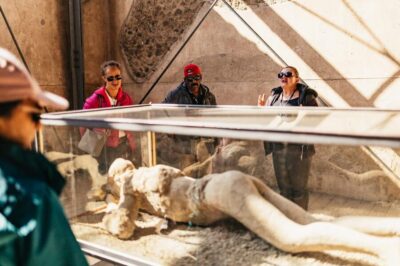
Pompeii and Mt. Vesuvius with Lunch and Wine Tasting
Read our review →
Archaeological Park Tour with Ticket on request
Read our review →