
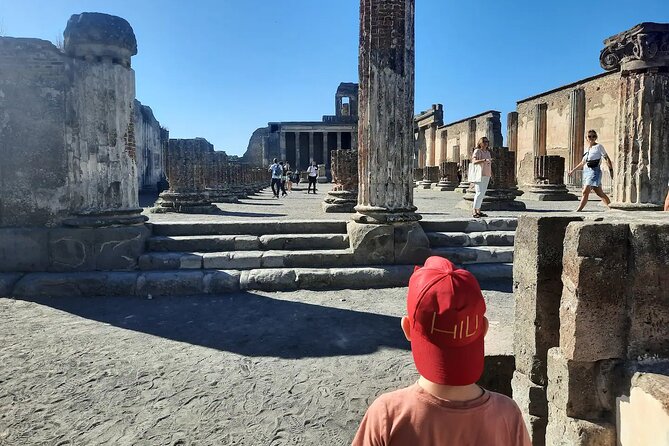
Reviewed · POMPEII TOURS
Pompeii: Exclusive Private Walking Tour with an Archaeologist
Pompeii can feel like a blur if you wander on your own. This tour is interesting because it gives you a focused route through some of the most telling parts of the city, explained by a real archaeologist, not just a general guide.
I love the way the itinerary balances big-picture places with eye-level details, from luxury homes to public life. I also like the private group setup, up to 12 people, which keeps the pace human and the questions flowing, and guides named Clelia, Ines, Leonardo, Lello, Paolo, and Lilo have been praised for making ruins feel readable. The one drawback to plan around: Pompeii entry tickets are not included, and one review also flagged meeting-point confusion, so you’ll want to confirm you’re at Coffee Shop Vittoria at Via Mare.
What You’re Really Buying: A Pompeii Archaeology Walk in 2 Hours
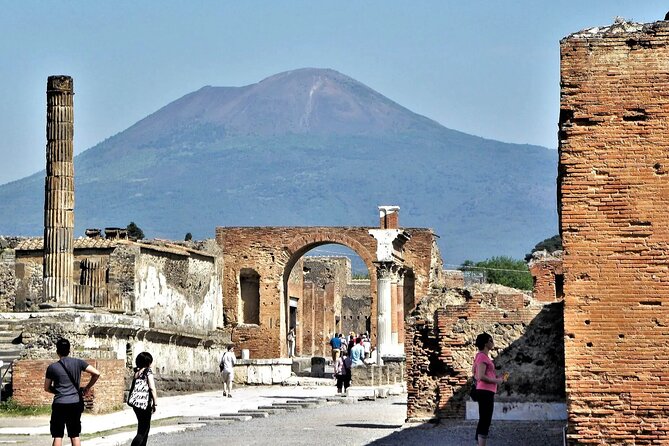
At about 2 hours, you are not trying to see all of Pompeii. You are trying to understand it. That is the key value here. Instead of marching through random streets, you follow a route that touches: wealth and domestic luxury, public baths, social life, and civic space. It’s the kind of path that helps you stop seeing Pompeii as a pile of stones and start reading it like a city.
This is an exclusive private tour for your group only, up to 12 people, and it’s offered in English. You also get a mobile ticket, which is usually one less thing to juggle once you’re in town. The small time window means you should arrive ready to walk and listen, because you will not have time to linger for long on your own at each stop.
The Start Point Matters: Coffee Shop Vittoria and Getting Oriented Fast
Your meeting point is Coffee Shop Vittoria, Via Mare, 80045 Pompei NA, Italy, and the tour ends back there. That round-trip matters because Pompeii is big, and even small delays can chew up your two hours.
Here’s my practical advice. Before you leave, save the meeting address in Google Maps, and aim to arrive early enough to spot your guide. One review mentioned difficulty finding the guide because the name of the company and the meeting spot didn’t match the message, so take that seriously even if it isn’t typical. If you’re arriving by train, it can still be fairly easy to connect at the meeting point, but don’t treat that “easy” part as automatic. Get there on time, then relax.
More Pompeii tours to compare:
- Pompeii: Entry Ticket and Guided Tour with an Archaeologist
★ 4.8 · 19,459 reviews - Pompeii: Entry Ticket with Optional Audio Guide
★ 4.2 · 12,360 reviews - Pompeii: Small Group Tour with an Archaeologist
★ 4.8 · 12,264 reviews
Tickets and Entry: What’s Included, What’s Not, and What to Expect at the Gate
The tour includes the archaeologist-led guidance and the private experience, but it does not include the entry ticket to the archaeological area. That means you should plan to buy your Pompeii admission separately.
A useful detail: the itinerary lists each stop with admission noted as free. In practice, that often means you can visit those areas without extra per-site fees beyond your main entry. Still, don’t assume anything at the ticket booth. Bring your entry confirmation, and make sure your Pompeii admission is active for the day you booked.
If you want the best day, do this in advance:
- Buy Pompeii entry so you are not stuck waiting.
- Keep your phone screen ready for the mobile ticket for the tour itself.
Casa del Menandro: Pompeii’s Luxury House to Set the Tone
You start at Casa del Menandro, often described as one of Pompeii’s richest homes in architecture, decoration, and the objects found inside. This stop is large, about 1,800 square metres, covering most of its insula. In plain terms, it’s a shortcut to seeing how wealthy Pompeii households lived, ate, worked, and displayed status.
A good archaeologist guide makes this stop work because it’s not just pretty walls. You’ll likely get help reading the layout and understanding why certain parts mattered more than others, like how rooms connected around courtyards and how decoration signaled wealth. The time here is about 20 minutes, so you won’t get a museum-style tour of everything. What you get instead is a strong foundation you can apply to later stops.
One caution: luxury houses can tempt you to stare straight ahead at the most obvious sights. Try to also look for how the space is organized. That’s where the “city” lesson starts to click.
Stabian Baths (Terme Stabiane): The Oldest Big Public Bath Complex
Next is the Stabian Baths, the oldest and largest of Pompeii’s public bath complexes, with original construction dating to around 125 BC. This matters because baths were one of the most important daily social hubs in Roman life. People didn’t just wash. They met, talked, waited, relaxed, and did a lot of their public interacting in and around the bathing routines.
With about 20 minutes here, your guide’s job is to translate stone into routine. You should expect an explanation of what different rooms were for, how people moved through the bathing process, and why public architecture like this mattered in a city that was anything but private.
The main limitation is time. Baths are complex, and if you try to “self-guide” it all in 20 minutes, you’ll miss the story. With the archaeologist leading you, you should get the functional overview fast, so you can walk away with a mental map instead of just photos.
More walking tours in Pompeii:
- Pompeii: Guided Walking Tour with Entrance Ticket
★ 4.3 · 1,423 reviews - Discover Pompeii: French Walking Tour of the Buried City
★ 4.8 · 253 reviews - Pompeii 3 Hours Walking Tour Led by an Archaeologist
★ 5.0 · 126 reviews - Pompeii: Highlights Guided Walking Tour
★ 4.6 · 105 reviews
Lupanar: The Brothel and the Power of Context
Then comes the Lupanar, Pompeii’s famous brothel, with special attention to erotic paintings on its walls. This stop can be uncomfortable for some people, but it’s also a serious historical source. It shows you how Pompeii handled commerce, sexuality, and street-level advertising within a real neighborhood context.
What makes this stop worthwhile is context. An archaeologist guide helps you read the imagery and the space without turning it into sensational entertainment. You get about 30 minutes here, which is longer than some of the other stops, suggesting it’s meant to be given some interpretive time, not just a quick photo stop.
My tip: treat this as a window into how ordinary people interacted with taboo subjects in public settings. If you come in expecting scandal only, you’ll miss the urban and social lesson.
Casa del Fauno: Hellenistic Luxury and the Meaning of Space
After that, you hit Casa del Fauno (House of the Faun), a grand Hellenistic palace originally constructed in the 2nd century BC during the Samnite period around 180 BC. It’s framed by a peristyle, meaning a surrounding colonnaded courtyard that helped structure the flow of the home.
This stop is about 20 minutes, which is enough for you to understand the big idea: wealthy Roman-period domestic life wasn’t just about bedrooms. It was about public-style display through courtyards, views, and architectural rhythm.
When a guide points out how the peristyle shapes movement and social visibility, the house stops feeling like “ruins” and starts feeling like an engine of daily life. That is also where the earlier Menandro luxury stop pays off, because you can compare domestic wealth at two different levels and understand what Pompeii households chose to emphasize.
Teatro Grande: Why Pompeii’s Big Theatre Still Feels Impressive
You then arrive at Teatro Grande, the biggest theatre in Pompeii. Even with quick timing at about 10 minutes, this is one of those places where scale hits you immediately. The theatre connects Pompeii’s private life to public culture. It’s where city events, performance, and civic gatherings would have mattered.
A good guide will likely point out seating design and the way the theatre shapes sightlines and movement. With only 10 minutes, you should focus on two questions:
1) How does it control viewing?
2) How does it bring people together?
If you can answer those on your walk out, you’ve gotten value even from a short stop.
Via dell’Abbondanza: The Best-Preserved Street for Reading Daily Life
Next is Via dell’Abbondanza, described as the best preserved street in Pompeii. This one is short too, about 10 minutes, but it’s a smart choice. Streets are how a city “speaks.” The paving, the storefront rhythm, and the way buildings open toward the walk help you imagine daily movement.
Think of it like punctuation. After you’ve seen houses, baths, and civic structures, the street acts as the glue. You start to understand that Pompeii wasn’t just a collection of famous sites. It was a place where people walked, traded, and socialized on connected routes.
Foro de Pompeya: The City’s Most Important Square
Finally, you end at the Foro de Pompeya, the most important square of the city. This is about 10 minutes, but it’s a powerful capstone because forums were the heart of public identity. This is where civic life became visible.
If you get even a basic explanation of how the forum functioned as a stage for politics, public announcements, and social gatherings, you’ll understand why an archaeologist route often ends here. It gives you a feeling for the city’s priorities, not just its buildings.
Why the Right Guide Changes Everything (And What to Look For)
Pompeii is the kind of place where a guide can either point at stones or explain how the pieces fit. In the strongest versions of this tour, guides have been praised for humor, clarity, and making the past feel usable. Names that came up include Clelia and Ines, plus guides like Leonardo, Lello, Paolo, and Lilo.
That matters because this route is tight. If your guide is strong, you’ll leave with:
- A sense of how wealthy homes were organized
- How Roman baths worked as public social space
- Why the Lupanar is best understood through context
- How the theatre and forum tie the city together
One review also mentioned an express-style pass that helped manage crowds. That’s not something I would assume will happen every time, but it’s a reminder that a good guide can help you avoid some frustration.
Your best move is simple: ask one question at the first stop. If the archaeologist can answer it in a way that helps you see the rest of the city, you’re set.
Price and Value: $421.03 Per Group, Up to 12 People
The price is $421.03 per group, for up to 12 people, for about 2 hours. That’s not “cheap” if you’re traveling solo. But it can be good value once you spread it across a group.
Here’s the math that helps. If you hit the max of 12 people, you’re roughly looking at about $35 per person for guided time, though your exact per-person cost depends on your group size. Even if you’re fewer, private archaeologist time can still be worth it because Pompeii entry lines and confusion cost time, and this tour is designed to make that time count.
Also, the “what you get” matters. You’re paying for interpretation, not just movement. In Pompeii, a strong explanation can make the difference between collecting photos and actually understanding what you’re seeing.
Who Should Book This Private Pompeii Tour?
This is a great fit if you:
- Want a guided route that makes Pompeii feel legible in a short time
- Like archaeological context more than just top-10 sights
- Travel with family or older teens who can handle steady walking and explanations
- Prefer private pacing over crowded group tours
It might be less ideal if you:
- Want to roam slowly and spend long periods photographing one spot
- Expect the ticket purchase to be fully handled for you, because entry to the archaeological area is not included
- Are prone to getting flustered about finding meeting points quickly, since one account flagged confusion
Should You Book It? My Practical Take
Yes, you should consider booking this tour if your goal is understanding, not just ticking off landmarks. The archaeologist-led format and the tight, city-reading route are exactly what you want if you have limited time and you’d like Pompeii to make sense fast.
Do it especially if you’ll be going as a couple, small family, or small group, because the group pricing improves the value. If you’re the type who likes a plan, and then uses that plan to explore on your own afterward, you’ll likely get more out of Pompeii beyond the two hours.
Just don’t underestimate the planning basics: secure Pompeii entry yourself, and arrive at Coffee Shop Vittoria on time so the start is smooth.
FAQ
How long is the private Pompeii tour with an archaeologist?
It runs for about 2 hours.
Is this tour private, and what’s the maximum group size?
Yes, it’s private, and it’s designed for your group only, up to 12 people.
Do I need an entry ticket to Pompeii?
Yes. Entry ticket to Pompeii is not included.
What language is the tour offered in, and do I get a mobile ticket?
The tour is offered in English, and you receive a mobile ticket.
Where is the meeting point, and where does the tour end?
You meet at Coffee Shop Vittoria, Via Mare, 80045 Pompei NA, Italy, and the tour ends back at the meeting point.
What is the cancellation policy?
It has free cancellation, and you can cancel up to 24 hours in advance for a full refund. If it’s canceled because a minimum number of travelers isn’t met, you’ll be offered a different date/experience or a full refund.
Recently reviewed around Pompeii
- Mt. Vesuvius Wine Tasting and Lunch Experience from Pompeii★ 4.5 · 20 reviews
- Pompeii Small Group with an Archaeologist and Skip The Line★ 5.0 · 121 reviews
- Pompeii from Afternoon to Sunset★ 5.0 · 108 reviews
- Private Guided Tour and VR Headsets in the Ancient Pompeii★ 5.0 · 3 reviews
- Visit Pompeii with a local expert guide★ 5.0 · 10 reviews
- Traditional Neapolitan Dinner in Pompei – Villa Franca – Family Restourant★ 5.0 · 8 reviews
- Discover Pompeii on this Guided Walking Tour of the Buried City★ 4.0 · 9 reviews
- 2 Hours Private Walking Tour in Pompeii with an Archaeologist★ 5.0 · 15 reviews
Pompeii Tours, compared.
Entry Ticket and Guided Tour with an Archaeologist
Read our review →

Pompeii Small Group Tour with an Archaeologist
Read our review →
Skip-the-Line Entrance Ticket with Audio Guide
Read our review →
Pompeii and Mt. Vesuvius with Lunch and Wine Tasting
Read our review →
Archaeological Park Tour with Ticket on request
Read our review →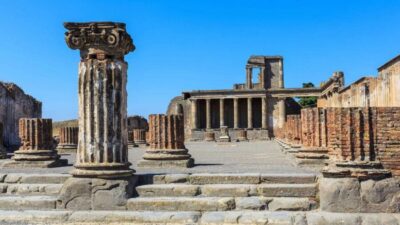
Browse the lists this tour appears in