
Reviewed · HERCULANEUM TOURS
Pompeii and Herculaneum small group tour – skip the line
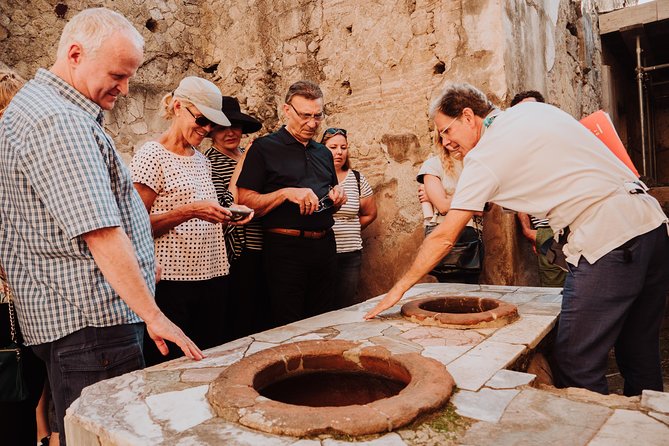
If you want two UNESCO World Heritage sites in one day, this Pompeii and Herculaneum small-group tour is a smart way to do it. You start in Pompeii with skip-the-line entry, then you transfer by train to Herculaneum, where the ruins feel calmer and easier to absorb.
I like how the day is built like a guided route, not a loose wander. In Pompeii, the stops are set up around real daily-life anchors like the Foro, major houses, and the big theaters, and guides such as Amadeau, Vince, Sergio, Paulo, and Diego bring that history to street level fast. The pacing also stays question-friendly, which matters in places where you might otherwise feel rushed.
One possible drawback: it is a long day with lots of walking on uneven ground. And based on real on-the-ground feedback, it is not stroller friendly, so if you need low-impact touring, you may have to rethink this format.
Key things to know before you go
- Skip-the-line entry in Pompeii and Herculaneum means less waiting and more time seeing
- Small group size (max 20) helps you ask questions and keeps the guide focused on your pace
- Pompeii route hits the big social spots: forum areas, thermal spaces, houses, and theaters
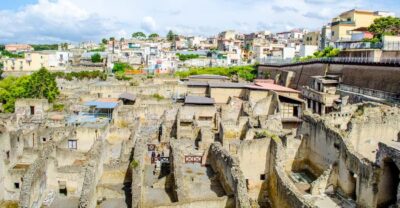
- Herculaneum feels more readable because the sites are less crowded and the houses highlight domestic life
- Train transfer via Circumvesuviana saves time versus juggling buses for both ruins
- Bring water and plan for bathroom breaks because the day runs long and the walkways are not smooth
A smart two-site day plan, Pompeii first then Herculaneum
This tour works because it respects how tiring Pompeii can be. You go in with a plan, not a map fantasy. Pompeii gets your attention first with major public spaces and showpiece homes, then you shift to Herculaneum after a train ride. That order matters because Pompeii’s scale can overwhelm you early, while Herculaneum later feels more human-sized.
I also like that you are not stuck arranging every moving piece. The tour includes one-way Circumvesuviana train tickets from Pompeii to Herculaneum and guidance throughout the whole day. You still need to handle your own return to Sorrento or Naples after the tour, but you avoid the headache of figuring out the in-between.
At $119.85 per person for roughly 5.5 hours, this is not a bargain, but it also is not overpriced for what you get. You are paying for a small group, a guide for the full run, skip-the-line access, and covered ground at both sites. If you would otherwise buy tickets and fight crowds on your own, the value starts to look more like a convenience fee that buys you time and clarity.
More Herculaneum tours to compare:
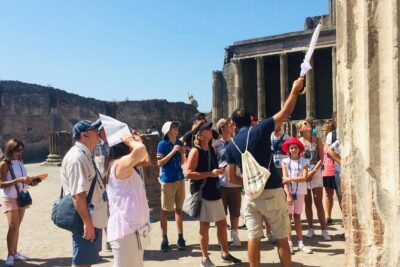
- Pompeii and Herculaneum Small Group Tour with an Archaeologist
★ 5.0 · 1,350 reviews - Pompeii: Small-Group Tour of Pompeii and Herculaneum
★ 4.8 · 867 reviews - Guided Day Tour of Pompeii and Herculaneum with Light Lunch
★ 4.5 · 311 reviews
Where the tour starts in Pompeii: Porta Marina Superiore and a guided storyline
Your Pompeii day begins at the main entrance called Porta Marina Superiore. The guide meets the group there holding an Askos Tours sign, which is useful when you arrive and instantly want your brain to switch from travel mode to museum mode.
Pompeii is chaotic if you go solo. Streets intersect, viewpoints change every few minutes, and it is easy to miss how the city worked. A good guide helps you connect dots, like how the forum connects commerce, civic power, and daily errands. On this tour, the route is structured so you see those connective hubs early.
Most stops are around 10 minutes, with the Teatro Grande a bit longer. That short, focused structure is great for keeping energy up, especially in heat. The tradeoff is that you will not linger forever at every wall. If you like slow soaking, you might want to budget a separate solo hour or two later.
Basilica stop: thinking about shelter, trade, and the rhythms of the day
One of the earliest stops is the Basilica. In Roman towns, a basilica was not just religious, it was civic and commercial. This one is described as an open portico that offered shelter to merchants and other activities. That detail helps you stop imagining Pompeii like a movie set and start picturing it as a place where people moved through daily business.
This is also one of those moments where a guide can make you notice things you would otherwise walk right past. Even a basic understanding of how Romans used covered spaces changes how you read the architecture.
Drawback to keep in mind: if you are coming right off a long travel day and you feel low energy, these early stops can still feel fast. The upside is that the guide’s job is to keep you oriented, and in the reviews, that orientation is repeatedly praised.
Foro di Pompeya and the main square: the city’s social center
The route swings into the Foro for a look at Pompeii’s main square. This is where the city’s public life would have happened. You get a feel for the scale and the “who mattered” part of urban planning.
From there, you move along the central street, and it starts to click why Pompeii is so famous. The layout shows how ordinary people lived beside political and economic institutions. You see why the forum areas matter for understanding the whole city, not just single monuments.
More Pompeii tours to compare:
- Pompeii: Entry Ticket and Guided Tour with an Archaeologist
★ 4.8 · 19,459 reviews - Pompeii: Entry Ticket with Optional Audio Guide
★ 4.2 · 12,360 reviews - Pompeii: Small Group Tour with an Archaeologist
★ 4.8 · 12,264 reviews - Pompeii Small Group Tour with an Archaeologist
★ 5.0 · 6,593 reviews
Casa del Menandro: a rich home as a window into everyday taste
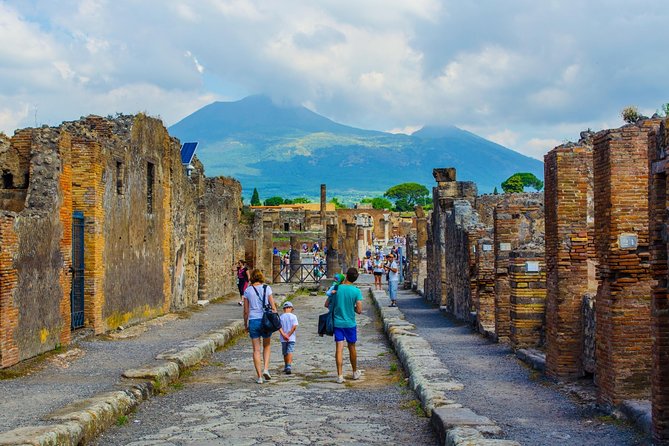
Next up is the Casa del Menandro. This house is noted as one of the richest in Pompeii, with impressive architecture, decoration, and contents. Even if you are not an art person, houses like this help you grasp social status. In Pompeii, decoration was not only about beauty, it was also about signaling.
A guided stop helps you interpret what you are seeing. Instead of only admiring floors or fresco fragments, you learn what the objects and layout likely meant in daily life. If you want a straightforward way to understand Roman “home life,” this is a strong stop type.
Granai del Foro and the striking museum-like display of casts
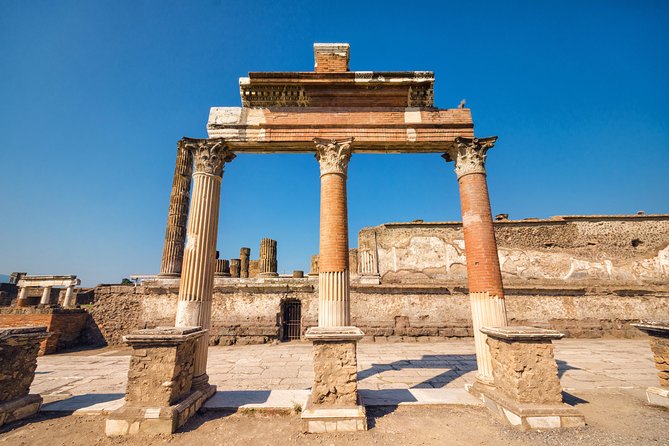
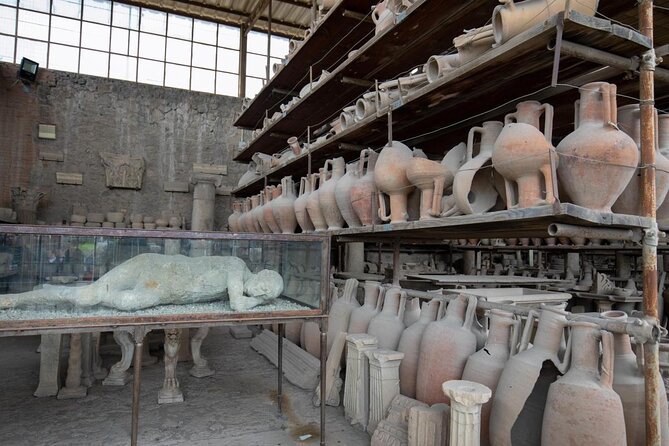
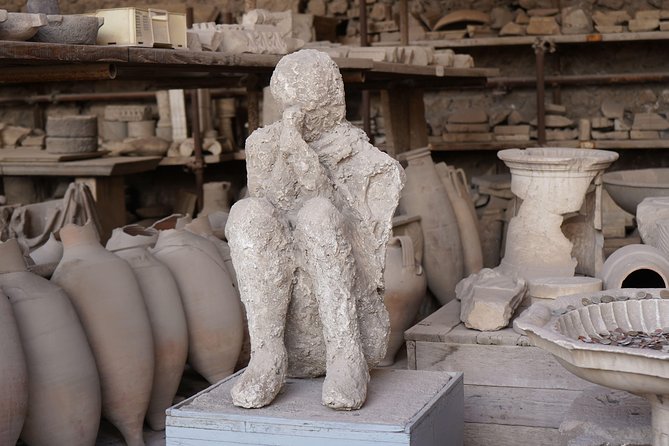
At the Granai del Foro, you get a mix of function and tragedy. The description mentions marble tables and baths for fountains at entrances of houses. It also notes casts of victims of the eruption, plus casts of a dog and a tree.
This is an intense stop, and the pace matters. A short visit is enough to absorb the shock without turning your whole day into a somber blur. It is also a reminder that Pompeii is not just “old ruins,” it is a snapshot of people caught mid-life.
Bring a steady mindset here. You might feel pulled between curiosity and discomfort. A good guide helps you keep respect and still learn.
Terme del Foro and thermal life: the oldest thermal complex vibe
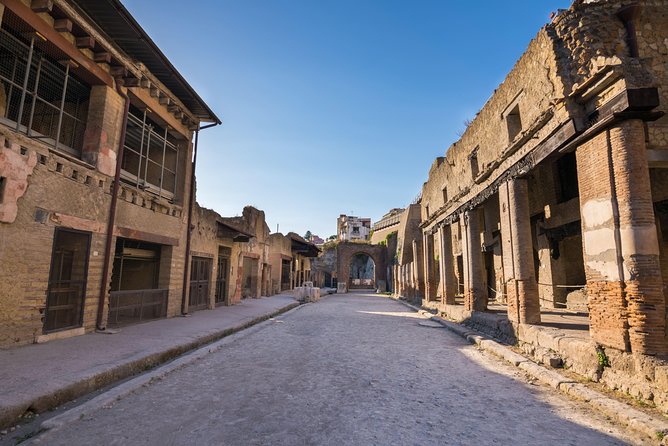
Then you hit the Terme del Foro, a vast thermal area. The tour description says these baths represent the oldest thermal complex in the city. That matters, because it places Pompeii’s daily routines in a long timeline, not just the final moment of the eruption.
If you ever wonder what Romans did besides politics and warfare, baths are your answer. They were social spaces as much as hygiene spaces. A guided walkthrough can help you imagine how people met, relaxed, and traded stories.
Pompeii’s brothel lane: sexuality, commerce, and social taboos
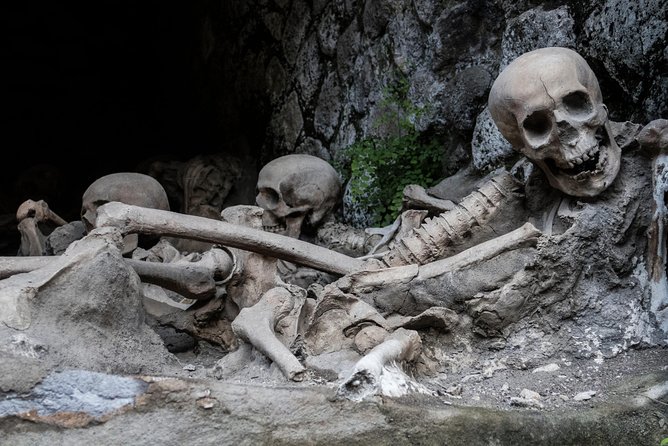
The itinerary includes a look at the most famous brothel in Pompeii. This kind of stop can surprise you because it forces you to confront Roman reality without modern filters.
It is presented as part of the city’s street life, not as a shock value carnival. Still, it is not a comfortable topic for everyone. If you prefer to keep your day light, you may want to steel yourself, or just remember that it is part of how the city functioned.
Casa del Fauno, Teatro Piccolo, and Teatro Grande: private grandeur meets public spectacle
The tour continues with the Casa del Fauno, one of the largest and most impressive private residences in Pompeii. This house helps you compare with Menander. Both are impressive, but they give you different flavors of elite life.
Then you move toward theater spaces, starting with a look at the Teatro Piccolo and then the Teatro Grande, which gets about 15 minutes. Pompeii’s theaters help you understand how public entertainment worked and why architecture mattered for crowds.
This is also where the guide’s delivery really matters. In reviews, guides repeatedly get credit for making the sites feel alive and not like textbook pages. When the guide connects theater design with how people would have used it, your visit gets easier.
Herculaneum by train: Circumvesuviana and a built-in breather
After Pompeii, you transfer to Herculaneum by train. The description says the ride is about 30 minutes, plus about 10 minutes walking to the ruins meeting point at the ticket office.
This is one of the practical wins of the tour. Doing Pompeii and Herculaneum back-to-back is a lot of time on your feet. Taking the train reduces the logistics stress, and the walking buffer is realistic.
There is also time for a quick lunch break if you want it. Meals and personal expenses are not included, but the tour time gives you a chance to grab something before you dive back into ruins. One review notes an air-conditioned mall stop for lunch time, which is exactly the kind of sanity saver you want in hot weather.
Casa dei Cervi and named houses: why labels help you remember
Herculaneum’s stops include several houses, and many of them are identified by what was found there. The Casa dei Cervi gets its name from marble statues of stags or deer in the peristyle.
This kind of naming is helpful, because it gives your brain a handle. You will probably see a lot of flooring patterns and fresco fragments, and names tied to specific finds help you sort what you saw later.
La Terrazza di M. Nonio Balbo, the College of the Augustales, and civic identity
Next comes the La Terrazza di M. Nonio Balbo. The provided description repeats the stags or deer note, but the takeaway for you is that the tour is organizing houses by their distinctive features rather than wandering randomly.
Then you visit the College of the Augustales. While the details in the tour description are brief here, this stop type is about community and organized life, not just private comfort.
Casa del Rilievo di Telefo: unusual access and the structure of neighborhoods
The Casa del Rilievo di Telefo is described as possibly belonging to a leading benefactor, Marcus Nonius Balbus. It is also described as unusual because it has private access to the adjoining Suburban Thermae to the south.
This stop is valuable because it shows how connected the elite and daily life could be. You are not just seeing a home, you are seeing how a neighborhood functioned and how leisure spaces might be shared or controlled.
Partem Domus lignea and the wooden partition idea
One of the more intriguing Herculaneum stops is Partem Domus lignea, the Casa del Tramezzo di Legno. The tour description calls it important for the elegant wooden partition that remained.
Even when you only spend about 10 minutes here, it can change your entire impression of Herculaneum. Pompeii is famous for its plaster and stone, but Herculaneum also shows how materials were preserved in a way that lets you picture the original rooms more vividly.
House of the Skeleton and what that name signals
The House of the Skeleton gets its name from human remains found in a second floor room. Again, it is a reminder that these are not set pieces. People lived here, and the evidence you see is tied to that fact.
A guided stop helps you keep the moment respectful while still learning what the discovery meant for archaeology and reconstruction.
Central Thermae: separate entrances, separate spaces
The Central Thermae stop gives you a strong “how did they live” moment. These baths date to around the beginning of the 1st century AD and are described as divided into men’s and women’s baths with separate entrances.
That detail helps you understand Roman bathing culture beyond “everyone went to the baths.” It hints at social order, routine, and how spaces were organized to match norms.
Casa del Salone Nero: carbonised door remains as a standout
The Casa del Salone Nero is described as one of Herculaneum’s more luxurious mansions, with a monumental entrance that still retains the carbonised remains of the doorposts and lintel.
That is the kind of visual proof that makes ruins feel personal. It is not just a wall, it is a burned trace of a moment. If you have any interest in how preservation can reveal details, this is worth paying attention to.
Casa Sannitica, Casa del Bel Cortile, and the variety of layouts
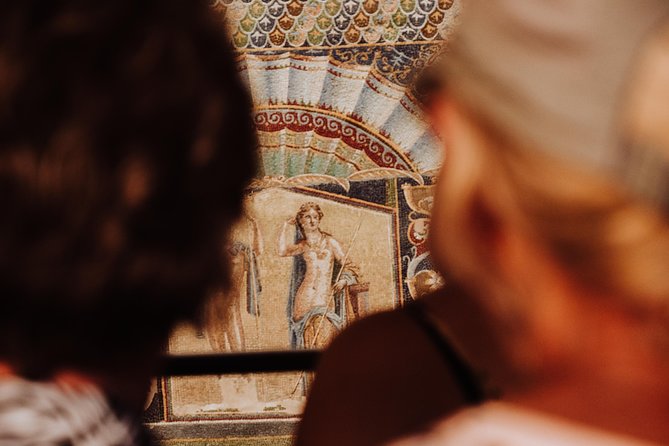
The tour moves through more houses with different styles. Casa Sannitica is described as typical of the Samnites, with an atrium and rooms decorated with frescoes. Casa del Bel Cortile is described as one of Herculaneum’s most original houses, with a courtyard, a stairway, and a stone balcony instead of an atrium.
The value here is variety. If your mental image of Roman houses is one template, these stops show you how different households adapted design to their priorities and available space.
House of the Grand Portal: charcoal traces and street-level drama
Finally, you visit the House of the Grand Portal. The description highlights collonnati, frescoes, and charred remains of wooden parts. You also get that sense that Herculaneum’s preservation can show damage in a way that Pompeii sometimes does not.
If you are the type who likes texture and detail, this stop can be a strong closing moment.
Pace, comfort, and your best prep tips
This is a high-output tour. In Pompeii and Herculaneum, you will move through many locations, often with quick time blocks per stop. That pacing is part of the appeal because you see a lot without getting stuck in any one place too long.
But you should prepare for the physical side:
- Bring water and actually drink it. One review suggests filling your water bottle at a Roman water spring, which can be a fun on-site perk if timing lines up.
- Use the toilet before you start. Once you are in a run of ruins, breaks are not built the way they are in a museum.
- Skip the stroller. Reviews say it is lots of uneven walking and not stroller friendly, with an expectation that you will end up carrying your child anyway.
Mobility is the other factor. One review notes it might be a problem for someone mobility impaired. If that describes you, you may want a more minimal route or a different tour style.
Also consider how you leave Herculaneum after the tour. One review notes the train station is about a 10 minute walk uphill from the exit area and that the station was under renovation in Sept 2025. That means you should follow posted signs and leave extra time if you are connecting onward during construction or strikes.
Guides and what makes the experience feel worth it
The strongest praise in the feedback is about the guide. Names like Amadeau, Vince, Sergio, Paulo, Vincenzo, and Diego come up with the same core theme: organization plus explanations that make you understand what you are seeing.
One review calls out Sergio as an archaeologist who works on the site. Even if you do not remember every detail, that kind of guide style tends to mean you get grounded answers, not vague history speeches.
Another repeated note is that guides keep the group feeling cared for, even when weather turns. One review mentions rain, and the guide handled it thoughtfully for kids and older adults alike.
If you value story and context, not just photos, this is where the money goes.
Should you book this Pompeii and Herculaneum small group tour?
Book it if:
- You want both UNESCO sites in one day without handling tickets and logistics on your own
- You like guided structure, especially in Pompeii where it is easy to get lost
- You want a small group and a guide who can answer questions
- You can handle lots of walking and uneven ground
Skip it or choose a different style if:
- You need a low-walking, low-stair plan
- You are traveling with a stroller and cannot do the carry-the-stroller reality
- You prefer long solo time at a few places over quick hits across many stops
For most people, this is a strong value because you are paying for clarity. You get the skip-the-line advantage, a train transfer that keeps the day moving, and a route that hits Pompeii’s public life and private houses before shifting to Herculaneum’s preserved domestic spaces. It is a long day, but it is also a very efficient one.
Recently reviewed around Pompeii
- Mt. Vesuvius Wine Tasting and Lunch Experience from Pompeii★ 4.5 · 20 reviews
- Pompeii Small Group with an Archaeologist and Skip The Line★ 5.0 · 121 reviews
- Pompeii from Afternoon to Sunset★ 5.0 · 108 reviews
- Private Guided Tour and VR Headsets in the Ancient Pompeii★ 5.0 · 3 reviews
- Visit Pompeii with a local expert guide★ 5.0 · 10 reviews
- Traditional Neapolitan Dinner in Pompei – Villa Franca – Family Restourant★ 5.0 · 8 reviews
- Discover Pompeii on this Guided Walking Tour of the Buried City★ 4.0 · 9 reviews
- 2 Hours Private Walking Tour in Pompeii with an Archaeologist★ 5.0 · 15 reviews
Herculaneum Tours, compared.
Pompeii and Herculaneum Small Group Tour with an Archaeologist
Read our review →
Herculaneum Entry Ticket with Optional Audio Guide
Read our review →
Herculaneum: 3D Walking Tour with Skip-the-Line Ticket
Read our review →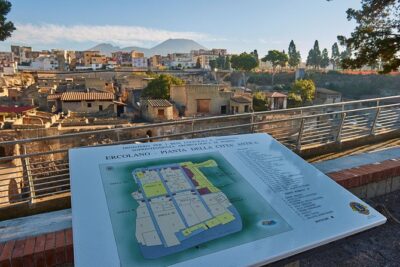
Guided Day Tour of Pompeii and Herculaneum with Light Lunch
Read our review →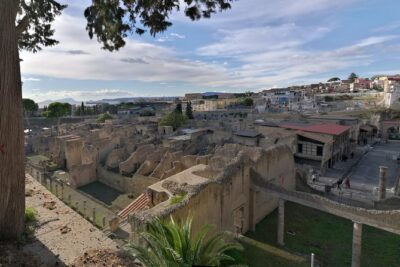
Private Day Tour to Vesuvius, Herculaneum & Pompeii with Pick Up
Read our review →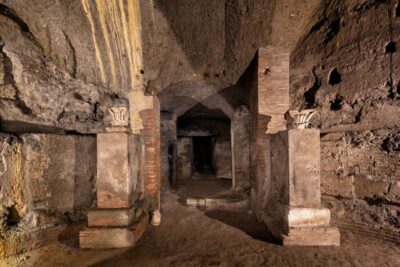

Herculaneum: Skip The Line Entrance ticket + Audioguide
Read our review →Browse the lists this tour appears in