
Reviewed · HERCULANEUM TOURS
Pompeii and Herculaneum Small Group Tour with an Archaeologist
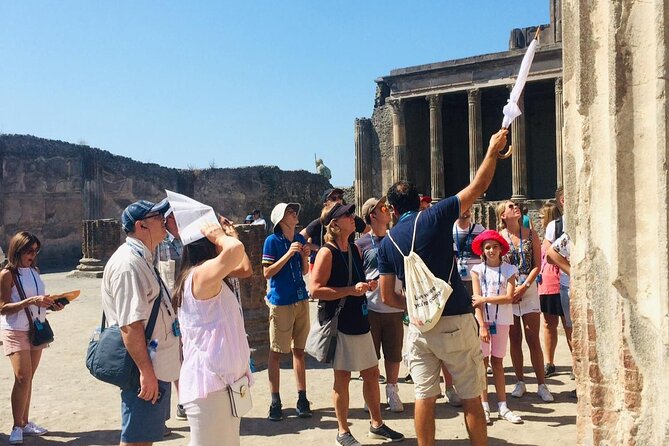
What makes this tour worth your attention is the way it stacks Pompeii and Herculaneum in one day, guided by an archaeologist so you are not just staring at stones. I really like two things: the small group size (max 20) keeps the day human, and you get skip-the-line entry with headsets so you can actually hear the story as you walk. The main thing to consider is pacing, especially in Pompeii, which is huge, so you will see the highlights rather than roam every corner.
In plain terms, this is a well-run “big hits” day. You start with major Pompeii landmarks, take a break for lunch on your own, then move to Herculaneum where the preservation makes it feel like the city is paused mid-life. If you are the type who wants slow wandering, you may feel a bit rushed when the schedule moves on fast.
Key highlights worth planning around
- Archaeologist-led storytelling in both sites, not just a walk-through
- Skip-the-line entry plus headsets so you can keep pace without losing the guide
- Smart transport between sites, minibus for some departures, Circumvesuviana train for the Pompeii start option
- Herculaneum’s preservation advantage, especially the houses and thermal areas that look shockingly intact
- Iconic Pompeii stops like the Stabian Baths, the Lupanar, and the House of the Faun
Pompeii and Herculaneum in One Day, the smart pairing
Pompeii and Herculaneum are often sold as siblings, but they feel different under your feet. Pompeii is the big, loud showpiece, with major public squares and big-name attractions like theatres and baths. Herculaneum is smaller and more intact, so it clicks into place faster when you are thinking about daily life, food, work, and home routines.
This tour’s layout helps you get both moods without trying to figure out transport and ticketing on your own. You do a guided stretch in Pompeii first, then you connect to Herculaneum with support included. That second part matters. The train transfer for the Pompeii start option is part of the package, and the minibus transfer is handled for the Naples, Rome, and Sorrento options.
If you have limited time in the area, it is a practical way to build a real mental map of what the eruption changed. And because you are guided, the ruins stop feeling random.
More Herculaneum tours to compare:
- Pompeii: Small-Group Tour of Pompeii and Herculaneum
★ 4.8 · 867 reviews - Guided Day Tour of Pompeii and Herculaneum with Light Lunch
★ 4.5 · 311 reviews - Private Day Tour to Vesuvius, Herculaneum & Pompeii with Pick Up
★ 5.0 · 279 reviews
Price and what you actually get for about $77
At about $77.09 per person, the price looks like a “deal” until you break down what is included. This is not just a tour guide walking beside you. You also get:
- Admission tickets for both Pompeii and Herculaneum included
- Guided tour service in both sites
- Headsets for all participants
- Transportation support: round-trip transfers for Naples and Sorrento options, and train plus transport for Rome travelers
- For the Pompeii start option, a one-way Circumvesuviana train ticket from Pompeii to Herculaneum
That means you are paying for a full day of logistics, not just narration. The entry fees mentioned for the ruins in the fine print give you a clue about why this works financially. Herculaneum is listed at 16 euros for adults (and a reduced rate for EU citizens ages 18 to 25), and Pompeii is listed at 20 euros for adults. When you put it all together with transport and guide time, you are paying for convenience plus interpretation.
The value really depends on your priorities. If you want the highlights with an archaeologist and you do not want to wrestle with timing and lines, this price can feel like a win.
How the small group and headsets change the day
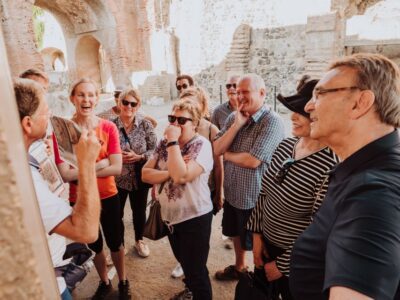
This is capped at a maximum of 20 travelers, which is the sweet spot. Big enough for energy, small enough that you can ask questions and not feel like you are in a school hallway during passing period.
You also get headsets for all participants. That might sound like a minor detail, but it changes everything when you are visiting places with crowds, uneven paths, and constant background noise. It lets the guide keep momentum while you keep up with the explanation, even when you are stopping at a wall painting, a floor mosaic, or an architectural detail.
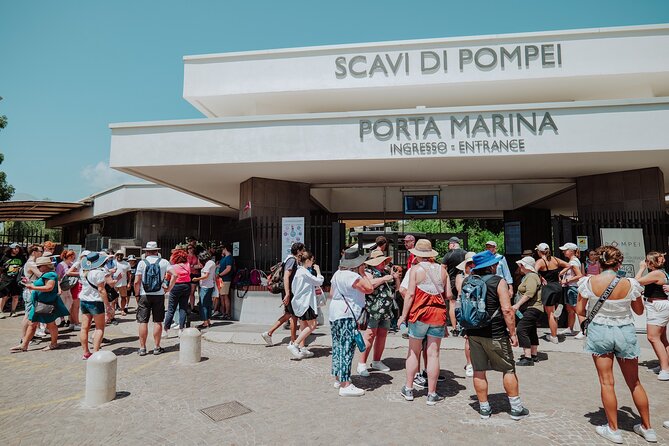
One more practical note: the tour runs in English, and the meeting point depends on your departure option. Pompeii starts at Porta Marina Superiore. Naples and Rome start at Starhotels Terminus. Sorrento starts at Piazza Angelina Lauro. Show up a little early, because the day moves from stop to stop with purpose.
Pompeii highlights: from the Basilica portico to Teatro Grande
Pompeii is huge, so the guide focuses on the landmarks that teach you how the city worked. The stops are short, often around 10 to 15 minutes, so you get a fast education in the big systems.
More Pompeii tours to compare:
- Pompeii: Entry Ticket and Guided Tour with an Archaeologist
★ 4.8 · 19,459 reviews - Pompeii: Entry Ticket with Optional Audio Guide
★ 4.2 · 12,360 reviews - Pompeii: Small Group Tour with an Archaeologist
★ 4.8 · 12,264 reviews - Pompeii Small Group Tour with an Archaeologist
★ 5.0 · 6,593 reviews
Basilica, where merchants sheltered
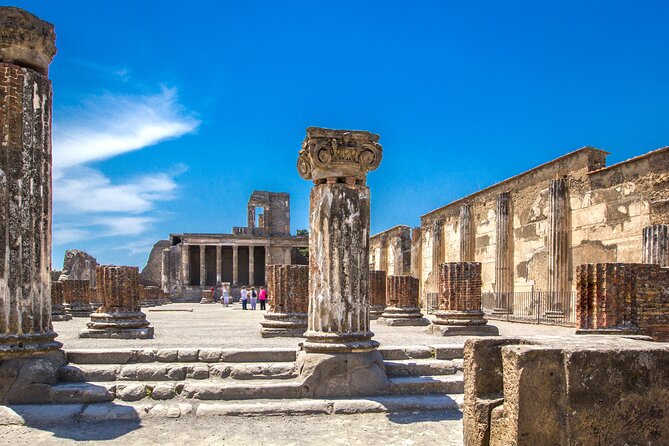
You start at a portico area called Basilica, basically a covered space where merchants and other activity took place. It is not just “a building.” It is a lesson in the city’s public rhythm: you meet, trade, wait out weather, and conduct business in the same kind of space.
Drawback to know: a quick stop here works for getting oriented, but it will not satisfy if you want to linger over inscriptions and floor patterns for a long time.
Foro de Pompeya, the city’s main square
Next is the Forum, Pompeii’s central square. This is where “what happened in everyday life” starts to feel real. You are stepping into the public stage: political life, commerce, announcements, and gatherings.
House of Menander, luxury as a teaching tool
You then hit the House of Menander, one of the richer residences. The focus here is architecture, decoration, and the contents. This is where you start seeing Pompeii not just as ruins, but as homes built to impress visitors and signal status.
Granaries of the Forum, plus casts tied to the eruption
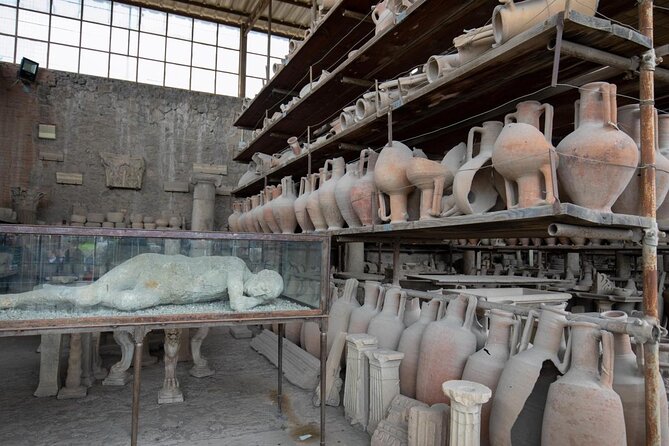
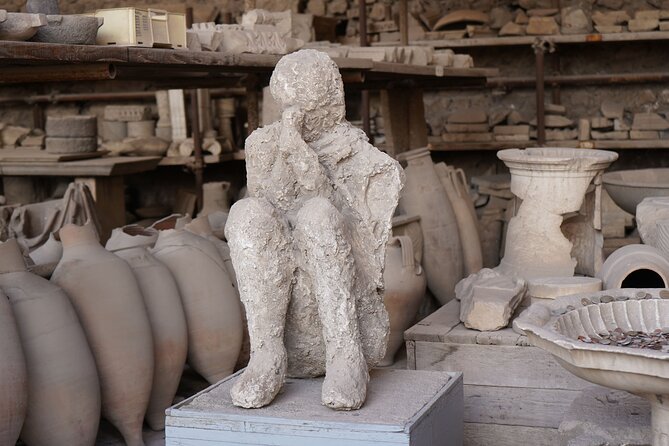
The granaries of the Forum add a darker layer. In the granary you see marble tables and baths for fountain systems, and you also get casts connected to the eruption, including references to casts of victims, plus a dog and a tree. It is a stark reminder that the site is not only about art and engineering, but also about catastrophe.
If you are sensitive, expect an emotional shift around these themes.
Stabian Baths, an old thermal complex
The Stabian Baths take you into the city’s social infrastructure. This complex is noted as the oldest thermal complex in Pompeii. Baths were places to talk, relax, and do routine daily life, not just “bathe.”
Lupanar, the famous brothel
You visit the Lupanar, Pompeii’s most famous brothel. It is historically important, and it is also not subtle. If that subject matter makes you uncomfortable, you can prepare yourself mentally before you step in.
House of the Faun, big private scale
The House of the Faun is one of the largest and most impressive private residences. This is a strong stop for understanding how wealth translated into space, layout, and display.
Odeon and Teatro Grande, theatres that sized up the city
You also see the Odeon (Teatro Piccolo), a smaller theatre, and then Teatro Grande, the most important theatre in Pompeii. Together, they give you a sense of how public entertainment fit into city life.
This is also one of those moments where you realize why an archaeologist guide matters. Without context, a theatre is just seating. With context, it becomes a social machine.
Plaster casts and why they stick with you
The tour description also points to Pompeii’s famous plaster casts as part of the guided experience. Those casts tend to linger because they turn a disaster into a human scale detail. Even if you only get to see a portion of them, you leave with a clearer emotional timeline of what happened.
Lunch break and the transfer plan that keeps you on schedule
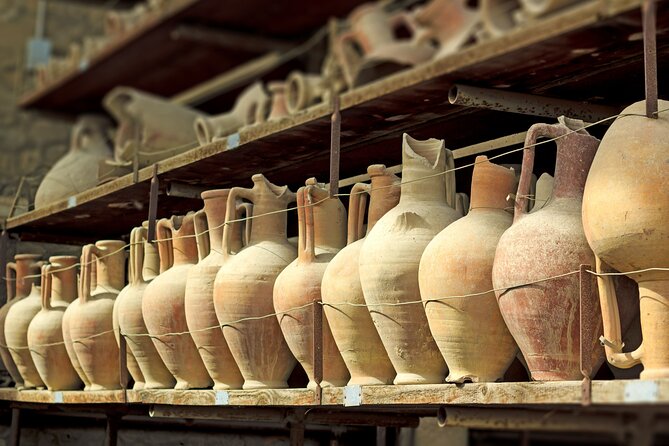
Lunch is not included. You get a quick lunch break, and you choose where to eat on your own. The goal is simple: fuel up, then move to Herculaneum without wasting time.
One thing to know from real-world feedback: a mall lunch stop can feel like a mood-killer if you came for pure archaeological atmosphere. If you want to keep the day more “site-focused,” plan to grab something nearby before you lose the momentum. A practical approach is to bring a snack so you are not hunting for food while the group regroups for transport.
Then comes the key move: getting from Pompeii to Herculaneum.
If you start in Naples, Rome, or Sorrento: minibus to Herculaneum
For the Naples, Sorrento, and Rome options, you travel with the guide by modern minibus directly to the Herculaneum archaeological site after lunch.
If you start in Pompeii: Circumvesuviana train plus a short walk
For the Pompeii start option, you use an included Circumvesuviana train ticket one-way. The ride is about 30 minutes, plus a 10-minute walk. You still travel with your guide, which is the part that saves you from figuring out the local connections under time pressure.
Herculaneum stops that show daily life, down to the doorposts
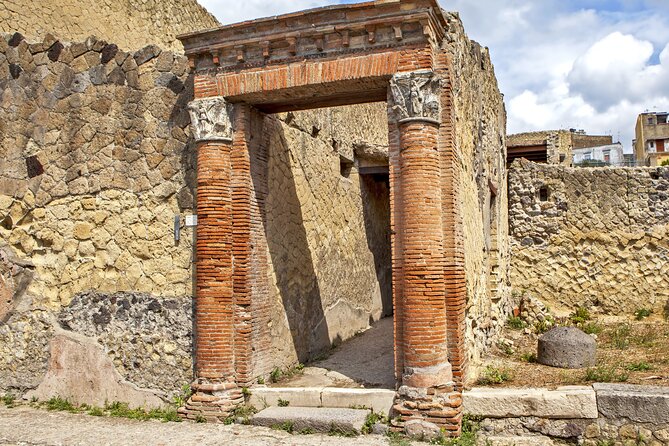
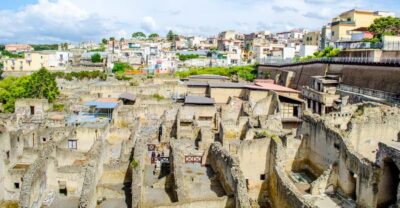
Herculaneum is where the tour earns its second half. The city is smaller, and the preservation often makes you feel like you are touring a place that was interrupted, not erased.
The guide brings you to the ticket office of the Herculaneum ruins on arrival. If you come by minibus, you drop off near the entrance. If you come by train, it is a short 10-minute walk from Ercolano Scavi station.
From there, the stops focus on houses, baths, and public buildings. You get a guided structure that keeps you from missing the “why this matters” details.
Houses named for art, objects, and the eruption
Several houses are described with very specific identifiers:
- House of the Deer, named for marble stags/deer in the peristyle
- Casa del Rilievo di Telefo, an unusual layout with private access to the adjoining Suburban Thermae
- Partem Domus lignea, Casa del Tramezzo di Legno, notable for an elegant wooden partition that remained
- House of the Skeleton, named after human remains found in 1831
- House of the Black Salon, where the monumental entrance still shows carbonised remains of doorposts and lintel
- Casa del Bel Cortile, known for a courtyard with a stairway and a stone balcony instead of an atrium
- House of the Grand Portal, a central area domus with collonnati, frescoes, and charred remains of wooden parts
The names might sound like museum labels, but they act like anchors. When the guide points out what survived and what it says about how people lived, the whole place becomes easier to picture.
Baths that split men and women
The Central Thermae are built around the beginning of the 1st century AD. They are divided into men’s and women’s baths with separate entrances. That is exactly the sort of detail you would likely miss if you were just roaming.
Public buildings tied to status and civic life
Not everything is private housing. You also visit buildings tied to civic and religious life:
- La Terrazza di M. Nonio Balbo, connected to a major benefactor and his honours, described in a long inscription on a funeral altar
- College of the Augustales, thought to be a center for Emperor Augustus cult and a headquarters tied to the Collegium Augustalium
These stops help you see that Herculaneum was not only domestic life. It had institutions, patronage, and organized beliefs.
Casa Sannitica and the city’s regional identity
Casa Sannitica is described as typical of the Samnites, showing how local cultures shaped architecture. You see the atrium skirted by a gallery with Ionic columns and fresco decoration.
When two hours in each site feels fast, and how to handle it
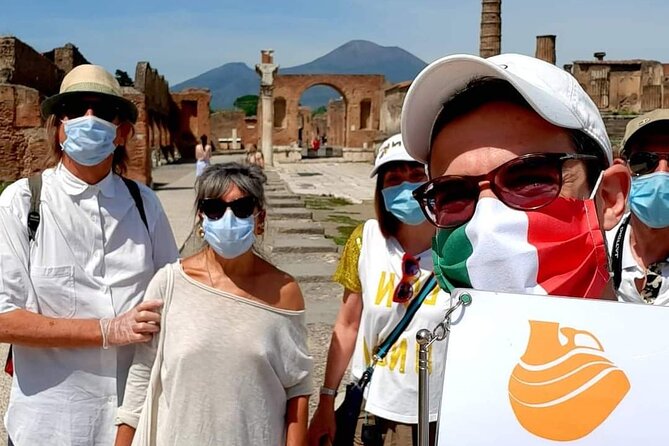
This is the real tradeoff. Pompeii’s guided portion is about two hours, and Herculaneum’s is also about two hours. That is enough time to hit the major highlights, but not enough time to slow down.
If you like to stop and stare for ten minutes at mosaics, frescoes, or a single architectural corner, you may wish you had more time in Pompeii specifically. It is simply enormous, and your brain wants to keep wandering.
The good news is that you get useful momentum. The guide helps you focus so the time you do have feels meaningful. And because the group uses headsets and stays together, you are not stuck waiting for stragglers or scanning for your next turn.
A small pro tip from the vibe of practical reviews: if you are taking the train segment, grab something small to eat before you board. Station timing can be tight, and you will appreciate not being hungry when you want to keep listening.
Who this tour fits best, and who should skip it
This works best if you are:
- Short on time and want both Pompeii and Herculaneum in one day
- Interested in how people lived, not just grand monuments
- The kind of person who likes asking questions while you walk, especially in a max 20 group
- Happy to prioritize highlights over slow self-guided exploration
This may not be your best fit if you:
- Want lots of free time in Pompeii to wander at your own pace
- Get frustrated by schedule-driven pacing and quick stops
- Need a quieter, less structured experience
As a matter of safety and comfort, the tour is also not recommended for visually impaired guests unless accompanied by a dedicated personal assistant, based on the tour notes.
Booking verdict: should you book this archaeologist Pompeii and Herculaneum tour?
I think you should book this tour if you want a guided day that does not waste your time. The combination is strong, the group size is manageable, and the included admissions and transport mean fewer headaches. The headsets are a real quality-of-life upgrade, especially in busy areas.
I would only hesitate if you are the kind of traveler who needs long, uninterrupted time in Pompeii to feel satisfied. In that case, you might choose a longer Pompeii-only plan, then add Herculaneum later. But if your goal is to learn fast, see the big anchors, and leave with a clearer picture of daily life under Vesuvius, this is a very solid choice.
FAQ
How long is the Pompeii and Herculaneum tour?
The tour runs approximately 6 to 11 hours, depending on your selected departure option and the day’s logistics.
Where do I meet for the tour?
Meeting points depend on your option: Pompeii at Porta Marina Superiore, Naples and Rome at Starhotels Terminus, and Sorrento at Piazza Angelina Lauro.
Is admission to Pompeii and Herculaneum included?
Yes. Entrance fees for both sites are included, including Herculaneum entry tickets and Pompeii express entry tickets.
How do you travel between Pompeii and Herculaneum?
If you start in Naples, Sorrento, or Rome, you travel to Herculaneum with your guide by modern minibus. If you start in Pompeii, you use an included Circumvesuviana train ticket (about 30 minutes) plus about a 10-minute walk.
Is lunch included?
No. Meals and drinks are not included, though the schedule includes a quick lunch break (own expense) before the transfer to Herculaneum.
What group size should I expect?
The tour has a maximum of 20 travelers.
Can I cancel for a full refund?
Yes. You can cancel up to 24 hours in advance for a full refund. If you cancel less than 24 hours before the start time, the amount paid will not be refunded.
Recently reviewed around Pompeii
- Sorrento: Pompeii and Vesuvius Day Trip with Entry and Lunch★ 4.4 · 11 reviews
- From Sorrento: Pompeii with an Archaeological Guide & Ticket★ 4.6 · 19 reviews
- Sorrento: Pompeii & Herculaneum Day Trip Entry and Lunch★ 4.6 · 27 reviews
- Pompeii: Skip-the-Line Guided Archaeological Discovery Tour★ 4.2 · 13 reviews
- 2-Hour Private Walking Tour of Pompeii★ 4.7 · 22 reviews
- From Positano: Pompeii Ruins Small Group Guided Tour★ 4.8 · 82 reviews
- Pompeii Positano Amalfi Day Trip from Rome by Car, No Bus!★ 5.0 · 5 reviews
- Pompeii VIP 3h Tour: Skip-the-line with your Archaeologist★ 4.9 · 13 reviews
Herculaneum Tours, compared.
Herculaneum Entry Ticket with Optional Audio Guide
Read our review →
Herculaneum: 3D Walking Tour with Skip-the-Line Ticket
Read our review →
Guided Day Tour of Pompeii and Herculaneum with Light Lunch
Read our review →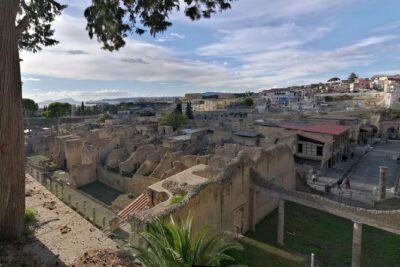
Private Day Tour to Vesuvius, Herculaneum & Pompeii with Pick Up
Read our review →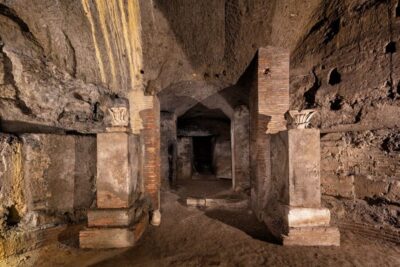

Herculaneum: Skip The Line Entrance ticket + Audioguide
Read our review →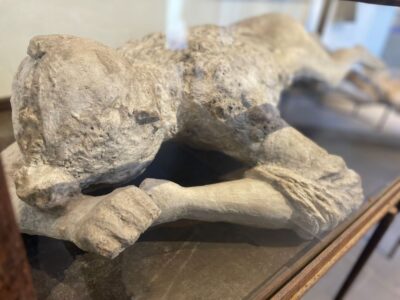
Pompeii and Herculaneum: Guided Tour with an Archaeologist
Read our review →Browse the lists this tour appears in