Reviewed · POMPEII TOURS
Pompeii tour with LOCAL GUIDE and SKIP THE LINE entrance
Pompeii is one of those places where the past feels close to your skin, thanks to volcanic ash that helped freeze daily life about 2,000 years ago. This tour is interesting because you pair that wow-factor with a local guide and skip-the-line entry, so you start learning fast instead of waiting.
I especially like how you get focused stops, not just wandering. Two standout highlights for me are the interior details at Casa del Menandro and the Roman street-level scenes around the Forum, where daily life, business, and power all met in one open space.
The main drawback is time. With about 2 hours of guided walking, plus a chance to keep exploring after, you can see key areas, but you will not cover Pompeii the way a half-day or full-day visit does.
Key things I’d zero in on
- Skip-the-line priority entry helps you start sooner at a busy site
- Small group size (max 14) keeps the pace manageable and questions easier
- Casa del Menandro details connect art, status, and household life
- Lupanar and the Forum give you a grounded look at everyday Roman culture
- Terme Stabiane lets you experience Pompeii’s thermal-world centerpiece
- You can stay inside after the tour, which is great for slow wandering
Pompeii’s ash-preserved streets, and why this tour format works
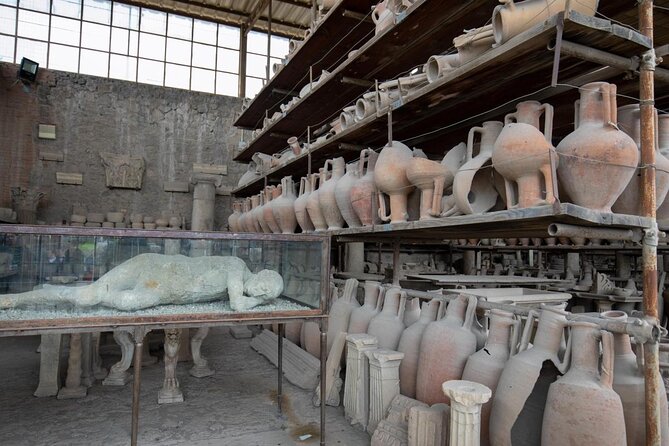
Pompeii works on you in a very specific way. The volcanic ash didn’t just preserve buildings, it preserved routines, layouts, and the feel of a city before the eruption. Even when you know the basics, walking the streets can trick your brain into thinking the catastrophe is around the corner.
This is also a site where a little guidance goes a long way. Pompeii is huge, and without a guide you may spend your energy collecting facts instead of understanding what you’re looking at. With a local guide, you get the “why” behind what survived, how homes were built and used, and what public spaces were actually for.
The timing here is the trade-off. You get a tight loop of major stops and key interpretations, and then you are let loose to wander more on your own. If you want Pompeii in full detail, plan extra time. If you want a strong first hit, this is a smart way to do it.
More Pompeii tours to compare:
- Pompeii: Entry Ticket and Guided Tour with an Archaeologist
★ 4.8 · 19,459 reviews - Pompeii: Entry Ticket with Optional Audio Guide
★ 4.2 · 12,360 reviews - Pompeii: Small Group Tour with an Archaeologist
★ 4.8 · 12,264 reviews
Skip-the-line entry and where you meet (Via Villa dei Misteri)
You meet at Via Villa dei Misteri, 3, in Pompeii, and the tour ends back at the same spot. The meeting area is described as being near the entrance to the ruins, and close to public transit and parking too, which is helpful if you are juggling buses or trains.
The big practical win is the priority service. At Pompeii, the “skip-the-line” part matters because queues can eat up the first hour of your visit when everyone else arrives at the same time. Starting with momentum also helps you stay in the learning mode, instead of getting tired and scattered before you even see the city.
This tour includes a mobile ticket, and it runs in English. It’s also capped at 14 travelers, which usually means fewer bottlenecks at narrow passages and a better chance to hear your guide.
Stop one: The Archaeological Park of Pompeii, where the guide sets the scene
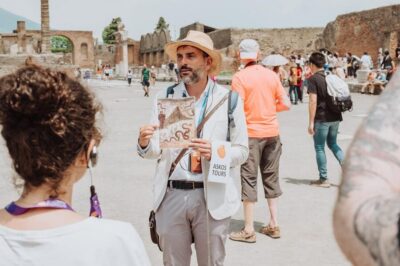
The tour begins at the Archaeological Park of Pompeii, near the entrance. Right away, your guide frames why Pompeii matters: the way ash preserved both the city structure and the people who lived there. That “preservation effect” is what makes Pompeii feel so unusually clear compared to many other ancient sites.
You also get a quick historic backbone. Excavations began in the 18th century, and after about 250 years, around 75% of the site has been uncovered. That means you are not just looking at ruins. You are seeing a work-in-progress history, pieced together step by step.
What I like about this opening is how it prepares you for the rest of the stops. You start with context, so when you see a home doorway, a public square, or a “room meant for a specific purpose,” it clicks as part of an urban system.
A consideration: Pompeii is full of sensory distractions. If you love photography, you may want to pause for a shot, but keep an eye on your timing so you still reach the key buildings before the guided portion ends.
Casa del Menandro: frescoed rooms, household status, and a real treasure story
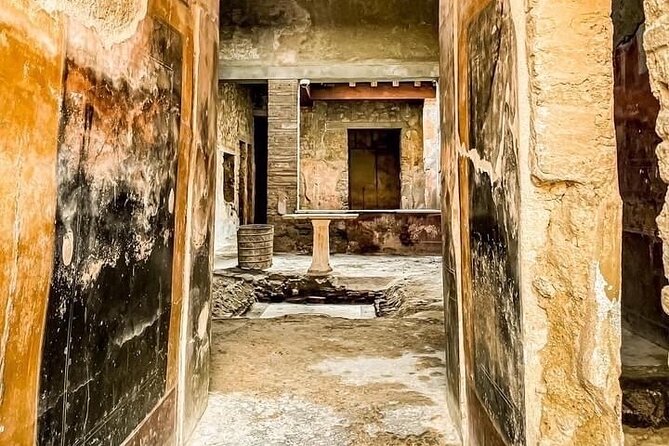
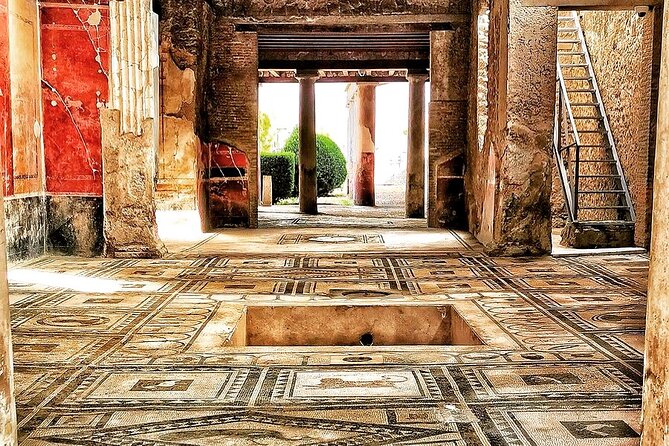
Casa del Menandro is a highlight for a reason. This was a large home tied to a high-ranking family, and the features you hear about connect art, daily life, and wealth in one place.
One of the first things your guide points out is the atrium with fresco scenes from major Greek epics, named from the Iliad and the Odyssey. The atrium is not just decoration. It is the kind of space that signals education, taste, and social identity. So even if you are not a “fresco person,” you get why the art mattered.
Then you move through the layout. The peristyle has a specific “rhodium” type arrangement, and you learn how the northern side was higher. The details might sound technical, but they are really about how the home was designed for comfort, light, and movement.
The house name comes from a portrait of Menander, an Athenian playwright, placed in the porch. That kind of detail is what makes Pompeii feel lived-in, not just excavated.
The most gripping moment is the underground story. Below part of the home, there is mention of an underground room, likely used like a cellar. During restoration, a chest holding 118 pieces of silverware was found and displayed at the National Archaeological Museum of Naples. Even though you might not see the silver itself here, the narrative helps you understand households as storage, planning, and valuables.
This stop also nods to banqueting culture with pottery used for serving, and it mentions a reconstruction of a wagon in the rustic quarter. That little shift from “elite rooms” to “work and storage life” makes the house feel more complete.
A practical note: Casa del Menandro is a stop where you will want to slow down your eyes. If you are rushing because you assume there is nothing else to see, you can miss the building logic your guide is explaining.
A few more Pompeii trips worth comparing
- Pompeii: Skip-the-Line Entrance Ticket with Audio Guide
★ 4.0 · 2,509 reviews - Pompeii: Guided Walking Tour with Entrance Ticket
★ 4.3 · 1,423 reviews - Pompeii: Skip-the-line-Ticket and Guided Tour
★ 4.6 · 1,152 reviews - Pompeii: Guided Tour with Skip-the-Line Entry
★ 4.9 · 812 reviews
Lupanar: the Roman brothel complex and how the site explains taboo life
Pompeii includes the uncomfortable parts of Roman life, and the Lupanar is one of the clearest. Your guide walks you through what the brothel was like, how it functioned, and how the space was physically arranged.
The building is described as having two floors. The upper level relates to the owners and slaves, while the lower level has five rooms lined along corridors, each arranged with built-in beds. The rooms were closed with curtains, so you get the sense of privacy and transaction happening in a tight, repetitive layout.
The tour also points out small features that ground it in reality, like a latrine visible under the stairwell. That kind of detail can feel jarring, but it also makes the history stop being abstract.
Another element your guide explains is how the walls used small erotic images along the corridor to advertise what customers could expect. It’s the Roman version of signage and sales, which is a strange thought, but it helps you understand the business as a physical system.
The timing on this stop is short, so you should expect a guided “what to look for” approach, not a slow, museum-style reading. Still, even a brief visit can change how you view Pompeii’s streets once you connect the space to the economics of the city.
Foro de Pompeya: the city’s control room, where business and power met
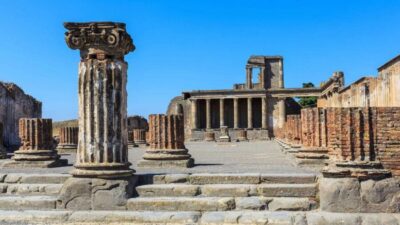
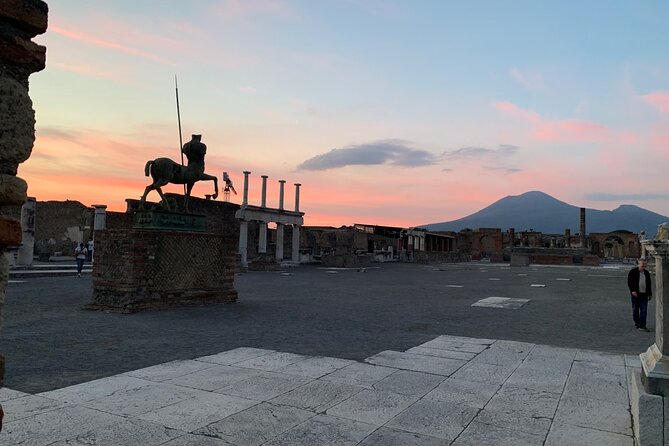
After the homes and private spaces, the Forum makes Pompeii feel like a real city again. The Civil Forum is framed as the center of daily life, where public buildings, administration, justice, and commercial activity overlooked the main square.
Your guide explains how the Forum’s look changed over time. It started as an open area in rammed earth, and then it was modified between the 3rd and 2nd centuries BC, when the space became more regular with arcades and a paved surface with tuff slabs. Later, in the imperial age, travertine slabs replaced earlier surfaces.
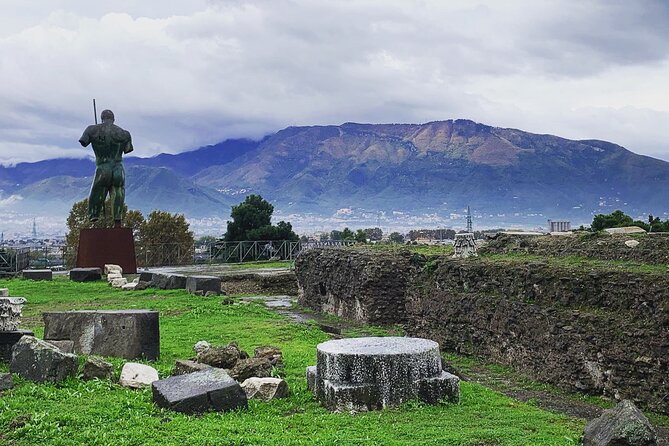
You also learn about orientation and symbolism. The axis of the square aligned with the facade of the Temple of Jupiter, placed in line with Vesuvius. That matters because it shows how the city used geometry and sight lines to connect religion, governance, and landscape.
Then there are details about inscriptions. Some bronze-letter recesses are mentioned, with the recesses designed for letters from a large inscription that once belonged there. That gives you a reason to look down and notice shapes you might otherwise ignore.
The Forum stop lasts long enough to feel like you’ve arrived somewhere important. It is also one of the best places to take a breath, because it gives you space to look around and get your bearings fast.
Terme Stabiane: walking into an ancient spa complex
The Stabian Baths, also called Terme Stabiane, are a standout because of how “everyday” they feel. Baths were social spaces, health routines, and a place where people passed time.
This complex is described as the oldest building of its kind in the city, and it was buried by the eruption of Vesuvius in 79. After excavation, it reappeared, giving visitors a chance to connect Roman leisure with an actual built environment.
Even if your stop time is brief, your guide’s explanation helps you understand what a bath complex was for. You’re not just looking at ruins, you’re seeing how the Romans turned hygiene and relaxation into a civic habit.
If you like architecture, this is a good moment to compare the “public world” of the Baths with the private rooms of the house. The shift in scale helps your mental map stick.
How long is enough, and what you might miss with a 2-hour guided walk

This tour is about 2 hours 30 minutes total, with roughly 2 hours of guided content noted in the experience flow. That means the stops are focused, and the guide will highlight the most meaningful places rather than trying to cover everything.
That’s the key trade-off you should plan around. If your goal is a quick, structured introduction to Pompeii that hits the major “wow and learn” points, this works well. If your goal is total coverage, you will want more time inside the site beyond what the guided portion offers.
The short stop lengths are not a problem by themselves. The issue is expectation. You will see the highlights like Casa del Menandro, the Lupanar, the Forum, and Terme Stabiane, but you will not roam every street in depth.
A practical way to fix that is simple: treat the guided loop as your map, then use the chance to stay afterward to slow down. That “stay inside after” option can turn a short tour into a more satisfying visit.
Guide quality makes or breaks Pompeii tours, and here it shows
Pompeii can feel overwhelming. The difference between a good visit and a great one is often the guide’s ability to explain what you’re seeing without drowning you in facts.
In this experience, the guide style has strong marks. Names that come up include Antonio, Gennaro, Anna, and Sasa. The common thread is pacing that allows questions and explanations that help families too, including how a guide made the ruins interesting for children.
There is also practical professionalism. One case described Anna waiting more than 20 minutes after people were delayed by train navigation issues. That kind of patience matters because Pompeii visits often depend on public transportation timing and walking routes.
Communication can be a hiccup if you are not careful. One example described confusing meeting-place information that made a group almost late. My advice is to double-check your exact meeting point and give yourself buffer time so you walk in calm, not sprinting.
Price and value: is $66.38 worth it?
At $66.38 per person, you are paying for three things at once: the entrance ticket, skip-the-line priority service, and an authorized local guide.
Here’s how I think about value in plain terms. Pompeii is popular, so the line time you avoid can be worth real money in the form of your vacation time. Then, the guide adds value by connecting rooms, symbols, and city layout so the site feels coherent instead of random.
Also, the group size matters. With a cap of 14 travelers, the experience is less likely to turn into a herd rushing through doorways. That makes your learning stick better, especially at stops like Casa del Menandro where the details reward attention.
The only reason I would say twice about booking is if you already know Pompeii and you plan to spend hours reading every wall. For that goal, a longer guided tour or a self-guided full day may fit better. But for most first-timers who want a smart overview plus time to wander, the price feels fair.
Who this tour suits best
I think this tour is a strong fit if you:
- Want skip-the-line entry without doing logistics juggling yourself
- Prefer a small group, around the size where your guide can still respond to questions
- Are seeing Pompeii for the first time and want clear highlights, not random wandering
- Enjoy a guided structure, then want time to explore on your own afterward
It might be less perfect if you:
- Want to linger for deep reading at every major building
- Think a short visit will give you the full Pompeii story
- Need a long, slow pace because you plan to watch every detail closely
Tips to get more out of it, without overplanning
Pompeii rewards steady footwear and smart pacing. Wear shoes you trust, because the ground can be uneven and you will be walking more than you think, even with short stop times.
If you care about audio, consider bringing something that helps you hear your guide clearly. The experience is in English, but the site can be noisy and crowded, and you will get more out of the explanations if you can listen well.
Also, go in with a simple mindset: this is a guided route that teaches you how to see. After the tour, use the chance to stay inside to slow down at the places you liked most, like the Forum area or a house interior that clicked with you.
Finally, check the weather plan for your day. The experience requires good weather, and if conditions cancel it due to poor weather, you should be offered a different date or a full refund.
Should you book this Pompeii skip-the-line tour?
If you want a compact Pompeii experience with priority entry and a real local guide, I’d say yes. It’s a good value when you want the biggest highlights, like Casa del Menandro, the Lupanar, the Foro de Pompeya, and Terme Stabiane, all connected by explanation instead of guesswork.
I’d book with eyes open about time. If you know you want a long, deeply paced Pompeii day, look for a longer guided option. If you want a smart first visit, then time to wander afterward, this one is an easy yes.
FAQ
Is the entrance ticket included?
Yes. The tour includes the admission ticket, along with skip-the-line priority service and an authorized local guide.
Do I need to book this as an English tour?
The tour is offered in English.
How long is the tour?
It runs for about 2 hours 30 minutes (approx.), with guided time around 2 hours noted in the experience flow.
Where does the tour meet and end?
You meet at Via Villa dei Misteri, 3, 80045 Pompei NA, Italy, and the tour ends back at the same meeting point.
What is the group size?
This experience has a maximum group size of 14 travelers.
Is there a mobile ticket?
Yes, it includes a mobile ticket.
Do they skip the line for entry?
Yes. Priority service is included so you can skip the line for entry.
Can I stay inside Pompeii after the guided part ends?
Yes. After the guided tour, you have the possibility of remaining inside the excavations.
Is the tour dependent on weather?
Yes. The experience requires good weather. If it is canceled due to poor weather, you will be offered a different date or a full refund.
What is the cancellation rule if I change my mind?
This experience is non-refundable and cannot be changed for any reason.
Recently reviewed around Pompeii
- Mt. Vesuvius Wine Tasting and Lunch Experience from Pompeii★ 4.5 · 20 reviews
- Pompeii Small Group with an Archaeologist and Skip The Line★ 5.0 · 121 reviews
- Pompeii from Afternoon to Sunset★ 5.0 · 108 reviews
- Private Guided Tour and VR Headsets in the Ancient Pompeii★ 5.0 · 3 reviews
- Visit Pompeii with a local expert guide★ 5.0 · 10 reviews
- Traditional Neapolitan Dinner in Pompei – Villa Franca – Family Restourant★ 5.0 · 8 reviews
- Discover Pompeii on this Guided Walking Tour of the Buried City★ 4.0 · 9 reviews
- 2 Hours Private Walking Tour in Pompeii with an Archaeologist★ 5.0 · 15 reviews
Pompeii Tours, compared.
Entry Ticket and Guided Tour with an Archaeologist
Read our review →

Pompeii Small Group Tour with an Archaeologist
Read our review →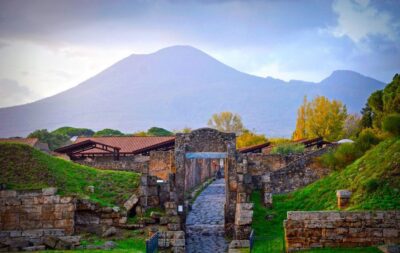
Skip-the-Line Entrance Ticket with Audio Guide
Read our review →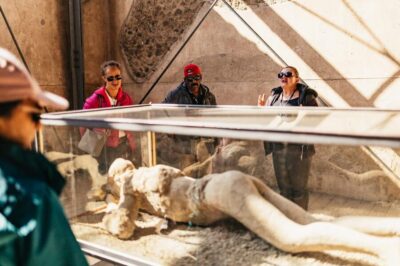
Pompeii and Mt. Vesuvius with Lunch and Wine Tasting
Read our review →
Archaeological Park Tour with Ticket on request
Read our review →