Reviewed · POMPEII TOURS
Small-Group Tour in Pompeii with a Real Archeologist, ticket included
Pompeii is one of those places where the ruins feel like a time machine, not a museum. What makes this experience stand out is the small group size and the chance to walk through the city with a real archaeologist who can put the stones back into human context fast.
I also like that you get a priority ticket approach plus a headset, so you spend less time stuck in logistics and more time hearing what matters. The main drawback to keep in mind: the route is fast, and on past tours some people felt not every advertised stop got full attention, so you should go in expecting a highlight pass, not a slow roam.
Pompeii With an Archaeologist, Not a Quick Grab-and-Go
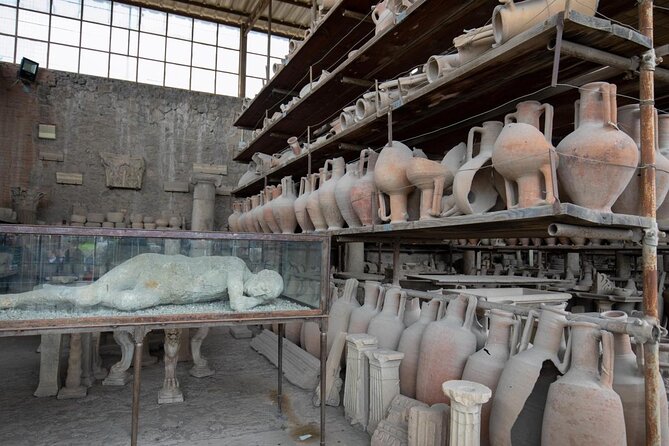
This tour is built around interpretation, not just sightseeing. You start with classic villa interiors, then move into public life, and end with the kinds of religious and entertainment spaces Pompeii is famous for. That mix is smart because Pompeii wasn’t only houses and statues. It was also commerce, travel, nightlife, worship, and crowds.
You’ll be with a maximum group size of 15 people, which is big enough to meet fellow travelers but small enough for your guide to answer questions and adjust pacing. Most tours include headsets, so even if you’re not standing right next to the guide, you still catch the key points. In plain terms, it helps you stay oriented while you’re walking through stone corridors and open courtyards.
One more practical note: this is an outdoor site, and Pompeii can feel brutal in warmer months. The good news is you’ll have chances for shade as you move between structures, but you should still plan to bring water and take short breaks when you can.
Price and Group Value at About $66 for 2.5 Hours
At $66.23 per person for around 2 hours 30 minutes, you’re paying for three things at once: a guided route, a professional guide (including an archaeologist), and a priority entry benefit. That’s often better value than buying a ticket and trying to figure out Pompeii on your own, because the guide’s job is to help you see connections you would otherwise miss.
Two details that matter for value:
- Priority ticket entrance for the Archaeological Park of Pompeii helps you lose less time at the start.
- A small group with a headset means more of your money goes to explanations, not just walking.
If you’re trying to maximize time in Pompeii without turning your day into a stamina test, this is a sensible option.
More Pompeii tours to compare:
- Pompeii: Entry Ticket and Guided Tour with an Archaeologist
★ 4.8 · 19,459 reviews - Pompeii: Entry Ticket with Optional Audio Guide
★ 4.2 · 12,360 reviews - Pompeii: Small Group Tour with an Archaeologist
★ 4.8 · 12,264 reviews
Entering With Priority Tickets and Using the Mobile Ticket
You’ll get a priority ticket entrance plus a mobile ticket, which is handy if you don’t want to hunt for paper confirmations. Priority entry doesn’t mean you won’t ever wait, but it usually reduces the frustration factor when queues are busy.
You’ll also be able to explore more after the tour. One thing to remember from the tour format: your guided time is a structured circuit, then you can use your included park access to go back for extra viewing on your own.
Your meeting point is Hotel Vittoria, Piazza Esedra, 80045 Pompeii NA, Italy, and the tour ends back at the same spot. That return matters because it makes the rest of your day easier to plan, especially if you’re pairing Pompeii with Naples or another nearby stop.
A Highlight Route Through Pompeii’s Most Talked-About Places
The tour takes you through nine core stops across Pompeii’s villas, public spaces, baths, and major civic buildings. Many stops include admission as part of the experience. One listed segment notes admission not included, so it’s worth knowing you may still need to rely on your park access rather than assuming each sub-area functions like a standalone ticket.
Here’s how the route feels, stop by stop.
Casa del Poeta Tragico and the Famous Cave Canem Mosaic
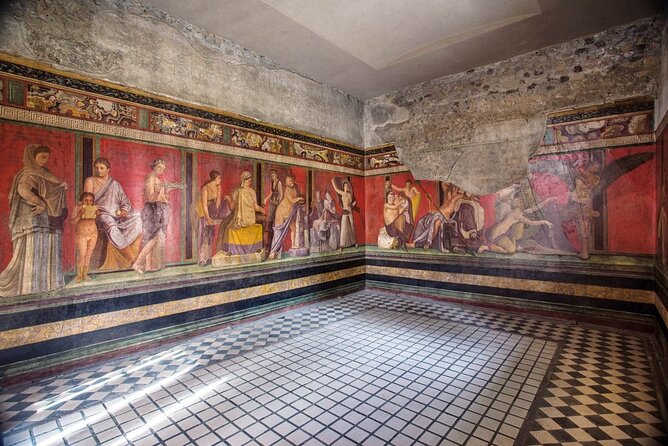
You begin at the elegant Casa del Poeta Tragico, an imperial-age house where the interior floor mosaic “Cave Canem” is the star. This is the kind of detail that makes Pompeii addictive. You see a work of art, then you realize it was placed at eye level for daily life.
What I like here is the contrast: before you move to crowds and public space, you get a real sense of how Romans lived inside their homes, with decoration that carried messages and personality. Even if you only spend about 15 minutes, this stop sets the tone.
A drawback to expect: 15 minutes in a preserved Roman interior can feel short if you love mosaics. But as an opening, it’s a great way to get your eyes tuned to Pompeii’s visual language.
A few more Pompeii trips worth comparing
- Pompeii: Skip-the-Line Entrance Ticket with Audio Guide
★ 4.0 · 2,509 reviews - Pompeii: Archaeological Park Tour with Ticket on request
★ 4.5 · 2,283 reviews - Pompeii: Guided Walking Tour with Entrance Ticket
★ 4.3 · 1,423 reviews - Pompeii: Skip-the-line-Ticket and Guided Tour
★ 4.6 · 1,152 reviews
Casa dei Vettii, Luxury on a Side Street
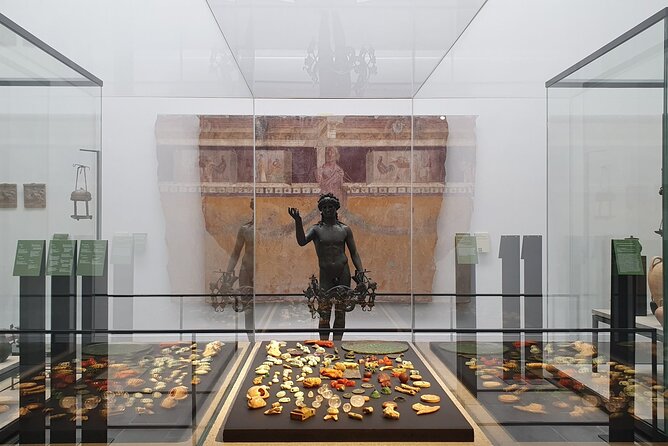
Next is the Casa dei Vettii, tucked along Vicolo dei Vettii. This house is named for its owners, Aulo Vettio Restituto and Aulo Vettio Conviva, and it’s known as one of Pompeii’s most luxurious residences.
This stop is valuable because it’s not just about scale. It’s about how wealthy households signaled status through art, layout, and everyday comfort. You’re also getting a second household after the Poeta Tragico, so you can start noticing differences rather than treating every villa as “another room.”
One realistic consideration: access and timing can vary. On a prior tour, a promise about seeing the House of Vettii did not match what the group experienced, so I’d treat this stop as a highlight you’ll aim for, not a guarantee of unlimited time.
Lupanar, Pompeii’s Brothel, and What It Still Reveals
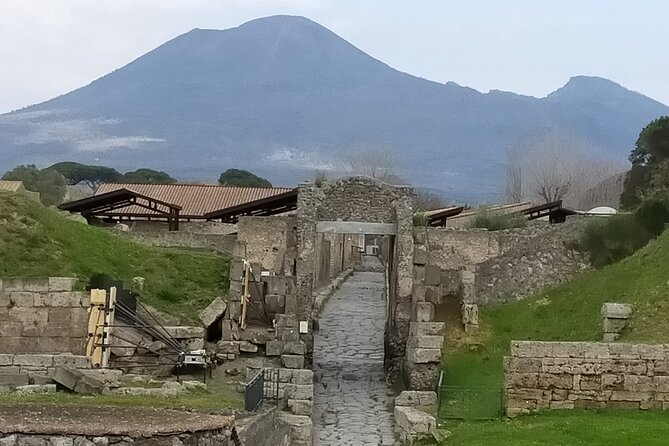
Then comes the Lupanar, the two-storey building known for prostitution. It’s one of the most visited places, and it’s easy to see why. This is social history you cannot get from a textbook.
The building is described as having five rooms on the ground floor and five on the upper floor, with beds that were more concrete than cushioned. In other words, this wasn’t glamour. It was business.
Why this stop matters: it shows that Pompeii had systems for everything, including the parts we usually prefer to pretend didn’t exist. It also forces you to think about how Romans organized space, service, and reputation in the same city where people admired art and hosted dinners.
If you’re the type who gets uncomfortable with adult-history sites, I’d still say this stop is worth including, but you might want to mentally pace yourself. It’s heavy material.
The Forum of Pompeii: Public Life Without Statues
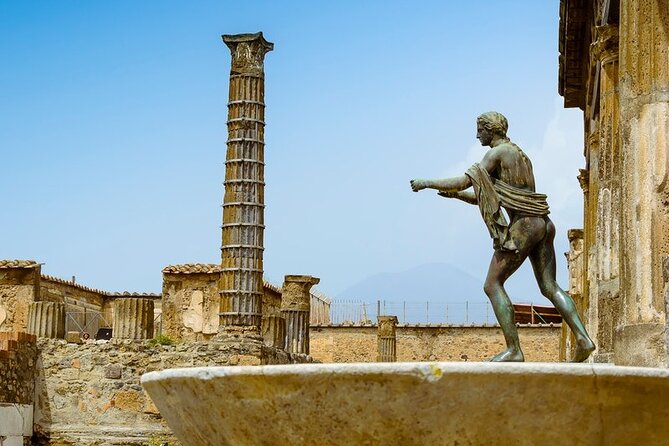
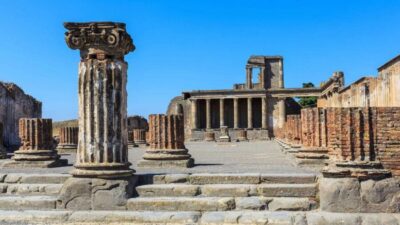
Next is the Forum, about 142 metres long and 38 metres wide. It was reserved for pedestrians and carts were not allowed, which is a detail that instantly changes how you imagine the space. This was designed for walking, gathering, and civic business.
Today the forum can feel bare because many statues and ornate flooring are gone. It’s believed that after the eruption, digging and reuse happened, and marble work was taken for later use in other projects.
I like this stop because it anchors you. Once you’ve seen homes and side streets, the forum helps you remember that Pompeii operated as a functioning city. The guide’s commentary can make this place click: think of it as the city’s operating system, not just ruins in open air.
Suburban Baths: Where Travelers Likely Passed Through
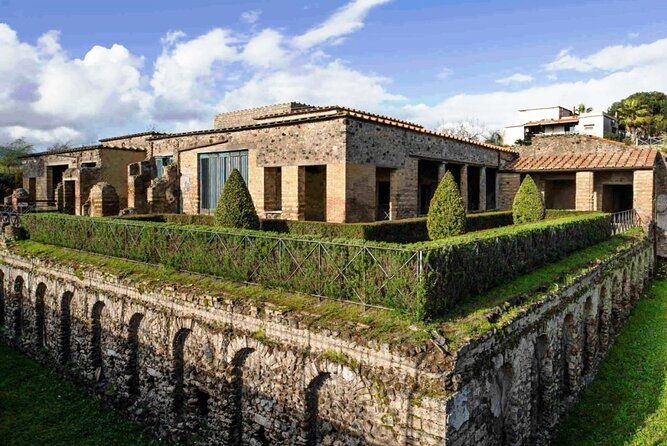
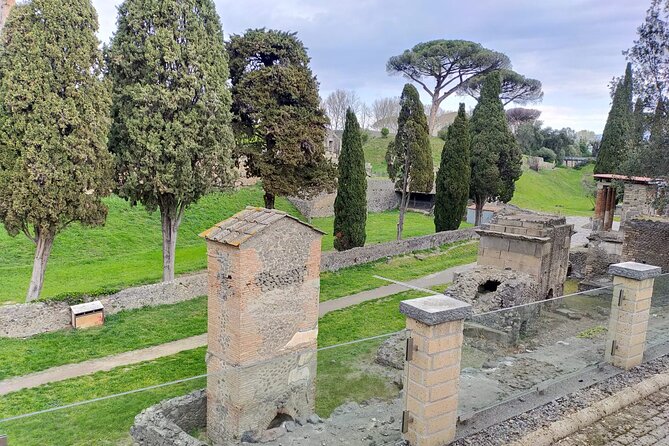
The tour moves outside the city walls to the Suburban Baths, also called thermal baths or spas. They’re located near a port area, described as large rocks where boats could be moored.
That location matters. It’s a strong hint that these baths likely served travelers, not just residents. You get a different Pompeii story here, one tied to movement and arrival.
This stop is also a nice break from nonstop walking inside dense residential areas. Even though it’s still hot outdoors, baths and water-related structures help your brain cool down, visually and conceptually.
Casa del Fauno and Casa del Menandro: Art, Scale, and Silver Finds
From baths you head into two major household stops.
Casa del Fauno
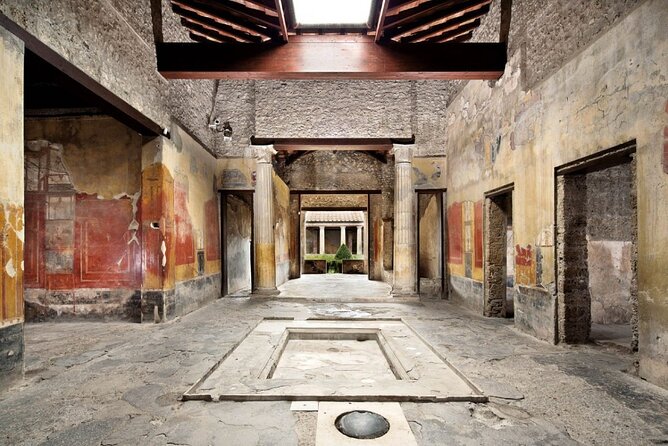
The Casa del Fauno gets its name from a bronze statue of a faun located in the impluvium. This is one of Pompeii’s most famous houses, and the fame is earned. The artistry and the layout give you the sense of a household that was meant to impress.
A short visit can work well here because the “wow” factor is built into the key elements. You don’t need hours to understand why this house became a reference point for Pompeii.
Casa del Menandro
Then it’s the Casa del Menandro, a prestigious home of about 2,000 sq. metres. It’s named after an fresco of the poet Menandro. This is where the tour gets especially detail-heavy: you’ll learn about 118 objects in silver, described as tableware, and see fresco themes connected to the Trojan War, including death imagery associated with Laocoonte, plus Cassandra and Ulysses.
Why I’d prioritize this stop: it shows how Roman taste mixed entertainment, learning, and elite collecting. Silver tableware is the literal luxury. The paintings and stories show the intellectual and cultural luxury.
Also, the scale helps you understand why Pompeii households weren’t just shelters. They were status statements, performed daily.
Archaeological Park Spotlight: Arena and Gymnasium Atmosphere
You then enter the wider Archaeological Park of Pompeii, with a focus on entertainment. The tour description includes Pompeii’s amphitheatre, built for gladiator-style games, and it notes a capacity of up to 20,000 people across three levels.
A surprisingly specific detail is the mention of a type of dark linen covering during hot summer months, which offered shade to spectators. Nearby you can also see the gymnasium, where youngsters would work out.
One note to keep in mind: this stop lists admission ticket not included, while the overall experience includes priority ticket access for the park. In practice, you’re still going into the park as part of the tour. If you want to be safe, treat this segment as where your park access matters most, and if anything feels unclear on the day, ask your guide before you enter.
Temple of Apollo: Religion Before and After the Eruption
The last core religious stop is the Temple of Apollo. This cult arrived before the eruption in 79 A.C., and the description also notes the cult’s following declined because Jupiter became a stronger god.
You’ll see a bronze representation of Apollo with bow and arrow, plus a statue of the goddess Diana.
This ending works well because it adds a civic and spiritual layer. After villas, public space, baths, and fights, you finish at a site focused on belief. It leaves you with a more complete picture of Pompeii as a place where people argued about gods, not just about money and food.
Guides Matter: When Paulo, Teresa, or Alfredo Take the Lead
A big reason people score this tour high is the guide. On past departures, guides like Paulo, Teresa, and Alfredo have been mentioned for making Pompeii feel readable instead of overwhelming.
What you want from a guide here is exactly what these names suggest from their reputations: clear explanations, pacing that keeps the group moving, and the ability to answer questions. One highlight from a prior experience was a guide who helped put objects into context, including how to date what you’re looking at and offering more than one interpretation when it comes to what digs might mean.
When you book, you’re not just buying access to buildings. You’re buying interpretation power, and in Pompeii that matters.
What the Tour Feels Like On the Ground, and How to Prepare
This is a site with uneven paths, lots of steps, and long visual lines. Even with a small group, you’ll be walking. The timing at each stop is about 15 minutes at most key points, plus a final park segment and temple stop.
So here’s the practical approach I recommend:
- Wear shoes you trust. Pompeii rewards good footing more than it rewards fashion.
- Bring water. In hot seasons, it’s not a nice-to-have. It’s a survival item.
- Use the headset so you can stay focused while you walk through open courtyards.
- Plan to stay curious after the tour. Your included access means you can return to areas that struck you.
If you hate being rushed, consider pairing this with extra free time in Pompeii later. The guided circuit is a strong start, but Pompeii is large enough that you’ll likely want a second pass.
Should You Book This Small-Group Pompeii Tour? My Take
I’d book it if you want priority entry, a small group, and an archaeologist style of explanation that ties buildings to daily life. At around 2.5 hours, it’s a good fit for first-time Pompeii visitors who want the main districts without losing the whole day.
Skip it or adjust expectations if:
- You want a slow, in-depth art-by-art study with long stops in each room.
- You’re the kind of visitor who needs every single advertised site with generous time.
- You’re extremely sensitive to adult-history content, since the Lupanar is part of the circuit.
If you’re balancing Pompeii with other stops in Campania, this is a solid use of time. If you’re staying nearby and want to go deeper, you can book it as your guided foundation, then build your own second loop with the access you receive.
FAQ
FAQ
What is the duration of the Pompeii small-group tour?
It runs for about 2 hours 30 minutes.
How many people are in the group?
The maximum group size is 15 travelers.
Is the Pompeii ticket included?
You get a priority ticket entrance for the Archaeological Park of Pompeii. The tour includes admission ticket access for most listed stops, and one listed stop notes admission ticket not included.
Where does the tour start and end?
It starts at Hotel Vittoria, Piazza Esedra, 80045 Pompei NA, Italy and ends back at the same meeting point.
What should I bring for a summer visit?
Bring water and plan for heat. The site can be very warm, and you will still be walking between stops.
What happens if the weather is bad?
If the experience is canceled due to poor weather, you will be offered a different date or a full refund.
Recently reviewed around Pompeii
- Mt. Vesuvius Wine Tasting and Lunch Experience from Pompeii★ 4.5 · 20 reviews
- Pompeii Small Group with an Archaeologist and Skip The Line★ 5.0 · 121 reviews
- Pompeii from Afternoon to Sunset★ 5.0 · 108 reviews
- Private Guided Tour and VR Headsets in the Ancient Pompeii★ 5.0 · 3 reviews
- Visit Pompeii with a local expert guide★ 5.0 · 10 reviews
- Traditional Neapolitan Dinner in Pompei – Villa Franca – Family Restourant★ 5.0 · 8 reviews
- Discover Pompeii on this Guided Walking Tour of the Buried City★ 4.0 · 9 reviews
- 2 Hours Private Walking Tour in Pompeii with an Archaeologist★ 5.0 · 15 reviews
Pompeii Tours, compared.
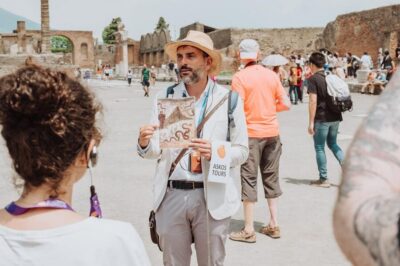
Entry Ticket and Guided Tour with an Archaeologist
Read our review →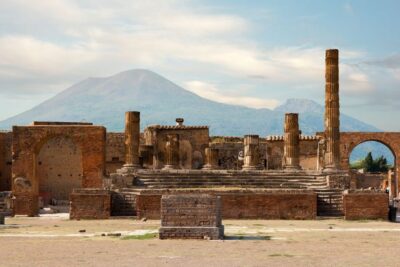

Pompeii Small Group Tour with an Archaeologist
Read our review →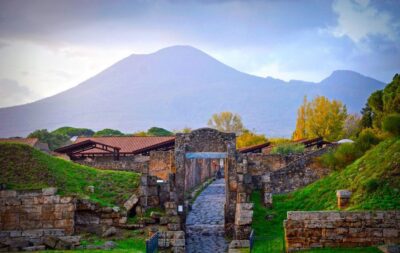
Skip-the-Line Entrance Ticket with Audio Guide
Read our review →
Pompeii and Mt. Vesuvius with Lunch and Wine Tasting
Read our review →
Archaeological Park Tour with Ticket on request
Read our review →