
Reviewed · POMPEII TOURS
Explore Pompeii with an Archaeologist
This tour is interesting because you do Pompeii with an archaeologist guide while you move from one major sight to the next, with less wasted time. I love the skip-the-line admission setup, which helps you get into the ruins without the usual start-of-day scramble. The tradeoff is simple, you cover a lot in about 2 hours, so it is not the tour for people who want to park and stare for long stretches.
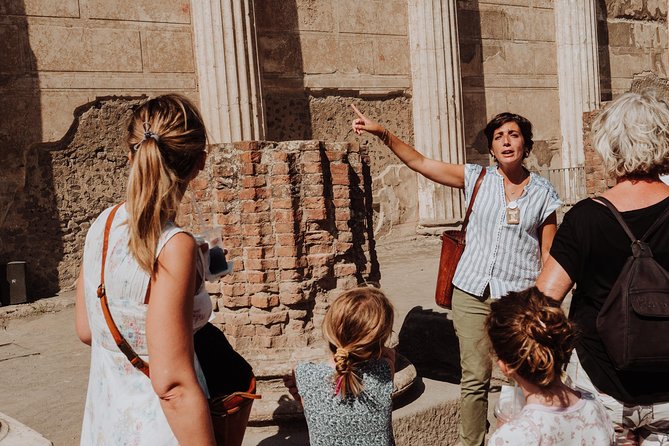
My second favorite part is the format. You stay in a small group, up to 20, and that makes it easier to ask questions and get real explanations instead of just listening while walking. I have seen how guides like Mario Celentano, Julia, Alexandra, and Ilaria bring the buildings to life with clear, patient answers, and this tour is built to support that kind of back-and-forth.
One drawback to think about before you book: Pompeii can get loud and crowded, especially during peak hours. Even with headsets (used when groups are 16 or more), it can get hard to hear if the group is packed into tight spaces or if you hit busier times of day.
Key things I’d plan around
- Skip-the-line entry helps you start seeing Pompeii sooner
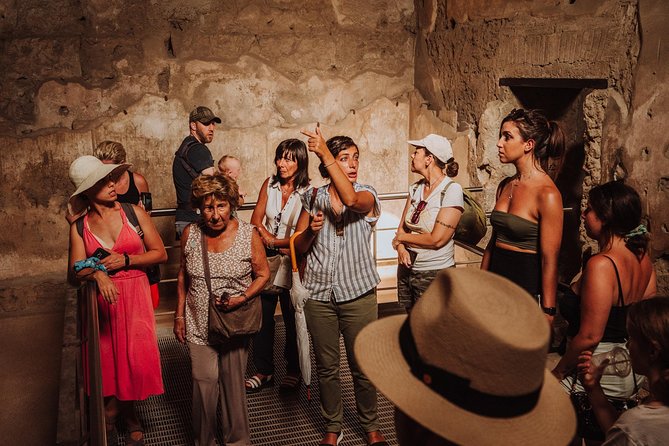
- Small group size (max 20) gives you more chances to ask questions
- Expert archaeologist guidance turns walls and street corners into understandable scenes
- Headsets for larger groups keep the commentary clear while you walk
- A well-paced highlights circuit covers Forum life, homes, baths, and the theater in one go
Porta Marina Superiore to Pompeii in Motion
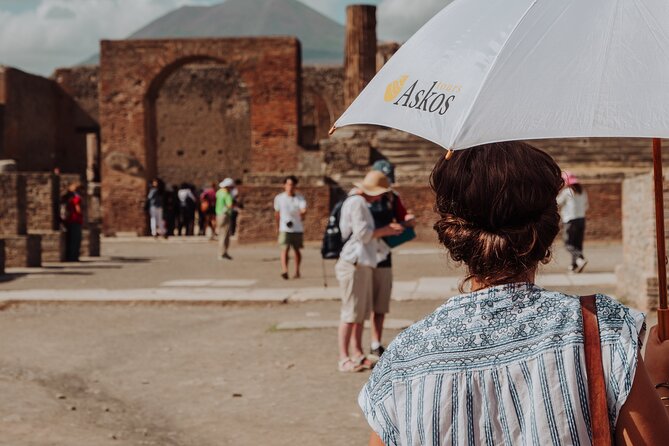
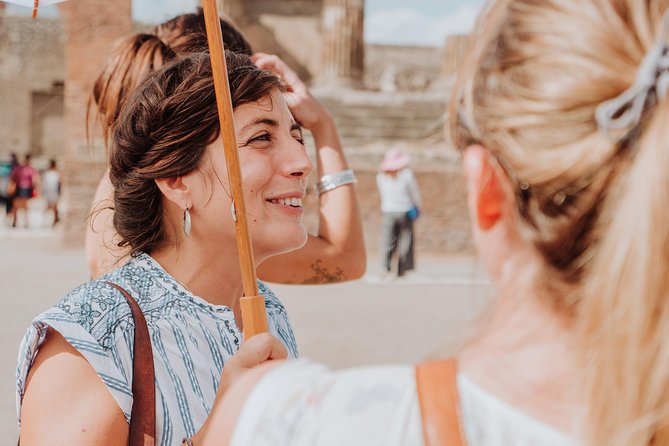
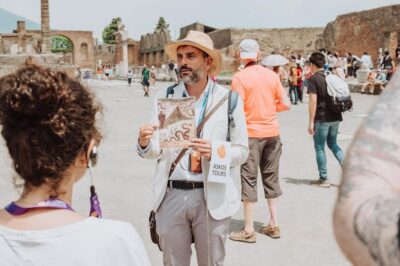
Your experience begins at the main entrance area of the Pompeii Archaeological Park, Porta Marina Superiore. The guide meets you holding an Askos Tours sign, which is a small detail that actually matters when you are dealing with big entrances and quick-moving tour groups.
From the start, you are not walking in blind. The archaeologist frames what you are about to see, then gives you the “why it matters” for each stop, not just the basic label. This is where you start building context fast, so the rest of the city feels less like random ruins.
A practical note: Pompeii is uneven underfoot. I strongly recommend sturdy shoes with good grip. If you are traveling in warmer months, plan for heat too, and bring something you can drink on, because this tour is an active walk even though it is only about two hours.
More Pompeii tours to compare:
- Pompeii: Entry Ticket and Guided Tour with an Archaeologist
★ 4.8 · 19,459 reviews - Pompeii: Entry Ticket with Optional Audio Guide
★ 4.2 · 12,360 reviews - Pompeii: Small Group Tour with an Archaeologist
★ 4.8 · 12,264 reviews
Forum Square and the Big Public Buildings
Early on, you hit the Foro de Pompeya, the main square. This part is where Pompeii stops feeling like a site of isolated rooms and starts reading like a working city. Your guide points out how public space was used and why certain buildings sit where they do.
Next comes the Basilica, often the kind of building that people rush past if they are doing a solo visit. Here, you get the function explained, so it is easier to understand why the architecture would have mattered to everyday life in the Forum area.
Two quick reasons this sequence is valuable for your time:
- It gives you the “big picture” of civic Pompeii early, before you wander into houses and quieter corners.
- It keeps your walking focused, since the stops are clustered and logical.
Lupanar and the Forum Granaries
Then you get to the Lupanar, known as the brothel. Some ruins tours avoid this kind of topic, but this one includes it, which is part of why people rate it so highly. The archaeologist explanations help you move past shock or stereotypes and look at the building in its real setting.
After that, you visit the Granaries of the Forum. This is one of those stops that makes you appreciate how many daily systems had to run just to keep a city functioning. If you like getting answers to practical questions, like where food was stored or how spaces supported public life, this stop does that job.
If you are bringing kids, this is also a moment where a guide’s tone matters. Reviews mention that guides are able to explain without turning it into awkward theater, and that is a big reason families often like this tour.
Houses of Menander and the Faun, what to look for
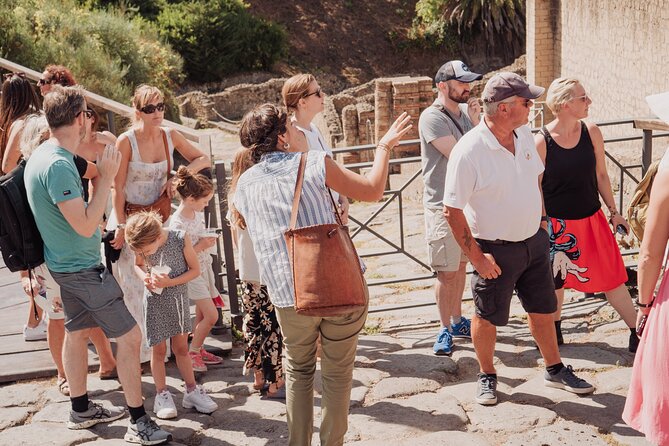
After the Forum, the tour shifts into domestic Pompeii with the House of Menander and the House of the Faun. These homes are not just “big rooms with old stuff.” Your archaeologist helps you notice layout choices and household details that make the space feel lived-in rather than museum-like.
This is where I find the guide work really pays off. Without explanations, you might look at a doorway or courtyard and move on. With a guide, you start asking better questions, like what people would have seen from the main areas and how daily movement through the house would have worked.
You also get a nice emotional range in the houses. Some houses can feel formal and tidy, while others seem more expressive and personal. Guides like Julia and Ilaria are praised for clarity, which is exactly what you want here, because homes can look similar if you do not know what to look for.
Same stretch of coast, a completely different day out:
- Pompeii Small Group Tour with an Archaeologist
★ 5.0 · 6,593 reviews - Pompeii: Skip-the-Line Entrance Ticket with Audio Guide
★ 4.0 · 2,509 reviews - Naples: Pompeii and Mt. Vesuvius with Lunch and Wine Tasting
★ 4.5 · 2,454 reviews - Pompeii: Archaeological Park Tour with Ticket on request
★ 4.5 · 2,283 reviews
Stabian Baths and Terme Stabiane
Next up is the Stabian Baths, the Terme Stabiane. Baths can be a highlight for a surprising number of people because they help you understand Pompeii as a city of routines, not just buildings frozen in time.
Your archaeologist helps connect the layout to how people would move through and use different spaces. Even if you are not a “bath person,” you still get a feel for how public life, hygiene, and social time blended into everyday rhythms.
Take a quick inventory of comfort needs here. If you need a break, this is often a good moment to slow down slightly, drink water, and let your legs reset. The walking is real, and the tour is designed to keep you moving, so it helps to plan your pauses.
Via dell’Abbondanza, a main street moment
Then comes Via dell’Abbondanza, the famous street. This stop is listed as free, but it is not wasted time. It gives you street perspective, which changes how everything else reads.
When you stand on a street with a guide pointing out what you would have noticed as a pedestrian, the ruins stop being a collection of photos. You start thinking in terms of movement and sightlines, which is a big part of understanding a whole city layout.
This stop also tends to be easier for families and for people who want a quick breath between building clusters. It is not “resting,” but it is a change of pace from interior or courtyard-heavy areas.
Thermopolium VI and grabbing a feel for daily food life
Your next stop is Thermopolium VI. This is a type of place that helps you visualize quick, everyday eating, rather than only formal dining rooms.
Even if you are just curious and not trying to memorize everything, an archaeologist guide makes these spaces click. You will look for clues about how it worked and what it would have offered. It is the kind of stop that feels practical and real, because food and daily stops are the universal part of travel history.
If you are traveling with a teenager or a foodie, this can land well. It also breaks up the flow, because after this you move into one of the biggest public structures in the route.
Teatro Grande, where the city gathers
Then you arrive at Teatro Grande, the theatre. This is one of those “wow” moments where you can see how a city would gather people for shared events. Your guide helps connect what you are looking at with how performance spaces worked.
In a compact, two-hour route, this stop works because it gives variety. You are not only walking through homes and public buildings. You also get an experience of civic entertainment space, which helps make the city feel complete rather than one-note.
One listening tip: If it is busy, you may have trouble hearing in the loudest areas. If that happens, ask your guide to repeat or shift your angle for a clearer listening spot. It is a small adjustment that can change the quality of the explanation.
Casa dei Vettii and the payoff of the last house
The final major house on the route is Casa dei Vettii. By now, you have already seen other homes, and this is where the tour often feels like it “lands.” Your guide helps you compare what you are seeing with what you noticed earlier, so the stop becomes more than just another set of walls.
Casa dei Vettii is also a strong finish because it is a place you can keep returning to in your mind after the tour ends. You start noticing how details inside homes connect to the people and routines that used them.
At the end of the experience, the tour finishes at Piazza Esedra. From there, you can continue on your own if you want more time in the areas that grabbed you the most.
Price, time, and what you actually get for $35.67
At $35.67 per person for about two hours, the value is in three places.
First, your admission fee is included, and the tour uses skip-the-line admission tickets. That matters because Pompeii’s entry process can waste time right when you want to get moving.
Second, you are paying for an archaeologist guide, not just a walk leader. The guide work is repeatedly praised, with names like Mario Celentano, Rosanna, Antonio, Alexandra, Diego, and Rafaela showing up in reviews for their clarity and their willingness to answer questions.
Third, the group stays small, maximum 20, which usually improves the listening experience and makes the tour feel less like a rush job.
What is not included is also important. Transportation and food are on you, so if you are coming from elsewhere, plan how you will arrive and carry water. The tour includes headsets for groups of 16 or more, but it does not replace good planning for comfort, especially in summer.
What can trip you up, and how to handle it
This tour is popular, and that can mean crowds. In very busy conditions, you might find it harder to hear even with headsets, especially if the group funnels into tight spaces. If hearing is your top priority, try to time your visit when the site is less packed, and position yourself where you can see and hear the guide.
Walking volume is another reality check. Even in a two-hour format, the surfaces are uneven. Bring shoes you trust on slippery stone and dirt, and do not plan to wear thin-soled sandals unless you enjoy pain.
Finally, the “archaeologist” part can mean different communication styles across guides. Most guides are praised for patience and interaction, but if you know you need more back-and-forth, arrive prepared with questions and do not be shy about asking.
Who this Pompeii tour suits best
This is a great fit if you want the highlights without getting overwhelmed by choices. You will see the Forum, Basilica, Lupanar, granaries, multiple homes, baths, a main street, Thermopolium VI, the theatre, and Casa dei Vettii, all in one connected route.
It also tends to work well for families. Reviews mention guides who keep explanations fun and age-friendly, and the small group format helps kids stay engaged instead of getting lost in a larger crowd.
If you want a slow, pick-your-own pace Pompeii afternoon, this tour might feel too structured. You will likely still want time afterward to wander deeper once you know the city layout.
Should you book Explore Pompeii with an Archaeologist?
Book it if you want a smart, guided highlights circuit with skip-the-line entry, a real archaeologist leading the way, and a small group that supports questions. At $35.67 with admission included, it is a strong deal for first-time Pompeii visitors who want to understand what they are seeing instead of only photographing it.
Skip it, or consider a different format, if you want extra flexibility to linger, or if your main goal is to focus on digging and excavation areas. Also, if you know crowds and noise wreck your concentration, pick your time carefully and bring the right expectations for a fast, two-hour walk.
If you do book, I would come ready to walk, drink, and ask questions. This is the kind of tour where a good guide turns Pompeii from a list of sights into a city you can actually picture.
Recently reviewed around Pompeii
- Sorrento: Pompeii and Vesuvius Day Trip with Entry and Lunch★ 4.4 · 11 reviews
- From Sorrento: Pompeii with an Archaeological Guide & Ticket★ 4.6 · 19 reviews
- Sorrento: Pompeii & Herculaneum Day Trip Entry and Lunch★ 4.6 · 27 reviews
- Pompeii: Skip-the-Line Guided Archaeological Discovery Tour★ 4.2 · 13 reviews
- 2-Hour Private Walking Tour of Pompeii★ 4.7 · 22 reviews
- From Positano: Pompeii Ruins Small Group Guided Tour★ 4.8 · 82 reviews
- Pompeii Positano Amalfi Day Trip from Rome by Car, No Bus!★ 5.0 · 5 reviews
- Pompeii VIP 3h Tour: Skip-the-line with your Archaeologist★ 4.9 · 13 reviews
Pompeii Tours, compared.
Entry Ticket and Guided Tour with an Archaeologist
Read our review →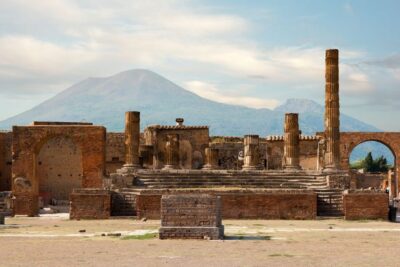
Pompeii Small Group Tour with an Archaeologist
Read our review →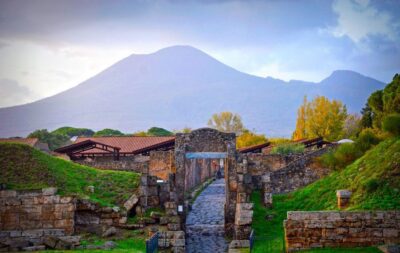
Skip-the-Line Entrance Ticket with Audio Guide
Read our review →
Pompeii and Mt. Vesuvius with Lunch and Wine Tasting
Read our review →
Archaeological Park Tour with Ticket on request
Read our review →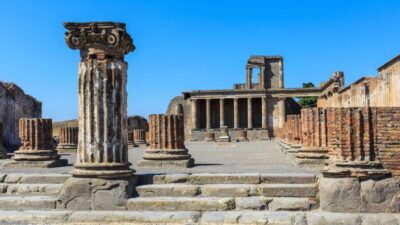
Browse the lists this tour appears in