
Reviewed · POMPEII TOURS
PompeiI Exclusive Tour with your Archaeologist in a Small Group
Pompeii looks like piles of stone until an archaeologist puts it in order for you. This archaeologist-led walk does that fast, in about two hours, with a planned route through the most readable parts of the ancient city. I also like the separate priority line at the entrance, because it cuts down the time you spend waiting and helps you start learning right away. One thing to consider: Pompeii is huge, so this tour focuses on major highlights and will not cover every single attraction.
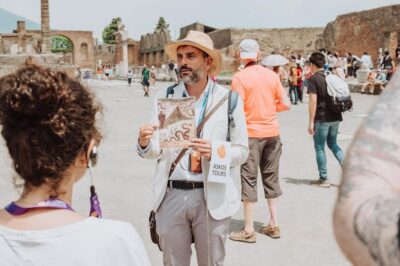
The other big plus is the small group size, capped at 15. That matters in Pompeii, where the difference between seeing something and understanding it often comes down to whether you can ask a quick question. In practice, guides such as Antonio, Rafael, and Ornella are praised for keeping the pace lively and answering questions clearly, which is exactly what you want when the stones start telling stories.
Quick hits before you go
- Priority access via a separate line, so your tour starts sooner
- Archaeologist guide who explains how excavators and historians know what they know
- A tight route through temples, the Forum, baths, food stalls, homes, and the theater
- Small group cap of 15, which keeps the walk relaxed and interactive
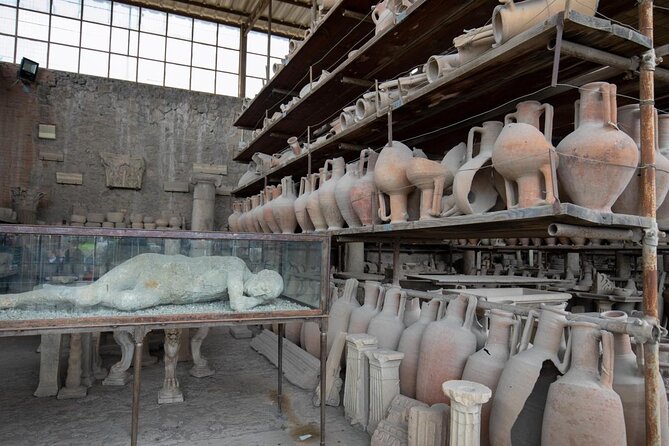
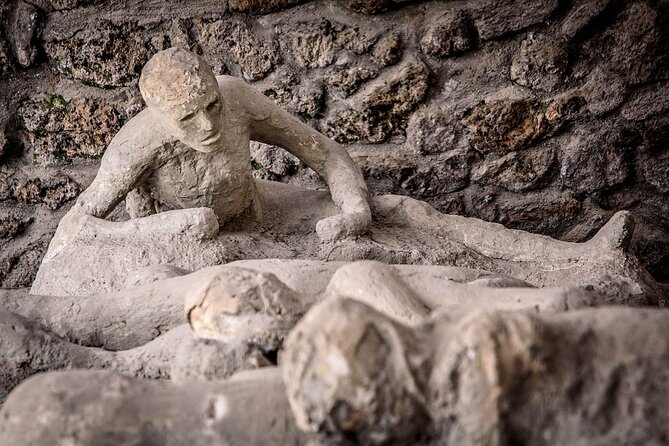
- Plaster casts of bodies at the Macellum area, a striking way to understand the eruption’s aftermath
- Two hours is enough to get your bearings, then explore more at your own pace
Why this Pompeii tour works better than wandering on your own
Pompeii is one of those places where your brain needs help. Without context, you end up moving from sign to sign, trying to guess what you are looking at. With a guide, the same walls and floor mosaics suddenly become readable, because someone connects them to daily life, religion, and the way Roman cities worked.
I like that this tour is not trying to cram everything into 2 hours. It chooses key stops and stays on a sensible path, so you get a coherent picture: who lived here, where people gathered, what they ate, how they cooled off, and where entertainment fit into the day. Instead of feeling lost, you come away with a mental map.
Another reason this tour feels good is the pace. Each stop is brief, which sounds strict on paper, but inside Pompeii it helps. You see the highlights, you learn enough to keep going later, and you do not burn your entire afternoon in one long slog.
Finally, the small group makes Pompeii feel human. Stones stay stones, but questions turn the experience on. When your guide can hear you, you get answers that make the next street clearer.
More Pompeii tours to compare:
- Pompeii: Entry Ticket and Guided Tour with an Archaeologist
★ 4.8 · 19,459 reviews - Pompeii: Entry Ticket with Optional Audio Guide
★ 4.2 · 12,360 reviews - Pompeii: Small Group Tour with an Archaeologist
★ 4.8 · 12,264 reviews
Meeting at Via Villa dei Misteri and finding your guide outside Porta Marina Superiore
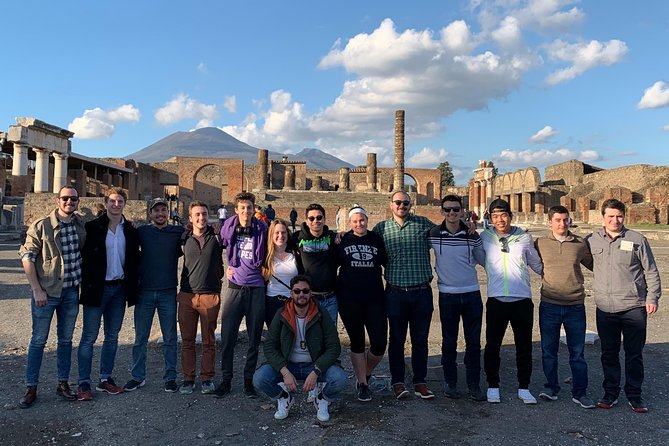
The meeting point is Via Villa dei Misteri 1, 80045 Pompei NA, Italy. From there, you head toward the western entrance area of the archaeological park, where the guide meets you with a Pompeii Vip sign.
That detail matters more than it sounds. Pompeii’s entrances can be confusing the first time you are there, and you do not want to waste your best learning hours hunting for your group. The tour is built so you start with the guide already in place and ready to lead.
This is also where the priority access helps. The guide includes an entry approach that uses a separate priority line, which is designed to avoid a long wait at the gate. In a place that runs on timed ticketing and crowded flows, “less waiting” translates directly into “more understanding.”
One important logistics note: your tour ticket is not the entry ticket for the Pompeii archaeological site. The tour price covers the guided experience, not the park admission. You buy Pompeii entry separately, and the operator sends you a link the afternoon before the tour to help you purchase online.
A realistic 2-hour route: what you will actually see (and what you will skip)
The route is built around the most recognizable and interpretable parts of Pompeii. You move from the Porta Marina Superiore area through temples and public spaces, then into places tied to everyday life like markets, baths, and food stalls. The walk ends with the Teatro Grande.
In the time you have, that is a smart choice. You are not trying to “complete” Pompeii, you are learning it. By the end, you should be able to recognize the Forum area in your mind, understand what the temples signal about Roman religion, and spot why certain houses matter.
Still, be honest with yourself about your expectations. This tour is a highlights route, not a full site sweep. If amphitheater or brothel areas are your must-see top priorities, plan extra self-guided time after the 2-hour walk. A short guided tour is great for getting oriented, and then you can decide what to chase next.
Also, some house interiors can be seasonal. The tour mentions both the House of the Faun and the House of the Vettii, and notes that these are subject to seasonal openings and closings. Even if you cannot step inside, the guide can still point out key features you would miss on your own.
Porta Marina Superiore to the Temple of Venus, the big idea behind the first stretch
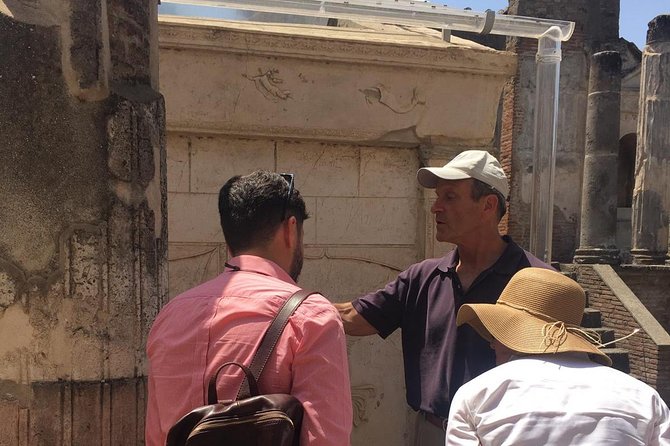
You start near Porta Marina Superiore, the western entrance to Pompeii. The guide explains the name connection to the road that once led toward the sea, which is a great way to orient you early. It also sets the theme for the whole visit: Pompeii was not just a city of ruins, it was a living crossroads.
The next stop is the Tempio di Venere (Temple of Venus). This temple is tied to Venus, the patron goddess of Pompeii. A guide’s value here is in interpretation. You are not just seeing columns or a platform, you are learning how religion shaped public space and how cities like Pompeii used worship to mark identity.
From there, you move into a more civic mode with the Basilica. This was one of the most lavish buildings in the Forum. It served practical roles, like business management and administration of justice. Roman public architecture is often misunderstood as “just fancy buildings.” With a guide, you get why it mattered.
Same stretch of coast, a completely different day out:
- Pompeii Small Group Tour with an Archaeologist
★ 5.0 · 6,593 reviews - Pompeii: Skip-the-Line Entrance Ticket with Audio Guide
★ 4.0 · 2,509 reviews - Naples: Pompeii and Mt. Vesuvius with Lunch and Wine Tasting
★ 4.5 · 2,454 reviews - Pompeii: Archaeological Park Tour with Ticket on request
★ 4.5 · 2,283 reviews
The Forum core: Basilica, Main Square, and the Temple of Jupiter with Vesuvius in view
The Forum, Main Square is the daily life hub. In Pompeii, the Forum area is one of the easiest places to grasp because everything feels like it points toward “where people came together.” You learn why the Forum was not a museum room, it was the city’s operating system.
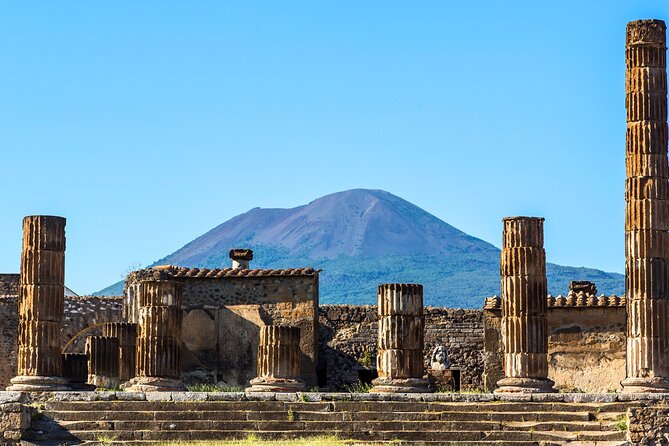
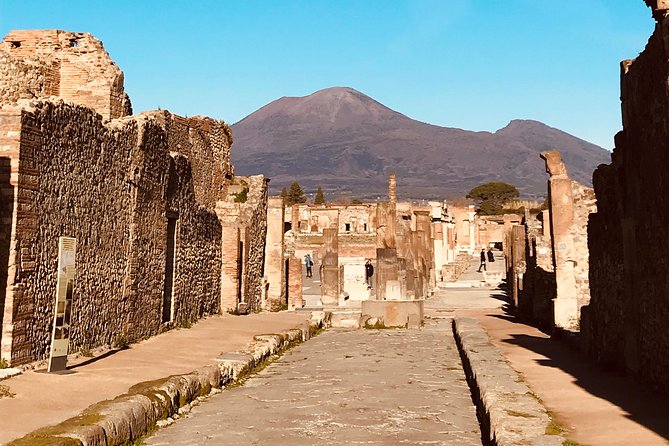
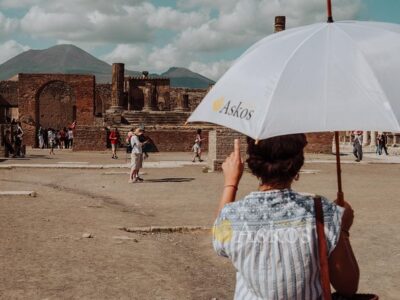
Right after that comes the Temple of Jupiter (Tempio di Giove Capitolino). The temple dominates the northern side of the Forum, and behind it you often get a scenic view of Vesuvius. That sightline is not just pretty. It helps you understand how Romans lived with the volcano looming in the background, because the natural world was part of their visual landscape even if it could not be predicted in daily planning.
This stop is also a chance for the guide to teach how archaeologists read the site. When you hear how scholars infer functions from layout, materials, and finds, you start spotting patterns quickly. You begin to see why the Forum feels like an organized plan, not random construction.
If you want one takeaway from Pompeii, let it be this: the city’s center was designed for interaction, and the ruins still show that structure clearly.
From the Macellum market to the Forum Baths: food, evidence, and cooling off
Next up is the Macellum, a monumental building used for the sale of food and daily consumer goods. Markets are where cities breathe. Even in ruins, the layout tells you how people shopped and how merchants organized goods.
One of the most talked-about parts of this route is the chance to see plaster casts of bodies in the Macellum area. These casts are a method archaeologists use to recreate the positions of people as they were at the moment of the eruption. It is heavy subject matter, so I recommend bringing a calm, respectful mindset. This is not sightseeing in the normal sense. It is learning through evidence.
Then you head to the Forum Baths (Terme del Foro). These are among the best-preserved parts of Pompeii. What makes them worth your time is how Roman bathing was built for routine and separation. The information provided notes that male and female areas had separate entrances.
A good guide helps you translate “bathroom ruins” into a system: entry, changing spaces, and the logic of movement through rooms. Even if you are not a bath enthusiast, the layout shows you how Romans spent time, socialized, and cared for themselves.
Thermopolium to the main street: how everyday Pompeii comes alive
After the baths, the tour switches into street-level daily life with a stop at the Thermopolium (Termopolio di Vetuzio Placido). A thermopolium was essentially an old diner, a refreshment stop for residents. This is where Pompeii gets real fast. Food businesses tell you what people wanted at hand, what kinds of meals were easy, and how often people moved through commercial streets.
Then comes the big visual shift to homes and wealth. The tour includes both the House of the Faun and the House of the Vettii. The House of the Faun is one of the largest in Pompeii, and the sidewalk includes a welcome inscription in Latin (HAVE). The House of the Vettii is known as one of the richest homes and is linked to Priapus, a god of prosperity.
Two practical cautions here. First, house openings can be seasonal, so you might see different levels of access depending on the day. Second, even when you do not go inside, the guide can still help you “read” the space so it does not feel like an empty shell.
From homes, you walk onto Via dell’Abbondanza, Pompeii’s ancient main street, also described as the decumanus maximus. This is a key street because it gives you context for the city’s movement. When you understand the main street, side lanes make more sense. Shops and thresholds feel less random.
Teatro Grande: why the theater still matters in a city of ruins
The final stop is the Teatro Grande. Comedies and tragedies in the Greco-Roman tradition were performed there. It is easy to underestimate the theater because it is not the only dramatic structure in Pompeii, but it teaches you something important about daily life.
The theater is where entertainment and social identity overlapped. Even in a city filled with domestic scenes and commerce, people still gathered for performances. A guide helps you connect the theater to the broader rhythm of Roman culture.
When the 2 hours ends, you should feel oriented, not finished. Pompeii rewards follow-up. If the amphitheater or brothel areas are high on your personal list, you will likely want extra time to reach them on your own. Think of this tour as the map plus the language basics. Then you get to choose the rest.
Tickets and price: what you pay $30.25 for, and what you still need to buy
The tour price is $30.25 per person, and the main value is what comes with that price: an authorized archaeology expert guide, a guided route through the key areas, and the separate priority line approach to avoid a long entrance wait.
Pompeii admission tickets are not included. The park admission cost is listed as €19 per adult, and admission is free for visitors under 18. So for most adults, you should budget the combined cost of the tour plus the site entry fee.
I like this setup because it forces clarity. You know you are paying for guided interpretation and a smoother entry experience, not for a bundle that might be unclear when you arrive. Just be careful that your tour ticket is for joining the tour, while your park ticket is the entry ticket.
One helpful detail: the operator sends a link the afternoon before the tour so you can buy entrance tickets online. It is one less thing to stress about the day of.
Who this Pompeii tour is best for (and when it may not fit)
This tour fits best if you want structure and meaning, not a scavenger hunt. If you have limited time in Naples or along the Amalfi Coast, a 2-hour Pompeii focus tour is a smart way to make your day count.
It also suits people who like asking questions. With a small group cap of 15, you get more back-and-forth than you would on a larger bus-style tour. The guide style is repeatedly described as enthusiastic and clear, and that kind of delivery is the difference between remembering names and actually remembering how the city worked.
Families can do well here too, especially if the kids can handle a couple hours of walking and explanation. One helpful review note in the provided information mentions ages 11 and 14 enjoying the tour in off-season, which makes sense. Short stops and guided context can work better than wandering for younger explorers.
If you want everything. Yes, Pompeii has more to offer. This tour will not cover every major attraction in the time window, so it may not satisfy someone who wants a full, no-skips checklist.
What to wear and expect: walking comfort beats fancy shoes
Pompeii’s ground can be uneven, and you will be on your feet for the whole experience. Bring comfortable walking shoes. This is not a luxury point, it is the difference between a great two hours and a miserable day.
Weather matters too. The tour requires good weather. If conditions are poor, the tour can be canceled and you are offered a different date or a full refund. Even when weather is not ideal, the provided information suggests that the guide can adapt your movement and look for shelter as needed, while still keeping the explanation going.
If you care about photos, you should know you can take pictures during the walk when the guide gives time. One review also notes that some behind-the-scenes areas might have photography restrictions, so follow the guide’s directions and you will avoid awkward moments.
Finally, plan your mindset for Pompeii. It is not only pretty views and restored mosaics. It includes evidence of tragedy, especially around the eruption and the plaster casts. A calm, respectful approach will help the experience feel more meaningful and less like a theme-park route.
Should you book this Pompeii archaeologist tour?
Book it if you want Pompeii with guardrails. This is the kind of tour that helps you understand what you are seeing, not just survive the walking. The small group, the archaeologist-led explanations, and the separate priority line make it feel efficient without feeling rushed.
Skip it or add extra time if your personal must-sees are very specific and you want to cover the entire site end to end. This tour is designed for the major core sights in about two hours, so you will likely need a second block of time to chase everything.
If you are visiting from Naples and you want the best use of limited hours, I’d treat this as your Pompeii foundation. Then you can wander with a map in your head instead of a phone full of guesswork.
FAQ
How long is the Pompeii exclusive tour?
It runs for about 2 hours.
Is the Pompeii archaeological site entrance ticket included?
No. Pompeii Park admission is not included. The listed price is €19 per adult, and free under 18.
Do I need to buy my tickets online before the tour?
Yes. The operator sends a link the afternoon before your tour so you can buy entrance tickets online.
Where do I meet the guide?
You start at Via Villa dei Misteri, 1, 80045 Pompei NA, Italy, and the guide meets you at the site entrance area with a Pompeii Vip sign.
Is this an English-language tour?
Yes, it is offered in English.
Is there a skip-the-line or priority entrance?
Yes. The tour includes entry via a separate priority line to help avoid a long wait at the gate.
How many people are in the small group?
The tour is limited to a maximum of 15 travelers.
Recently reviewed around Pompeii
- Sorrento: Pompeii and Vesuvius Day Trip with Entry and Lunch★ 4.4 · 11 reviews
- From Sorrento: Pompeii with an Archaeological Guide & Ticket★ 4.6 · 19 reviews
- Sorrento: Pompeii & Herculaneum Day Trip Entry and Lunch★ 4.6 · 27 reviews
- Pompeii: Skip-the-Line Guided Archaeological Discovery Tour★ 4.2 · 13 reviews
- 2-Hour Private Walking Tour of Pompeii★ 4.7 · 22 reviews
- From Positano: Pompeii Ruins Small Group Guided Tour★ 4.8 · 82 reviews
- Pompeii Positano Amalfi Day Trip from Rome by Car, No Bus!★ 5.0 · 5 reviews
- Pompeii VIP 3h Tour: Skip-the-line with your Archaeologist★ 4.9 · 13 reviews
Pompeii Tours, compared.
Entry Ticket and Guided Tour with an Archaeologist
Read our review →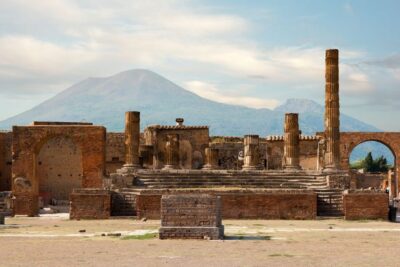
Pompeii Small Group Tour with an Archaeologist
Read our review →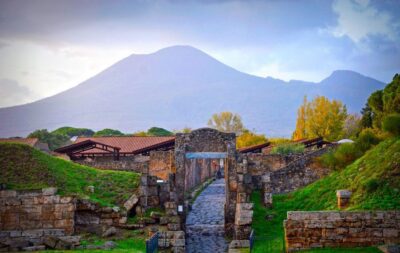
Skip-the-Line Entrance Ticket with Audio Guide
Read our review →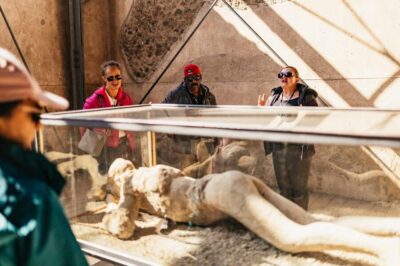
Pompeii and Mt. Vesuvius with Lunch and Wine Tasting
Read our review →
Archaeological Park Tour with Ticket on request
Read our review →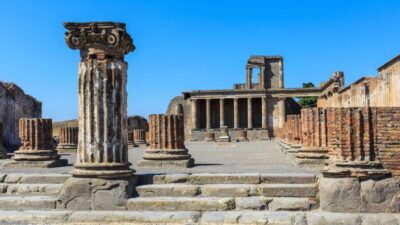
Browse the lists this tour appears in