
Reviewed · POMPEII TOURS
Pompeii VIP 3h Tour: Skip-the-line with your Archaeologist
Pompeii works on you fast, because you are walking through a whole Roman city that froze in time after the eruption. What makes this experience extra interesting is that you do not just see ruins, you get a guided read on how the city functioned, from entrances and temples to homes and public spaces.
I especially love that you get skip-the-line access right at the start, so you lose less time waiting and more time looking. I also like that the tour includes a private archaeologist, not a generic run-through, plus admission tickets so you are not juggling extras.
One thing to consider: Pompeii’s ticketing is personal now. You must share full names and bring original ID or passport, and you have to be on time because the tickets are tied to the people in your group.
Key things to know before you go
- Skip-the-line with your archaeologist: easier entry and a smoother start to your 3-hour window.
- Admission tickets are included: less hassle, and you can focus on the places you actually came to see.
- Fresh insights from recent finds: the route includes an antiquarium stop with artifacts from last excavations.
- A tight circuit of major sites: forum spaces, temples, baths, theatres, and the amphitheatre all in one go.
- Domus highlights, including newly opened houses: you get a close look at some of the more important private residences.
- A darker, unforgettable stop: the Garden of the Fugitives and the story of escape during the eruption.
VIP skip-the-line at Porta Marina Superiore, then you’re in
Your tour begins at Porta Marina Superiore, right in front of Hortus Bar. That matters because Pompeii can feel like a lot all at once, and a clear starting point helps you get your bearings fast before you march into the ruins.
Skip-the-line service is a real value add here. If you have ever shown up for a Pompeii ticket and watched other groups shuffle forward while you wait, you already know why this matters. With less delay, you also arrive at your first major focus point with more energy and attention.
This is a private group experience, and the guide is there to keep the pace readable for you. If you want a tour that feels like a conversation with a trained expert, not a headset lecture, this structure usually fits well.
More Pompeii tours to compare:
- Pompeii: Entry Ticket and Guided Tour with an Archaeologist
★ 4.8 · 19,459 reviews - Pompeii: Small Group Tour with an Archaeologist
★ 4.8 · 12,264 reviews - Pompeii: Skip-the-Line Entrance Ticket with Audio Guide
★ 4.0 · 2,509 reviews
The 3-hour “Roman day” route, and how it stays coherent
A 3-hour Pompeii tour can go two ways: either it’s rushed and patchy, or it’s selective and smart. This one leans toward selective and smart, because the route is built like a quick map of how the city worked.
You move through the city from the main entrance area, then into civic and religious spaces, then toward markets and baths. After that, you shift into residential houses and dramatic public buildings like theatres and the amphitheatre. The whole point is that you start to see Pompeii as a living place, not just a collection of walls.
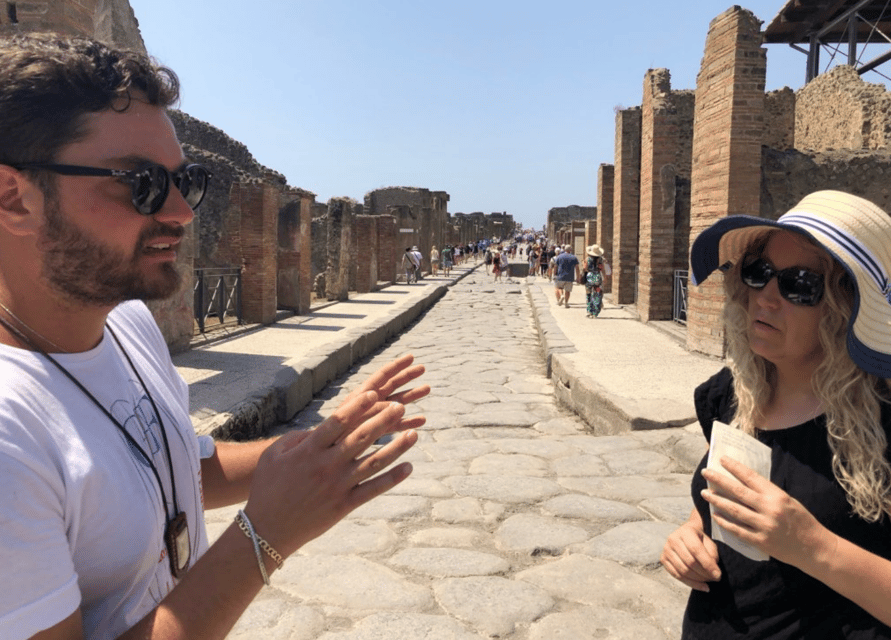
Because you are with a local licensed archaeologist, the stops connect to each other. You are not only looking at what’s standing, you are learning what would have been happening around it, like how people navigated from street grids to forums, and how daily routines shaped the city.
Vesuvius views and the antiquarium stops that make the story click
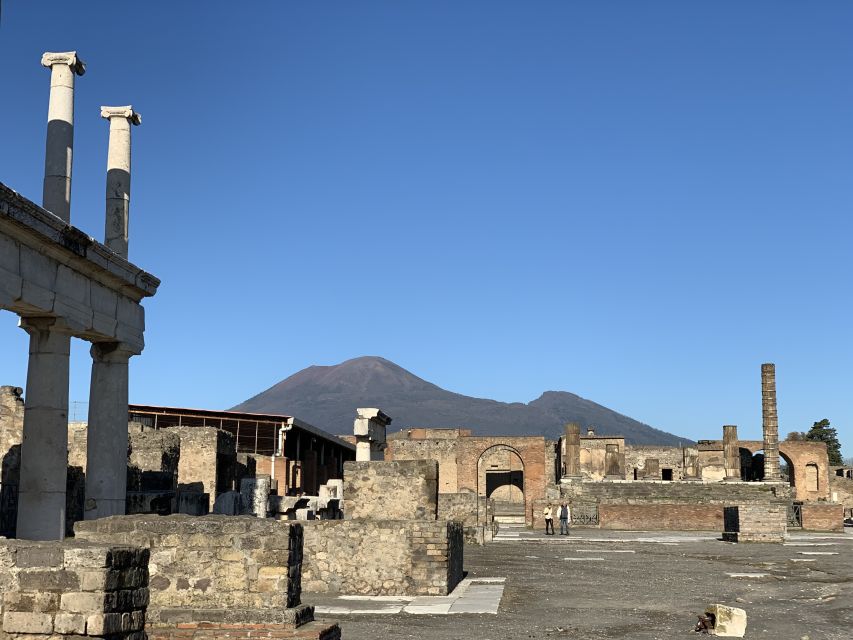
Early in the tour, you pass through the area connected with the city entrance and get that classic sightline toward Mount Vesuvius. Even if you think you already know Pompeii, seeing the volcano in relation to the ruins helps your brain lock onto the cause of the disaster instead of treating it like a vague background.
One of the most useful moments comes at the antiquarium. Your guide shows objects found in the last excavations, and those specific items do more than look impressive. They give you a concrete sense of how archaeologists update the record when new evidence appears.
Two examples that make this stop memorable are a coin that changed what scholars understood about the date of the eruption, and a heavy golden arm cuff. Those are not just souvenirs you admire. They are clues that help explain how dating works and why excavation never fully stops.
If you like stories that connect objects to bigger conclusions, you’ll appreciate how this part of the tour is designed to make evidence feel real.
Basilica, civic spaces, and the forum where Roman life happened
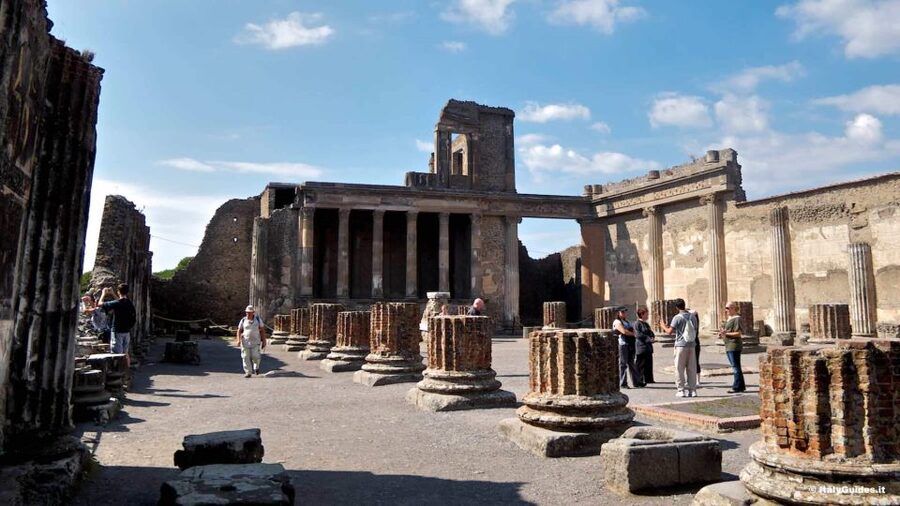
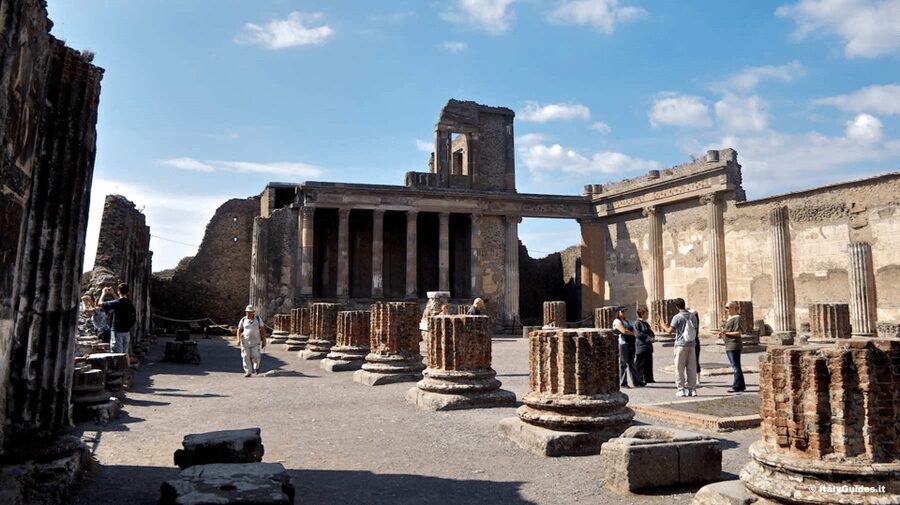
Next up, the tour works its way into the major public core, including the Basilica and the civic areas around the forum. This is where you learn that Roman cities were not only about temples and houses. They were also administrative hubs, meeting zones, and places where commerce and law intersected.
You’ll walk along the main thoroughfares, including the Greater Decumano, and you’ll get glimpses into how streets and buildings organized movement through the city. Your guide will also point you toward the main temple zones around the forum, including major stops such as the Temple of Apollo and the Temple of Jupiter.
The payoff here is that temples start to feel less like random landmarks. You understand why these spaces mattered to power and public identity, and why so much civic energy concentrated in the same districts.
A small consideration: Pompeii is uneven ground and there are lots of open areas. If the weather is hot, plan to pace yourself, sip water when you can, and rely on shade in the ruins where it exists.
A few more Pompei Campania trips worth comparing
- From Naples: Pompeii and Herculaneum VIP Tour with Lunch
★ 4.4 · 129 reviews - From Naples: Pompeii Ruins VIP Guided Tour
★ 4.4 · 35 reviews - Private Luxury Minivan Full-Day Amalfi Coast Driving Tour
★ 5.0 · 163 reviews - Sorrento: Luxury Private boat drinking & watching the sunset
★ 4.8 · 5 reviews
Markets, baths, and what people did between temples
From the forum zone, you shift into places tied directly to everyday life, including the Macellum, which is Pompeii’s market hub. Even in ruins, markets tell you how people ate, traded, and socialized.
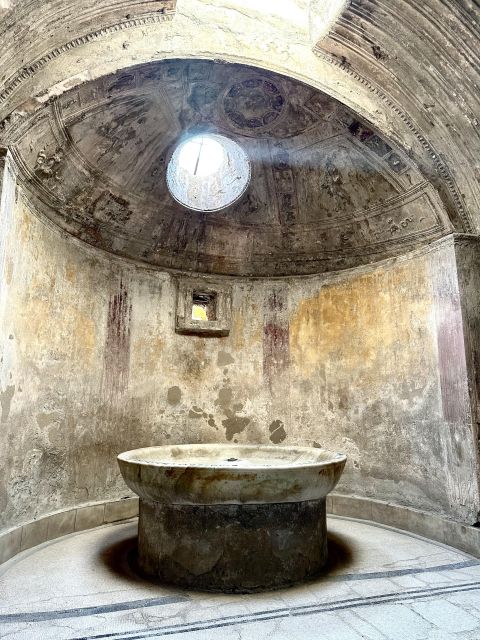
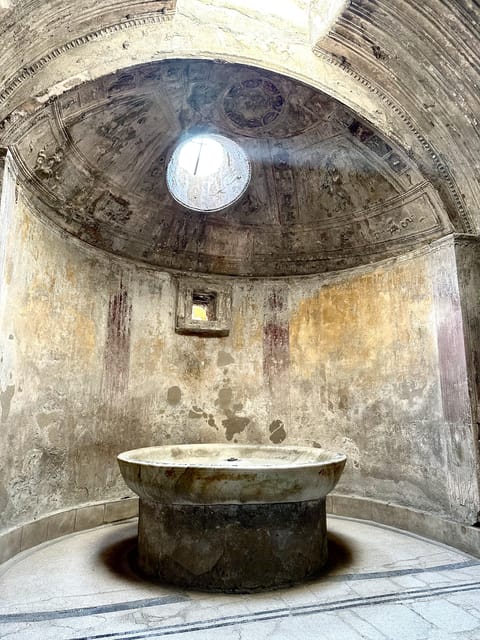
Then you head to the bath area, including the Forum Baths and a look at parts of the thermal system. Baths are one of my favorite categories in Pompeii tours because they explain Roman culture without requiring deep political context. You see how bodies, space, routine, and community built the day-to-day rhythm.
Your guide’s interpretations are key here. Instead of just pointing out floors and walls, they help you understand what the spaces were designed to do, and how visitors would have used them.
If you care about practical daily life in the Roman world, this section is usually where the tour clicks hardest.
Houses, restorations, and the appeal of newly opened domus
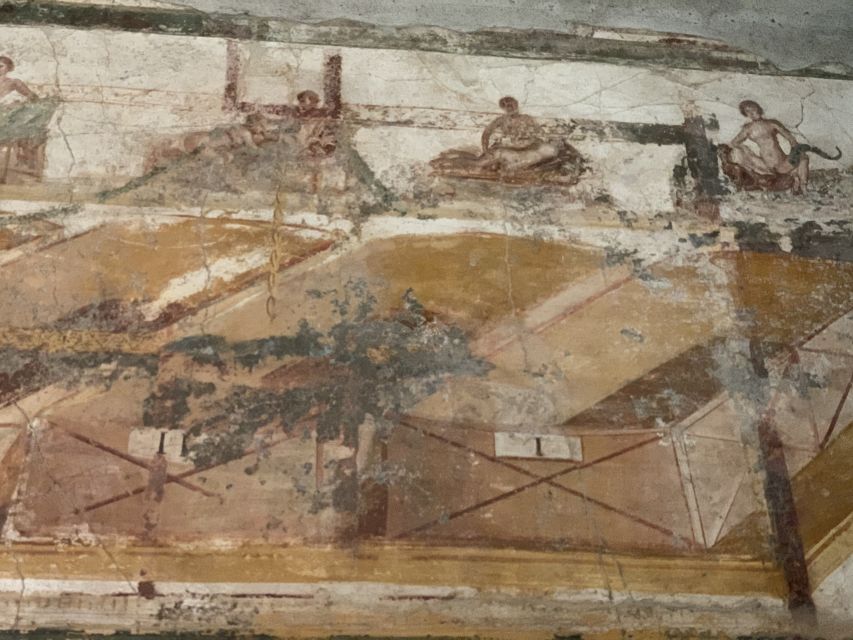
Pompeii’s private residences can feel overwhelming because there are so many. What you want in a short tour is the right selection, and this one includes major domus stops such as the House of the Tragic Poet and the House of Menander.
You also get a chance to see restorations like the House of Golden Cupids. That kind of stop is valuable because restoration raises questions you should actually ask while you visit. What are you looking at, original material or reconstructed pieces? Your archaeologist helps you interpret what is authentic and what is a best-available reconstruction.
A specific highlight in the tour description is that you discover some of the most beautiful domus, including houses recently opened. That matters, because seeing the same evergreen postcard version of Pompeii can get repetitive. Newly opened areas can add fresh sightlines and details that you might not get from a slower, more standard loop.
One note for expectations: you are touring a site under protection, so you should be prepared to see areas in a controlled way, with limits in certain spots. That’s normal here and not a deal-breaker.
The Garden of the Fugitives, where the story turns heavy
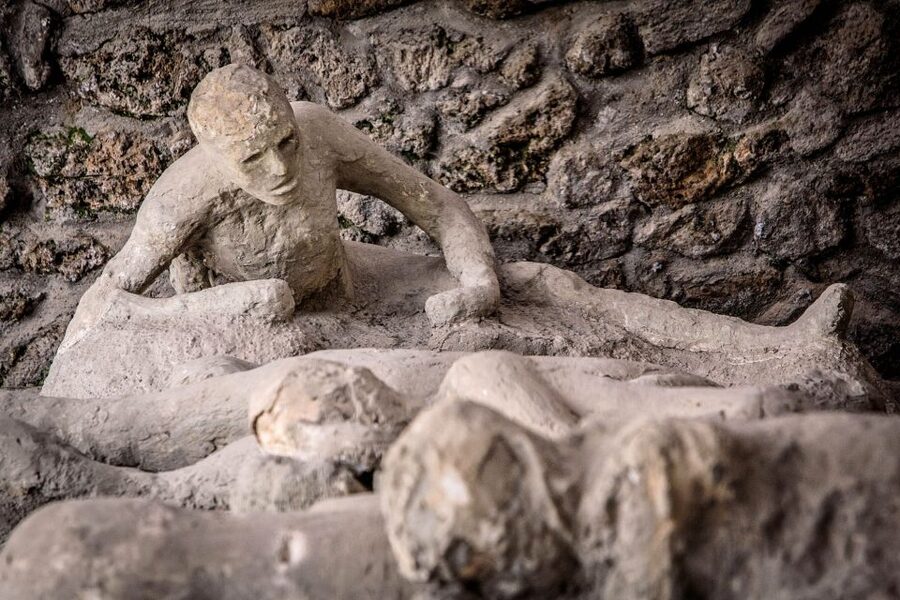
Then comes the emotional core of Pompeii, the Garden of the Fugitives. This stop is where your guide explains what happened to people who tried to escape during the eruption.
You’ll see the evidence of those deaths through their body moulds. That visual is hard to process, but it is also why Pompeii feels so uniquely real. It’s not just tragedy as a headline, it is human-scale information carved out of volcanic ash and time.
A good archaeologist does not just say what happened. They help you understand why people moved where they did and what options existed in the moment. That context makes the stop more than a grim photo op.
If you prefer lighter material, you might find this segment intense. But if you want to understand the full arc of Pompeii, this is a must.
The theatre and amphitheatre: Roman crowds, drama, and sound
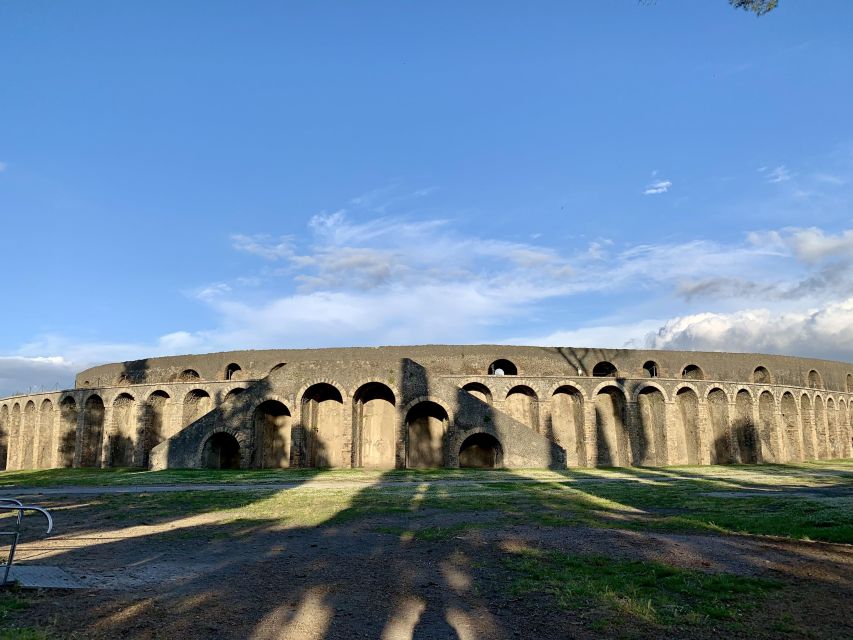
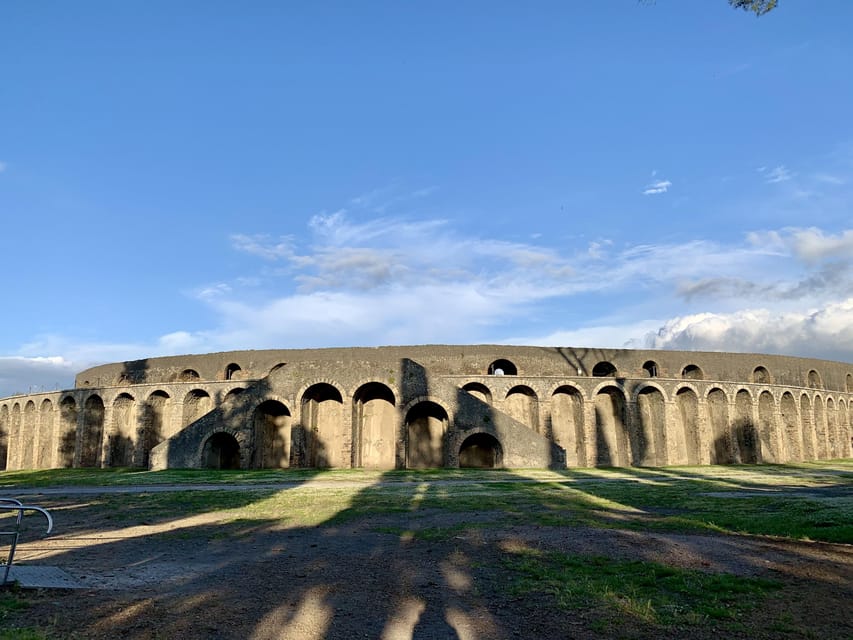
As you head toward the later public buildings, the tour includes major performance spaces such as the Large Theatre and ends with the Amphitheatre. These stops are more than dramatic architecture. They help you see how Roman leisure worked and how crowds gathered around shared experiences.
Your guide also mentions the Great Gymnasium, where you can view many daily objects exposed there. That’s another strong category because it links back to real life, not just ceremony.
The amphitheatre is a fitting last stop. It brings everything together, civic identity, entertainment, and public space, all in one place. Even if you only have 3 hours, finishing in a venue built for crowds can leave you with a strong final image of how Pompeii functioned before the catastrophe.
Price and value: what you actually get for $407.83
The price shown is $407.83 per group up to 1, for a 3-hour private tour. In plain terms, this is not the budget style of Pompeii touring. You are paying for three things: private guidance, skip-the-line entry, and admission included in the tour price.
Is it worth it? Often, yes, if you care about interpretation. With a trained archaeologist, the ruins become readable. Instead of walking around with questions, you get answers pointed at the specific places you are standing in.
It also tends to be a good fit if you are visiting on a busy day and want to reduce time spent in queues. And because admission tickets are included, you avoid surprise add-ons on top of the guide fee.
Just check your exact group size when you book. The pricing is listed per group with an upper limit, so make sure it matches how many people will be joining.
Who this VIP Pompeii tour suits best
I think this tour suits you best if you want:
- A guided, evidence-based approach, not just sweeping general facts.
- A focused circuit that hits the forum, baths, houses, and major performance spaces.
- A private format where you can ask questions and keep the pace in your comfort zone.
It also works well for first-timers who want Pompeii’s big landmarks without losing the thread. And it’s a solid choice if you have already visited Pompeii once and want a more expert lens, especially with attention to recent excavation finds.
Quick practical tips before you step onto the ruins
Wear comfortable shoes. Pompeii is uneven, and you will walk more than you expect in 3 hours.
Bring sunscreen and plan for sun exposure in open areas. Even in mild weather, Pompeii can feel hotter in the open courtyards.
The tour has rules you should know. Pets are not allowed, and alcohol and drugs are not allowed. If you need water or a break, do it early in your walk, not at the very end when your time budget tightens.
Guides are offered in English, French, Spanish, and Italian, and the tour is listed as wheelchair accessible. If mobility is an issue, it’s smart to confirm the exact meeting and route flow when you book.
So, should you book it?
If your goal is to leave Pompeii with a clearer picture of how the city worked, this tour is an excellent bet. The big reason is the combination of skip-the-line, admission included, and a personal archaeologist who can connect places to evidence, including the antiquarium’s recent excavation finds.
If you’re traveling on a tight budget or you prefer to wander slowly on your own, you might find the price steep. But for many people, paying for a guide is what turns Pompeii from sights into understanding.
FAQ
FAQ
How long is the Pompeii VIP tour?
It lasts 3 hours. You can check availability to see starting times.
Where does the tour start and end?
The meeting point is Porta Marina Superiore, in front of Hortus Bar. The tour ends back at the same meeting point.
Is admission included in the price?
Yes. Admission tickets are included, along with skip-the-line service.
What languages are available for the live guide?
The tour offers live guiding in English, French, Spanish, and Italian.
Do I need to provide full names for tickets?
Yes. Pompeii’s ticketing rules require your full name and surname be added to the ticket, and you should bring an original ID or passport for all participants.
What should I bring, and what is not allowed?
Bring comfortable shoes and sunscreen. Pets are not allowed, and alcohol and drugs are not allowed.
Recently reviewed around Pompei Campania
- From Sorrento: Pompeii with an Archaeological Guide & Ticket★ 4.6 · 19 reviews
- From Positano: Pompeii Ruins Small Group Guided Tour★ 4.8 · 82 reviews
- Pompeii Positano Amalfi Day Trip from Rome by Car, No Bus!★ 5.0 · 5 reviews
- Pompeii & Virtual Museum Private 2-in-1 Kid’s Tour★ 4.9 · 9 reviews
- Pompeii & Vesuvius★ 4.3 · 12 reviews
- From Naples: Pompeii Wheelchair-accessible with a Guide★ 5.0 · 8 reviews
- Pompeii Tour_Skip the line ticket + audioguide★ 4.7 · 17 reviews
- Pompeii Skip-The-Ticket-Line Tour with an Archeologist★ 5.0 · 14 reviews
Pompeii Tours, compared.

Entry Ticket and Guided Tour with an Archaeologist
Read our review →

Pompeii Small Group Tour with an Archaeologist
Read our review →
Skip-the-Line Entrance Ticket with Audio Guide
Read our review →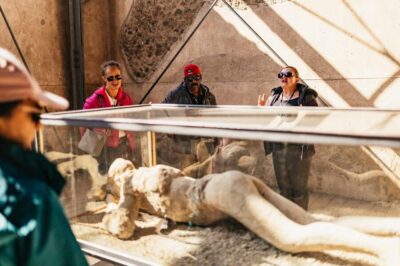
Pompeii and Mt. Vesuvius with Lunch and Wine Tasting
Read our review →
Archaeological Park Tour with Ticket on request
Read our review →
Browse the lists this tour appears in